

Network News
Professor Dr. Gerd Auffarth continues to be one of the world’s leading ophthalmologists, according to “The Ophthalmologist”. The journal has now published its “Power List 2025” of the most influential representatives of the field. The Medical Director of the Eye Clinic at Heidelberg University Hospital (UKHD) has now been named on the list for the […]
read more
3D bioprinting: NMI, TU Darmstadt and Black Drop develop improved bioink
Joint press release by the NMI and the Technical University of Darmstadt (How) can we 3D print tissues that mimic the complex anatomy of natural body tissue as closely as possible? 3D bioprinting is a great hope in the field of regenerative medicine to produce miniaturized tissues and organ precursors with biological functionality. Today, however, […]
read more
Voyager Acquisition Corp. Announce Business Combination Agreement to Create Nasdaq-Listed Biopharmaceutical Company Advancing a Pipeline of Next-Generation Cancer Therapies
The proposed business combination would create a publicly traded, clinical-stage biopharmaceutical company focused on the development of a comprehensive pipeline of next-generation cancer therapies. ZURICH, SWITZERLAND, and BROOKLYN, NEW YORK, USA, April 23, 2025 — VERAXA Biotech AG(“VERAXA” or the “Company”), an emerging leader in designing novel cancer therapies, and Voyager Acquisition Corp., a Cayman Islands […]
read more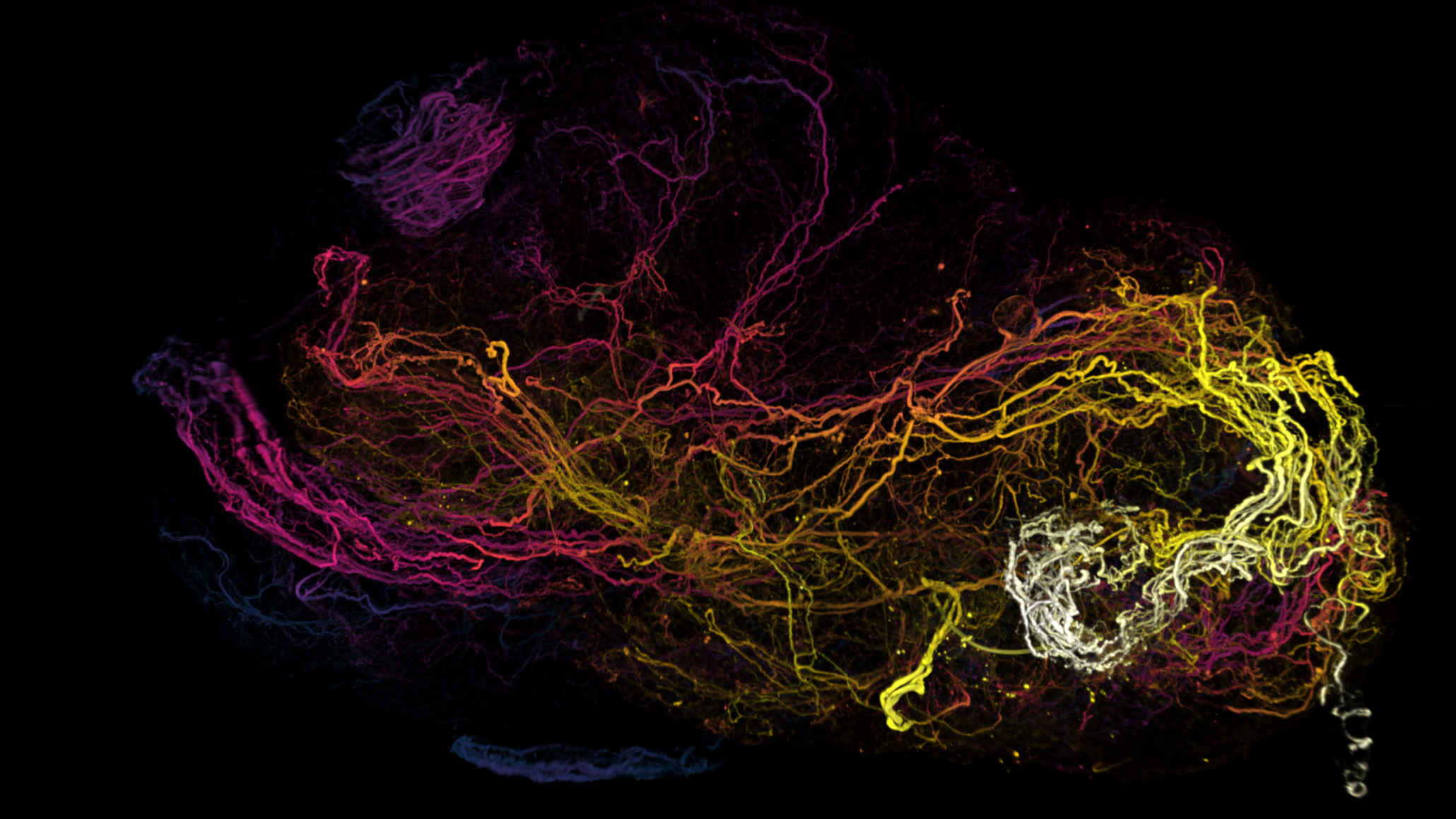
Pancreatic Cancer: Interactions between Neurons and Tumor
Nikon Imaging Center at Heidelberg University achieves three-dimensional reconstruction of nerve network in the pancreas tissue Pancreatic cancer is fueled by connections to the nervous system, as was shown by scientists from the German Cancer Research Center (DKFZ) and the Heidelberg Institute for Stem Cell Technology and Experimental Medicine (HI-STEM). In a recent study, they […]
read more
NEC Laboratories Europe and Data-Driven.AI enhance AI medical diagnosis to improve the early detection of disease and illness
HEIDELBERG, Germany, April 15, 2025 – NEC Laboratories Europe and Data-Driven.AI are working together to enhance medical laboratory diagnosis and increase the effectiveness of preventive health measures and early clinical intervention to improve the well-being of patients. If detected early, many illnesses and diseases can be managed or resolved without serious complications. However, by the time recognizable symptoms present themselves, […]
read more
Helping children with cancer with flowers
From April 28 to May 24, you can once again buy and give flower creations throughout Germany for the benefit of children and young people with cancer. With its campaign “Blumen schenken. Hoffnung spenden.” (Give flowers. Spread hope.) the Hopp Children’s Cancer Center Heidelberg (KiTZ) wants to draw attention to the urgently needed research for […]
read more
Blenrep (belantamab mafodotin) combinations approved by UK MHRA in relapsed/refractory multiple myeloma
GSK plc (LSE/NYSE: GSK) today announced the authorisation of Blenrep by the Medicines and Healthcare products Regulatory Agency (MHRA). In the UK, Blenrep is approved for the treatment of adults with multiple myeloma in combination with bortezomib plus dexamethasone (BVd) in patients who have received at least one prior therapy, and in combination with pomalidomide plus dexamethasone (BPd) in […]
read more
New regulatory protein of the neuronal cytoskeleton identified
The growth and function of nerve cells is based on a lattice-like structure called membrane-associated periodic skeleton (MPS). However, how the organization of the MPS is controlled has not been elucidated until now. A team from the Max Planck Institutes for Medical Research and for Multidisciplinary Sciences has now discovered that it is regulated by […]
read more
New Member: Welcome in our cluster to Cytion
Cytion is a global leader in authenticated cell lines, serving as a trusted repository of high-quality, contamination-free biological resources. Founded in 2004 as Cell Lines Service, the company has curated over 1,000 cell lines from diverse tumors, tissues, and species. Its mission is to safeguard scientific assets and provide researchers with reliable research reagents. With […]
read more