

Research
Using a new combination of three sensors and artificial intelligence, researchers at Heidelberg Medical Faculty of Heidelberg University and Heidelberg University Hospital are recognising patterns in babies’ movements that show whether their nervous system is developing healthily. The way an infant moves spontaneously in the first few months of life can indicate whether its nervous system […]
read more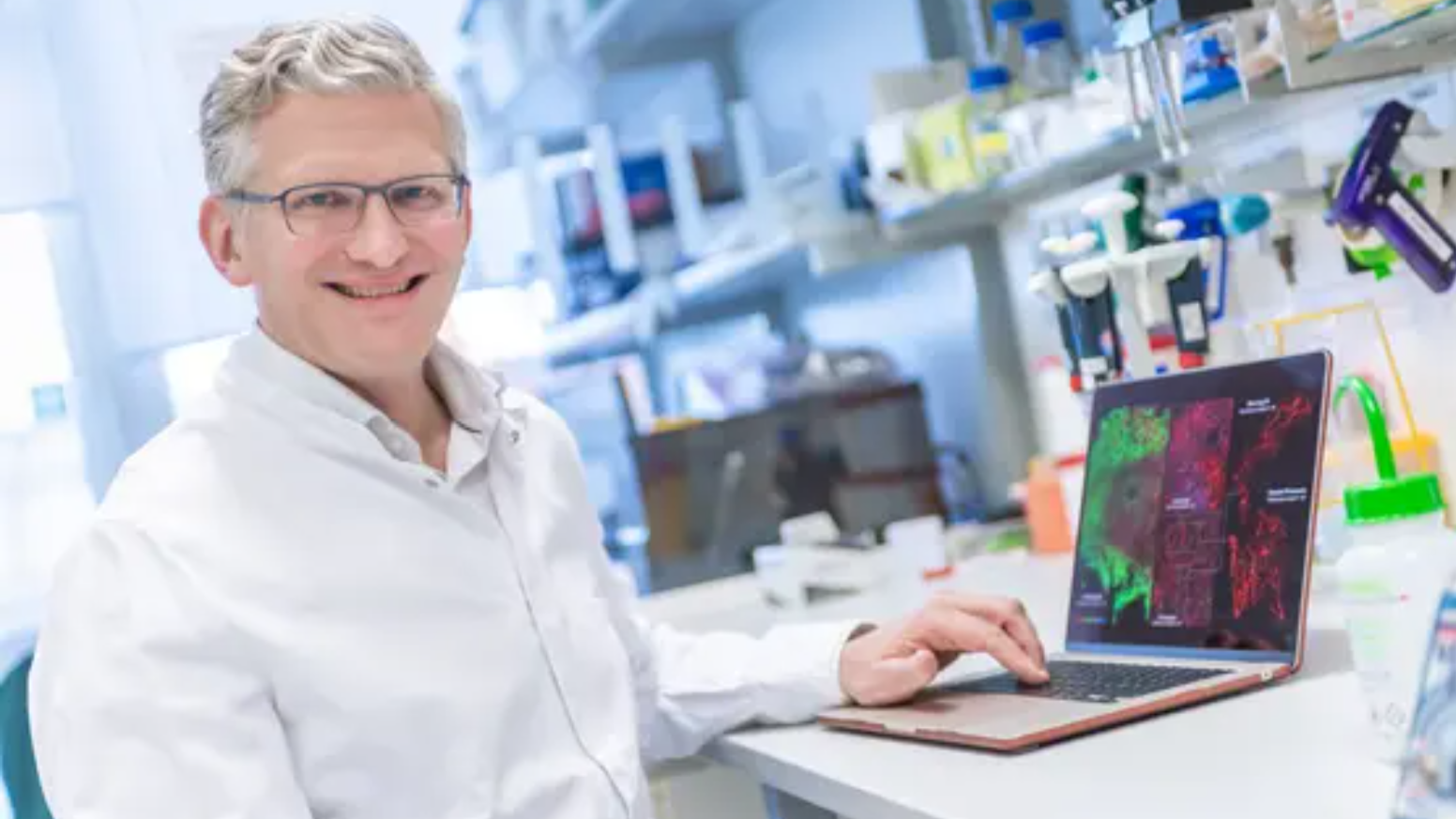
Frank Winkler receives the Brain Prize 2025
This year, the most highly endowed award in the neurosciences and neuromedical research honors pioneering work on the interactions between the nervous system and brain tumors: Neurologist Frank Winkler, who conducts research at the University of Heidelberg and at the German Cancer Research Center (DKFZ) and treats patients with brain tumors at Heidelberg University Hospital, […]
read more
Understanding rare diseases with digital twins
New EMBL-EBI project explores the use of a concept developed in aerospace engineering to support rare disease research, diagnosis, and treatment Rare diseases are individually uncommon, but together they affect over 300 million people worldwide. There are more than 7,000 conditions that are classed as rare diseases, and many of them don’t have approved treatments. […]
read more
NMI TT in Reutlingen and Düsseldorf University Women’s Hospital develop high-precision method for analyzing individual circulating tumor cells
Researchers led by Dr. Michael Pawlak from NMI Technologie Transfer GmbH (NMI TT) in Reutlingen and Prof. Dr. Hans Neubauer from the Women’s Hospital at the University of Düsseldorf have developed a new method that enables a more precise analysis of individual tumor cells circulating in the blood. This allows not only the previously possible […]
read more
New Member: Welcome in our cluster to CAVIGEN UG
CAVIGEN develops thermoformed microstructures for cell culture, including microcavities, porous microcavities, sensor-integrated microcavities (sensor arrays), and microchannels. Its patented technology enables precise oxygen measurement in 3D cell cultures, enhancing the physiological relevance of in vitro models, improving drug development processes, and reducing the need for animal testing. CAVIGEN’s business model follows a razor-and-blade approach, offering […]
read more
Zukunft braucht Menschen: Podiumsdiskussion zu Fachkräften im Gesundheitswesen
Nicht nur in der Versorgung, sondern auch in der Wirtschaft fehlen Fachkräfte in der Gesundheitsindustrie. Bei einer Podiumsdiskussion am 11. März 2025, die am Vortag der Jobmesse T5 in Stuttgart stattfindet, will das Forum Gesundheitsstandort Baden-Württemberg zu den Themen Fachkräfte gewinnen, Wirtschaft stärken und Gesundheit fördern diskutieren. Ob Medizintechnik, Pharma oder Biotechnologie – Baden-Württemberg ist […]
read more
New Publication from CeMOS: Exploring the Aβ Plaque Microenvironment in Alzheimer’s Disease Model Mice by Multimodal Lipid-Protein-Histology Imaging on a Benchtop Mass Spectrometer
Müller, E.; Enzlein, T.; Niemeyer, D.; von Ammon, L.; Stumpo, K.; Biber, K.; Klein, C.; Hopf, C. Exploring the Aβ Plaque Microenvironment in Alzheimer’s Disease Model Mice by Multimodal Lipid-Protein-Histology Imaging on a Benchtop Mass Spectrometer. Pharmaceuticals 2025, 18, 252. https://doi.org/10.3390/ph18020252 Abstract Amyloid-β (Aβ) plaque deposits in the brain are a hallmark of Alzheimer’s disease (AD) neuropathology. Plaques […]
read more
Heart drug Beyonttra™ (acoramidis) approved in EU for treatment of transthyretin amyloidosis in adults with cardiomyopathy
Approval based on positive results from Phase III ATTRibute-CM study / Beyonttra™ is a near-complete (≥90%) stabilizer of transthyretin (TTR) minimizing amyloid formation / Phase III ATTRibute-CM study with Beyonttra™ has shown clear benefits on cardiovascular endpoints already starting as early as 3 months after treatment initiation Berlin, February 11, 2025 – The European Commission has […]
read more
Optical nanoscopy without the ON/OFF
Researchers have increased the resolution in fluorescence microscopy by a factor of 30 without having to sequentially switch fluorescent molecules between light and dark states. The Nobel Prize-winning STED and PALM/STORM microscopes, as well as other super-resolution fluorescence microscopes, provide resolutions of a fraction of the wavelength of light. However, to image adjacent fluorescent molecules […]
read more