3D bioprinting: NMI, TU Darmstadt and Black Drop develop improved bioink

Joint press release by the NMI and the Technical University of Darmstadt
(How) can we 3D print tissues that mimic the complex anatomy of natural body tissue as closely as possible? 3D bioprinting is a great hope in the field of regenerative medicine to produce miniaturized tissues and organ precursors with biological functionality. Today, however, scientists are still working on the challenge of producing a printable and at the same time compatible starting material. Researchers at the NMI Natural and Medical Sciences Institute in Reutlingen, TU Darmstadt and Black Drop Biodrucker GmbH have developed a new type of bioink that improves the transport of nutrients in printed tissue, for example.
Bioprinting: many challenges, many opportunities
3D bioprinting, bioink, electrospinning: what is it anyway? 3D printing has now found its way into many areas of life and, above all, the economy. It is a process in which a three-dimensional object is printed using a special starting material. In 3D bio-printing, this starting material is bio-ink, which contains living cells and is combined with hydrogels and biological factors, for example, to print organic objects. In addition, electrospinning can be used to produce wafer-thin fibers.
Electro-spun fibers enable nutrient transport
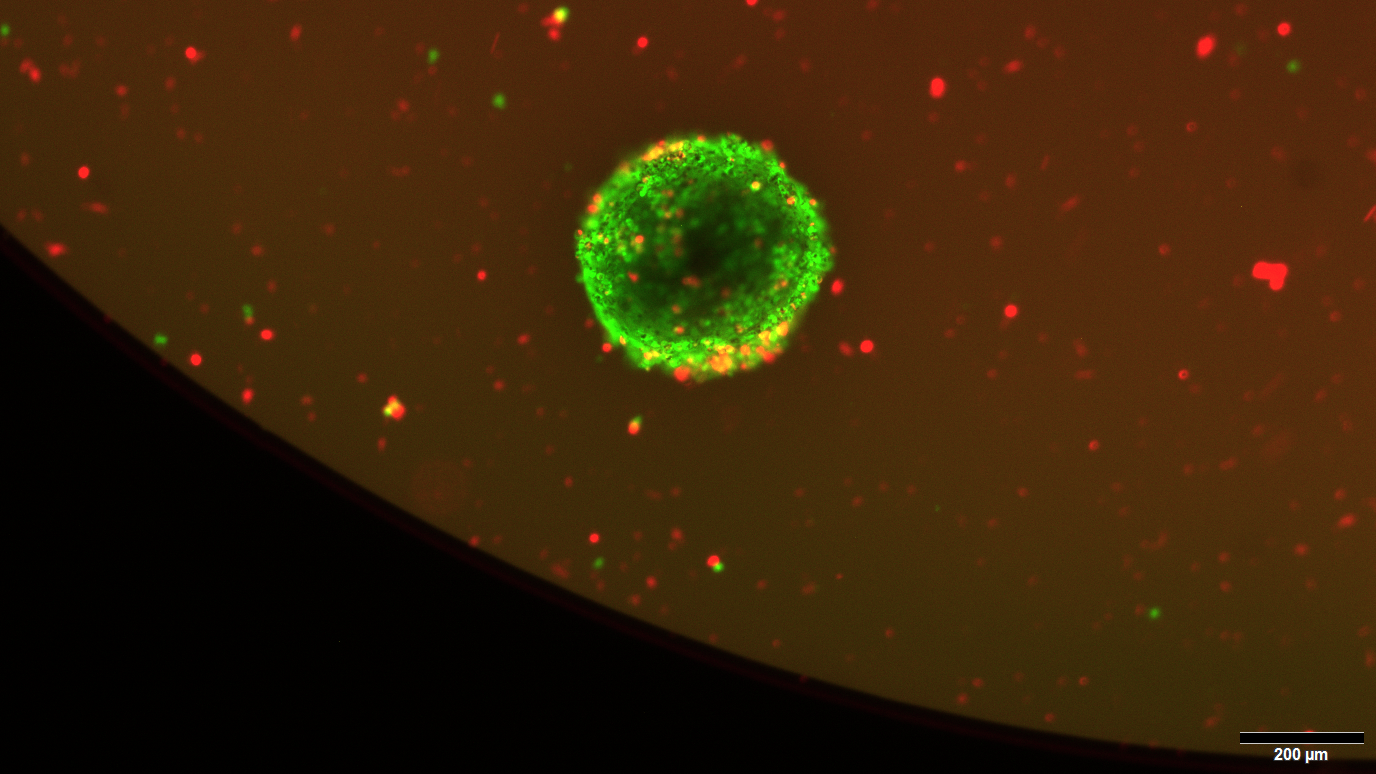
“With a diameter of 5-10 µm, these fibers are in the range of blood capillaries and are the significant advance in our bio-ink,” explains Dr. Hanna Hartmann, Head of Division at the NMI and inventor in the joint patent. Until now, the transport of nutrients in 3D-printed tissue has been a major problem. “The fibers now measurably improve this transport. The particularly exciting finding for us is that they don’t even have to be hollow on the inside,” reports Jannik Stadler, site manager of Black Drop Biodrucker GmbH, which played a key role in the development of the bioink as coordinator of the BMBF-funded NatInk project. This bio-ink also has particularly advantageous properties in terms of its mechanical strength and swells less. Annabelle Neuhäusler, a doctoral student at the Institute for Printing Machines and Printing Processes at TU Darmstadt, was able to demonstrate this in the joint publication.
A step towards better tissue models for pharmaceutical research
In future, such improved bioinks could be used to produce tissue models for pharmaceutical research, for example. This could eliminate the need for animal testing and allow patient-specific active ingredients to be tested. Another field of application lies in the area of regenerative medicine. In addition to increasing nutrient diffusion, fiber integration helps to improve the mechanical properties of bioinks. This is particularly important for surgical applications, where handling, dimensional stability and primarily strength play a key role.
Publication:
Electrospun microfibers to enhance nutrient supply in bioinks and 3D-bioprinted tissue precursors; https://doi.org/10.1088/1758-5090/ad9d7a
Patent:
Hydrogel-Verbundwerkstoff und Verfahren zu dessen Herstellung
More informationen on the NatInk project. The project was funded by the Bundesministerium für Bildung und Forschung (BMBF); funding code 13XP5177C.
About Black Drop Biodrucker GmbH:
Black Drop Biodrucker GmbH is a German biotech company specializing in 3D bioprinting and its application in the field of regenerative medicine and pharmaceutical research. Founded in 2017, the company’s product portfolio covers the entire biofabrication process chain: from bioinks and customized 3D bioprinting hardware and software to microfluidic chips for the production of vascularized organ-on-chip systems.
Particular highlights include the recently added bio-ink CureDrop and the Black Drop BioVOC. CureDrop is a recombinant collagen-based bio-ink with photo-crosslinkable properties. The BioVOC is a microfluidic chip compatible with 3D bioprinting that can be used to produce vascularized tissue models.
Together with the modular 3D bioprinting system REGENATE, they offer the possibility to build completely animal-free 3D tissue models for pharmacological research.
About TU Darmstadt
TU Darmstadt is one of Germany’s leading technical universities and a synonym for excellent, relevant research. We are crucially shaping global transformations – from the energy transition via Industry 4.0 to artificial intelligence – with outstanding insights and forward-looking study opportunities.
TU Darmstadt pools its cutting-edge research in three fields: Energy and Environment, Information and Intelligence, Matter and Materials. Our problem-based interdisciplinarity as well as our productive interaction with society, business and politics generate progress towards sustainable development worldwide.
Since we were founded in 1877, we have been one of Germany’s most international universities; as a European technical university, we are developing a trans-European campus in the network, Unite! With our partners in the alliance of Rhine-Main universities – Goethe University Frankfurt and Johannes Gutenberg University Mainz – we further the development of the metropolitan region Frankfurt-Rhine-Main as a globally attractive science location.