3D-Printed Tissue Substitute
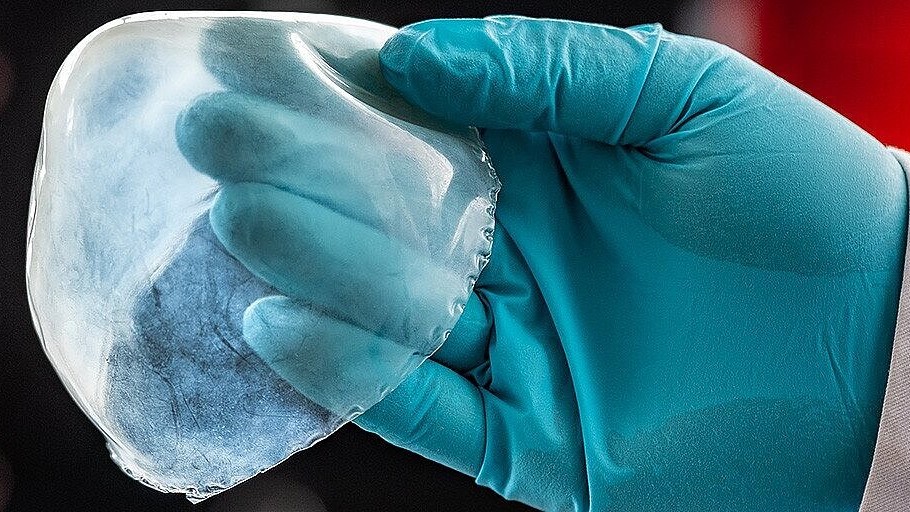
A novel developed biomimetic tissue substitute combines precisely tunable mechanical properties with biological functionality and is now ready for applications in medical technology. The material was developed in the »PolyKARD« project by the Fraunhofer Institute for Applied Polymer Research IAP and the NMI Natural and Medical Sciences Institute. From April 20 to 24, 2026, the new material will be presented together with further developments from Fraunhofer IAP at the Hannover Messe, at the Fraunhofer joint booth in Hall 11, Stand D33.
Press release from Fraunhofer IAP dated April 20, 2026.
The development of functional implants places high demands on materials: they must be both mechanically resilient and biologically compatible. Natural tissues such as the pericardium exhibit complex properties that can only be replicated to a limited extent with conventional polymers. In particular, the nonlinear, stress–strain behavior — initially flexible, then becoming significantly stiffer with increasing load — remains a key challenge in material development. Against this background, the project »PolyKARD« funded by Federal Ministry of Research, Technology and Space (BMFTR / funding code 13XP5087) aimed to develop a biomimetic tissue substitute that technically reproduces these properties while remaining adaptable to various medical applications.
Structure meets biomaterial
Within the project, Fraunhofer IAP at the Potsdam Science Park, together with the NMI, developed a multilayer structure that combines defined mechanical and biological properties. The basis is a dense polymer film made of polyurethane acrylate. A wavy metastructure is then applied via 3D printing. This structured layer largely determines the mechanical behavior of the tissue substitute. Subsequently, electrospun collagen — produced using a process developed at the NMI — is applied to support biological functionality. The quality of the collagen fibers is monitored using specialized enzymatic and non-invasive spectroscopic analyses. »Our tensile tests show very similar strain and strength behavior to natural pericardial tissue. When stretched, the waves elongate, allowing the material to remain flexible. Only at higher strain does stiffness increase abruptly«, explains Dr. Hadi Bakhshi from Fraunhofer IAP, who developed the material and printing technology for the structural design together with Dr. Wolfdietrich Meyer. Meyer adds: »By deliberately combining structural design and biomaterials, we can achieve mechanical properties that closely resemble those of natural tissues.«
Biomimetic and biocompatible
Specific cell–material interaction studies at the NMI demonstrate good biocompatibility of the material. Cytotoxicity tests revealed no adverse effects on cells. In addition, studies with human skin fibroblasts and epithelial cells indicate that the three-dimensional morphology of the fiber network provides a favorable environment for cell adhesion and growth. »The results show that technical materials and biological functionality can be specifically engineered and combined into biomimetic materials«, says Dr. Hanna Hartmann from the NMI. »This opens up new possibilities for the development of biohybrid implants. That is why we have now jointly filed a patent for this tissue substitute.«
Material and technology ready for new applications
The developed tissue substitute is not limited to a single application. Rather, the material concept can be transferred to various medical fields, for example artificial blood vessels, stent grafts, substitutes for the dura mater, or applications in artificial skin. For companies in the medical technology sector, this opens up new approaches for developing high-performance implants. The combination of mechanical adaptability and biological functionality can help improve both the durability and performance of implants. »Our development has reached a stage where it can be translated into concrete applications«, explains Meyer. »The next step is to collaborate with industrial partners to realize specific products and bring them to market-ready applications.«
Picture: © Fraunhofer IAP / Till Budde