Complications after liver transplantation and leukemic niches: Heidelberg Faculty of Medicine honors outstanding early-career researchers
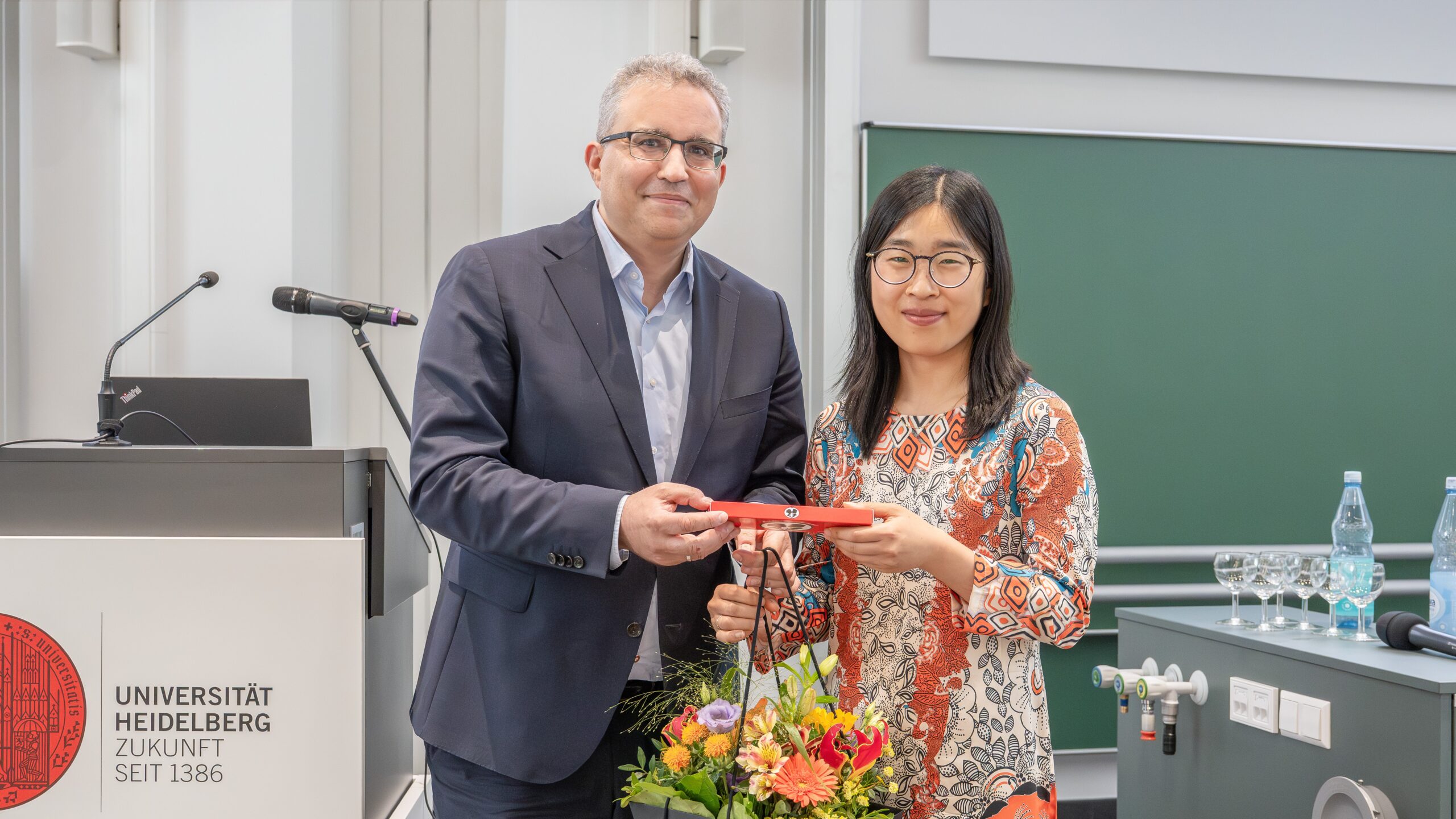
The Heidelberg Faculty of Medicine at Heidelberg University presented the Anita and Friedrich Reutner Prize for Medical Research and the Hoffmann-Klose Prize for an outstanding Clinician Scientist project at this year’s Faculty Day – an event bringing together students, researchers, and teaching staff. The award recipients, Christine Zhang-Hagenlocher and Kristina Müller, are early-career physician-scientists
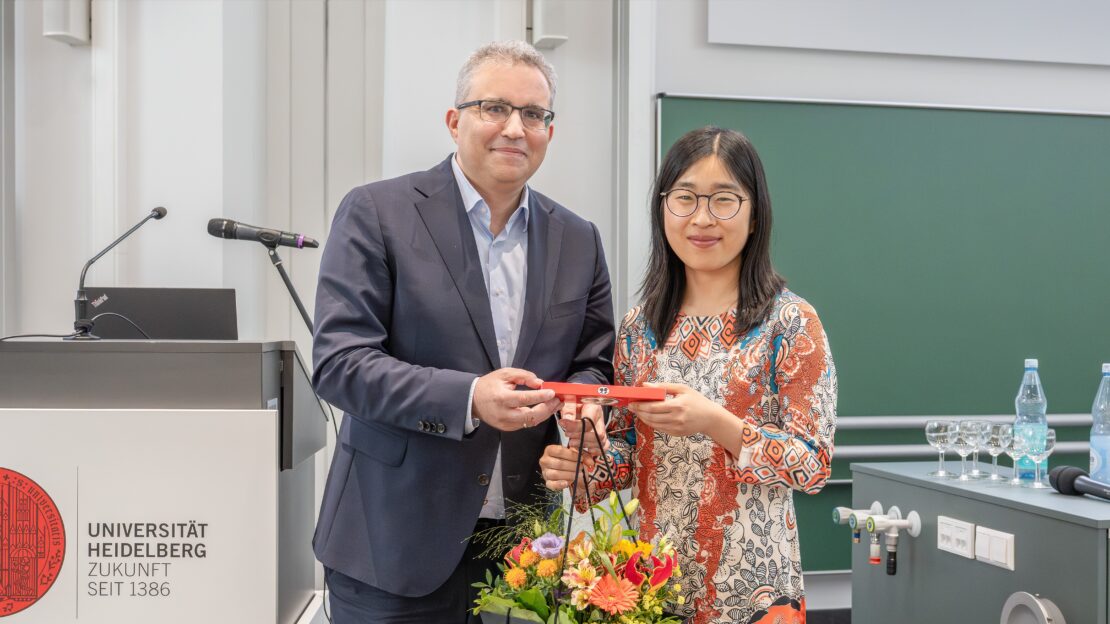
From new insights into the treatment of complications following liver transplantation to research into leukemia relapse, the awards presented at the second Faculty Day highlighted both the diversity of topics and the close alignment of early-career research at the Heidelberg Faculty of Medicine with patient care. PD Dr. Christine Zhang-Hagenlocher received the Anita and Friedrich Reutner Prize for Medical Research. Endowed by Professor Dr. Friedrich Reutner – Honorary Senator of Heidelberg University – the prize carries an award of €10,000 and recognizes outstanding clinical and translational research achievements by early-career scientists.
Dr. Kristina Müller was awarded the Hoffmann-Klose Prize for the best application to the Clinician Scientist Program at the Heidelberg Faculty of Medicine. Funded by the Hoffmann-Klose Foundation, the prize is endowed with €15,000 and supports innovative research projects by physicians in training.
The Faculty Day brings together students, researchers, teaching staff, and employees of the faculty, providing opportunities for exchange, networking, and insights into current research topics and career pathways.
“The Faculty Day showcases what defines the Heidelberg Faculty of Medicine: scientific excellence, dedicated teaching, and individuals who advance research and medicine with great passion,” says Professor Michael Boutros, Dean of the Heidelberg Faculty of Medicine at Heidelberg University. “This year’s award recipients exemplify the innovative strength and high scientific standards of our institution”, says Prof. Dr. Michael Boutros, Dean of the Heidelberg Faculty of Medicine at Heidelberg University.
Improving outcomes after liver transplantation: Anita and Friedrich Reutner Prize for PD Dr. Christine Zhang-Hagenlocher
Complications of the bile ducts are common after liver transplantation, particularly strictures and bile flow obstruction. One effective treatment is endoscopic retrograde cholangiopancreatography (ERCP), in which narrowings are dilated endoscopically. In her award-winning work, PD Dr. Christine Zhang-Hagenlocher, senior physician at the Interdisciplinary Endoscopy Center of Heidelberg University Hospital, investigated whether patients also benefit in the long term from the structured treatment approach established at Heidelberg University Hospital. To do so, she analyzed long-term outcomes in approximately 165 patients treated in Heidelberg.
The results show that the treatment concept has a lasting effect. Sustained clinical success was achieved in 70.1 percent of patients. Moreover, Zhang-Hagenlocher was able to demonstrate an association between successful endoscopic treatment and improved survival: median survival among patients with sustained clinical success was 19.7 years, compared with only 7.7 years in patients without successful therapy. These findings provide important evidence that the choice of treatment strategy can have a long-term impact on outcomes following liver transplantation.
Bile duct strictures can be treated in various ways. The Heidelberg approach relies on a structured endoscopic treatment regimen and balloon dilation. In this procedure, physicians guide a thin tube with a camera into the bile duct, position a small balloon at the site of the narrowing, and inflate it in a targeted manner to reopen the duct – without requiring repeat surgery. Treatment follows a defined schedule with multiple follow-up and intervention appointments.
“The work of PD Dr. Zhang-Hagenlocher combines scientific excellence with direct relevance to patient care. Her research demonstrates how clinically oriented research can help further improve treatment following liver transplantation. Such work is an outstanding example of translational medicine and the close integration of research and care at our institution”, says Prof. Dr. Michael Boutros, Dean of the Heidelberg Faculty of Medicine at Heidelberg University.
Tracking relapse: Hoffmann-Klose Prize for Dr. Kristina Müller
Why do leukemias sometimes return despite successful treatment? This question is the focus of the Clinician Scientist project led by Dr. Kristina Müller, a physician in training at the Department of Hematology, Oncology and Rheumatology at Heidelberg University Hospital. Her research centers on B-cell acute lymphoblastic leukemia (B-ALL), a form of blood cancer that is particularly common in children but also occurs in adults. She investigates the so-called leukemic niche – the altered bone marrow microenvironment shaped by leukemia cells. Leukemia cells do not exist in isolation; rather, they interact closely with their surroundings and can influence these conditions to their advantage.
To better understand these processes, Müller uses bone marrow organoids. These stem cell–derived cellular structures replicate key characteristics of human bone marrow and make it possible to study processes that can only be observed to a limited extent in patients. In the long term, the findings are expected to contribute to a better understanding of therapy resistance and relapse, and to support the development of new treatment approaches.
“The Hoffmann-Klose Prize recognizes outstanding scientific ideas at an early stage of a career. With her project, Dr. Müller is pursuing an innovative approach to better understand therapy resistance and relapse in leukemia. This is an excellent example of how the Clinician Scientist Program brings together scientific excellence and clinical experience,” says Professor Michael Boutros, Dean of the Heidelberg Faculty of Medicine at Heidelberg University.
Award for excellence in teaching
In addition, students presented the PaLMe Teaching Award in recognition of outstanding contributions to medical education. Through this award, medical students honor exceptional commitment to the training of future physicians. It underscores the central importance of teaching in medical education and recognizes educators who support and mentor their students in exemplary ways.
This year’s recipients are: Professor Dr. Joachim Kirsch, Director of the Department of Medical Cell Biology; Dr. Lisa Gölz, Teaching Coordinator at the Pharmacological Institute of the Heidelberg Faculty of Medicine; and Professor Dr. Klaus Herfarth, Deputy Medical Director of the Department of Radiation Oncology and Radiotherapy.