DKFZ Sets Records for ERC Synergy Grants
A historic success for the German Cancer Research Center (DKFZ): Four DKFZ researchers are receiving one of the prestigious ERC Synergy Grants this year—more than ever before at a single institution in a single funding round. Three of the four international research consortia are coordinated by the DKFZ. In total, the projects will receive approximately 44.5 million euros, of which about 13.7 million euros will go to the DKFZ. The award-winning teams aim to decipher the influence of sex chromosomes on health (Duncan Odom), to use artificial intelligence to predict antigens from antibody sequence alone (Nina Papavasiliou), to understand why cancer risk increases with age (Martina Seiffert) and to detect cancer in children as early as possible (Frank Westermann).
ERC Synergy Grants are among the most coveted and fiercely competitive research grants in Europe. Through these grants, the European Research Council (ERC) supports scientific projects with the potential for groundbreaking discoveries. A prerequisite is that researchers with diverse skill sets pool their expertise so that, together, they can answer questions that cannot be solved individually.
The bar for this top-tier funding is correspondingly high. This makes this year’s success at the DKFZ all the more remarkable: no fewer than four of its researchers, together with their international teams, prevailed in the competition. Three of the four projects are even being coordinated by the DKFZ.
“Four ERC Synergy Grants in a single call for proposals—that is a historic success for the DKFZ and a strong signal of the international leading position of our research,” says Michael Baumann, Chairman and Scientific Director of the DKFZ. “This call for proposals demonstrates the scientific potential that arises when outstanding researchers pool their expertise across disciplinary and national boundaries. I am extremely proud of our scientists, whose ideas are opening up new avenues for cancer and health research.”
Duncan Odom (DKFZ) is investigating how the sex chromosomes X and Y influence the development of the body and health. Until now, biological differences between the sexes have been attributed primarily to the effects of hormones. However, recent data show that the sex chromosomes play an important role even in early stages of development—long before sex hormones are produced. In the SexChromFunctions project, researchers from the DKFZ, the Francis Crick Institute, and Memorial Sloan Kettering Cancer Center aim to identify which genes are responsible for this and how they influence the development and function of organs. A particular focus is on the liver. The results are expected to help explain why certain diseases occur at different rates in women and men. In the long term, this could lead to gender-specific approaches to prevention and treatment.
Total funding: 10.7 million euros, of which approximately 3.8 million euros are allocated to the DKFZ.
Nina Papavasiliou (DKFZ) aims to determine whether the genetic blueprint of an antibody alone can predict which target structures it recognizes and to which it binds. To this end, the international research team TrypanoFormer (DKFZ, Heidelberg University, Johns Hopkins University at University of Nottingham) is utilizing a unique survival strategy employed by the African trypanosome. This is a parasite that constantly changes the protein antigens on its surface, thereby evading the antibody response. This natural mechanism makes it possible to gather large amounts of data on the interactions between antibodies and their target antigens. This data will be used to train artificial intelligence-based prediction models to match any antibody sequence to the antigen it binds. In the long term, this could enable the targeted development of antibodies and the creation of new approaches for vaccines and immunotherapies.
Total funding: 10.1 million euros, of which 3.5 million euros are for the DKFZ.
Why does the risk of cancer increase with age? And what role does the tissue surrounding the cancer cells play in this? The interninvolvedesearch team EDEN, in which Martina Seiffert (DKFZ) is involved, is investigating these questions. The project is coordinated by the Instituto de Investigaciones Biomédicas August Pi i Sunyer; other partners include the Institute of Cancer Research, London, and at University of Oxford. The focus is on colorectal cancer and a common form of blood cancer. Using a novel method, the researchers can track the history and evolution of individual cell populations over extended periods of time. Their goal is to determine whether age-related changes in the surrounding tissue promote the development of cancer—or whether emerging cancer cells first alter their environment, creating conditions that support their own growth. The findings are expected to help identify early warning signs of cancer development and develop new strategies for cancer prevention.
Total funding: 14 million euros, of which 3.0 million euros are allocated to the DKFZ.
Frank Westermann (DKFZ and KiTZ Heidelberg*) is researching neuroblastoma, a cancer that primarily affects infants and young children. The tumor develops before birth but is often not detected until the disease is well advanced. While some neuroblastomas regress on their own, others develop into life-threatening tumors. In the EVO-DETECT project, Westermann and colleagues from the University Hospital of Cologne, and the Institute Curie aim to identify which early changes in the genome and in gene regulation determine the disease’s subsequent course. Based on these findings, the goal is to develop a blood test capable of detecting the first signs of neuroblastoma in newborns and infants. In the long term, this could help identify dangerous tumors early and prevent severe disease progression.
Total funding: 9.8 million euros, of which 3.4 million euros are allocated to the DKFZ.
*The “Hopp Children’s Cancer Center Heidelberg (KiTZ) is a joint institution of the German Cancer Research Center (DKFZ), Heidelberg University Hospital (UKHD), and Heidelberg University (Uni HD)
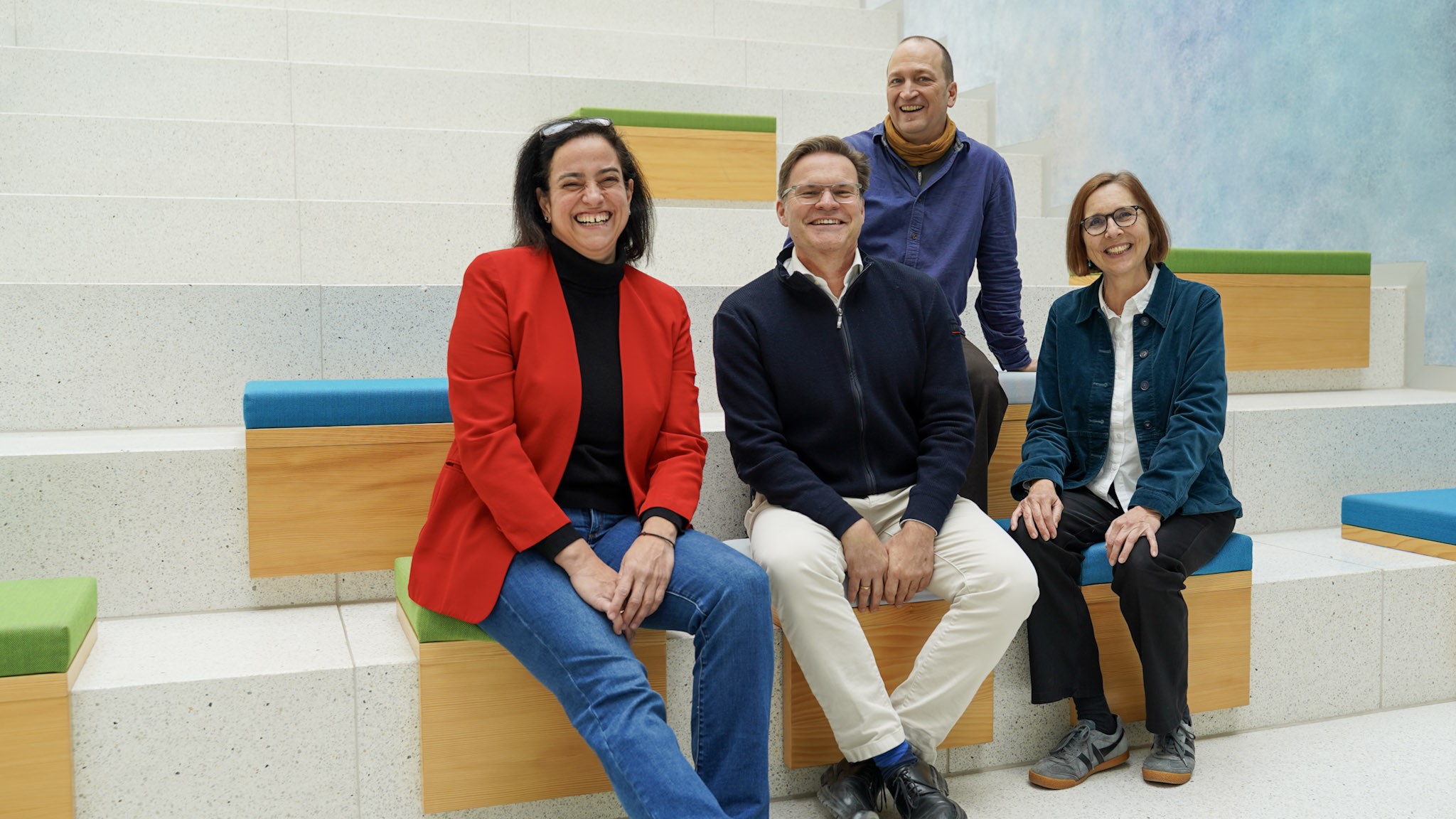
A picture of the four grant holders is here available for download.
Terms of Use: Use is free of charge. The German Cancer Research Center (DKFZ) permits one-time use in connection with reporting on the topic of the press release or on the DKFZ in general. Please provide the following image credit: Tatjana Pauka/DKFZ
Distribution of the images to third parties is permitted only after prior consultation with the DKFZ Press Office (Tel. 06221 42 2854, Email: presse@dkfz.de). Use for commercial purposes is prohibited.
Partners in the four research consortia:
SexChromFunctions
- Memorial Sloan Kettering Cancer Center: Dana Pe’er
- The Francis Crick Institute: Edith Heard
- James Turner
TrypanoFormer
- Universität Heidelberg: Dominik Niopek
- Johns Hopkins University: Monica Mugnier
- University of Nottingham: Bill Wickstead
EDEN
- Instituto de Investigaciones Biomédicas August Pi i Sunyer: Inaki Martin-Subero
- The Institute of Cancer Research: Trevor Graham
- University of Oxford: Alison Simmons
EVO-DETECT