Double ERC success for DKFZ researchers
With its “Consolidator Grants”, the European Research Council (ERC) supports excellent scientists in advancing their independent careers. This year, Ana Banito (Hopp Children’s Cancer Center Heidelberg/German Cancer Research Center, DKFZ) and Aurélie Ernst (DKFZ) are pleased to receive the prestigious ERC funding. Ana Banito will use the two million euros in funding to find new therapeutic approaches for the better treatment of sarcomas in children. Aurélie Ernst will use the grant to explore how and under what molecular circumstances cancer develops from cells with an unstable genome.

© Marius Stark/DKFZ
Ana Banito studies sarcomas, an extremely heterogeneous group of tumors of the bone and soft tissue that particularly affect children. Despite decades of clinical studies, there is still a lack of effective treatments for these tumors. A common feature of sarcomas in children is their low mutation load. Instead, they often contain a genetic rearrangement specific for the respective tumor type. This leads to the formation of a fusion protein (onco-fusion), which drives the development of the disease.
The cell of origin of the vast majority of sarcomas is unknown. Ana Banito’s lab has recently developed a versatile approach to model various types of pediatric sarcoma subtypes from mouse muscle. Using these models, she aims to identify the identity of the cells of origin of different sarcomas and to find out why they are prone to transformation.
Banito is particularly interested in whether the fusion proteins are also required for the maintenance of the tumor and, if so, to what extent the transformation to tumor cells is reversible. Do the tumor cells retain the memory of their previous normal state and can they possibly be reprogrammed?
Ana Banito studied biology at the University of Lisbon and completed her doctorate in the field of life sciences at Imperial College London in 2011. She then worked as a postdoc at the Memorial Sloan Kettering Cancer Center in New York, among other places. Since 2019, Banito has headed the “Soft Tissue Sarcoma” junior research group, which is based at the Hopp Children’s Cancer Center Heidelberg and the DKFZ.
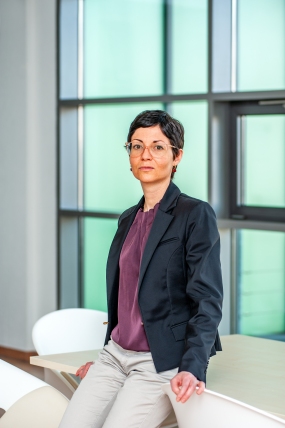
© Jutta Jung/DKFZ
Aurélie Ernst studies chromosome instability, a phenomenon that leads to an accumulation of changes in chromosome number and structure. When chromosome segments are missing, duplicated or inserted in the wrong orientation, this can lead to cancer development. Chromosome instability is associated with aggressive tumors and poor prognosis. However, it is not yet known which of the molecular changes actually lead to the development of malignant cells. Her hypothesis is that the onset of chromosome instability is the tipping point that govers the fate of a pre-cancer clone. For her ERC project, she wants to use single-cell and spatially resolved multi-omics methods to analyze the essential steps and factors by which chromosome instability leads to malignant transformation.
Ernst is interested in quantifying the instability rate of the human genome and in understanding how and why cells with chromosome instability are selected and expand. For this project, she is using two tissues that are at the opposite spectrum in the human body in terms of their regenerative capacity, namely the brain and the intestine. In order to find strategies for possible early cancer detection and intervention, Ernst wants to understand the mechanisms and etiologies of chromosome instability.
Aurélie Ernst studied biosciences and biochemistry in France and in the US. She completed her doctorate on brain tumor development at the DKFZ and then did a postdoctoral training on neural stem cells at the Karolinska Institute. Since 2019, she has headed the junior research group “Genome Instability in Tumors” at the DKFZ.