Molecular guardian inhibits aggressive brain tumor’s ability to switch between identities
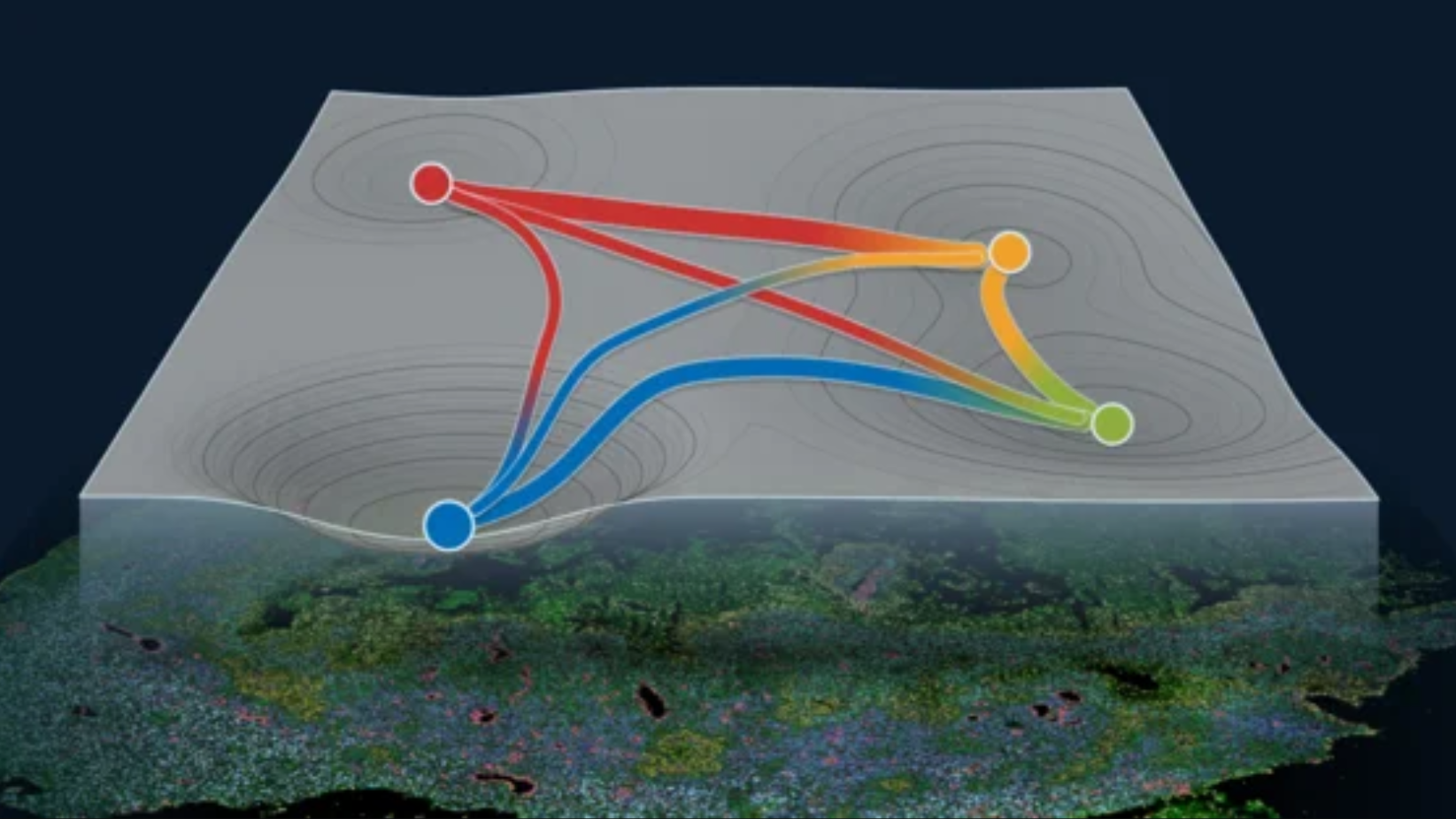
One of the reasons for the high aggressiveness of glioblastomas is their remarkable adaptability. A team led by scientists from the German Cancer Research Center (DKFZ), the European Molecular Biology Laboratory (EMBL), HITBR*, and the Wellcome Sanger Institute, Cambridge, now describes in Nature how glioblastoma cells switch between different states. At the same time, the researchers identified a key factor that, acting as a guardian of cell identity, limits this adaptability. A second, a companion paper published simultaneously in Nature shows that, despite their great diversity, glioblastomas follow a surprisingly similar developmental pathway.
(C) Bayraktar / Wellcome Sanger Institute und Mall / DKFZ
Glioblastoma is one of the most aggressive brain tumors in adults. One reason for this is its enormous diversity and adaptability: tumor cells can change between different states. This so-called cellular plasticity contributes to the continued development of tumors and their response to therapies.
An international team led by researchers from the DKFZ, EMBL, and the Wellcome Sanger Institute in Cambridge has now shown that these state transitions do not occur randomly, as previously assumed, but follow a structured molecular logic. The transcription factor MYT1L plays a key role in this process: It acts as a molecular guardian that actively suppresses alternative cell states, thereby keeping tumor cells in a comparatively less adaptable—and thus less aggressive—state. MYT1L is also known outside the field of cancer research: Mutations in this gene are among the known genetic causes of autism spectrum disorders.
For the study, the researchers analyzed gene activity and chromatin accessibility in more than one million cells from glioblastomas of twelve patients. Using a specially developed AI method, they reconstructed the regulatory networks and factors that determine which states a tumor cell can adopt, and which changes are favored or blocked. The predictions were then systematically tested on cell lines isolated from patient tumors.
The Guardian of Cellular Identity as a Molecular Tumor Brake
In the process, MYT1L proved to be a particularly effective molecular brake: The factor “locks” regions of the genome that are required for alternative cellular programs, thereby severely limiting the plasticity of the tumor cells. This effect was largely maintained even under radiation or treatment with the standard drug temozolomide. In mice, glioblastomas with increased MYT1L activity also grew more slowly, invaded the surrounding brain tissue to a lesser extent, and the animals survived longer.
Conversely, the loss of MYT1L reactivated plasticity and accelerated the development of malignant traits. “This shows that cell identity with low plasticity is maintained only if all other states are actively suppressed on a permanent basis,” explains Moritz Mall (DKFZ and HITBR*), one of the study’s lead investigators.
The findings open up a new perspective on potential treatment strategies. “Instead of solely inhibiting the growth of cancer cells, future efforts could also focus on specifically limiting their ability to change and adapt,” says Moritz Mall. Further preclinical studies are still needed before these findings can potentially lead to therapeutic approaches.
Glioblastomas: Surprisingly Similar Developmental Pathways
The Nature publication appears simultaneously with a companion study led by the Wellcome Sanger Institute, in which researchers from DKFZ, EMBL, and the University of Cambridge also played leading roles. Both studies are based on the same extensive single-cell and multi-omics dataset from the twelve glioblastomas.
With this study, the international team demonstrates that, despite their great diversity, glioblastomas follow a surprisingly similar developmental pathway. Tumor cells often begin in a relatively “young,” development-like state and change step by step as the tumor grows. Deeper within the tumor, they increasingly behave like injured brain cells and eventually enter a state of oxygen deprivation and stress.
These different cellular states are therefore not randomly distributed but form distinct spatial zones within the tumor. Immune cells in the surrounding area also change in accordance with these zones and may influence the development of cancer cells. “A snapshot of tumor diversity thus becomes a map of possible pathways between the tumor’s various states,” says Oliver Stegle (DKFZ and EMBL), one of the principal investigators for both studies. He adds, “Our results provide a kind of roadmap for glioblastoma development that could open up new therapeutic approaches in the long term.”
* HITBR: The Hector Institute for Translational Brain Research is a joint research institution of the Central Institute of Mental Health (ZI) at the German Cancer Research Center (DKFZ) and the Hector Foundation II.
Publications:
Manu Saraswat, Laura Rueda-Gensini, Elisa Heinzelmann, Tannia Gracia, Fani Memi, Grant de Jong, Jannes Straub, Cedar Schloo, Dirk C. Hoffmann, Erik Jung, Tim Kindinger, Louis Masclef, Bettina Weigel, Bryce Lim, Faustus Tuschmann, Sophie Weil, Oliver Gould, Richard Mair, Katharina Mikulik, Martin Rohbeck, Wolfgang Wick, Frank Winkler, Omer Ali Bayraktar, Oliver Stegle, Moritz Mall: Decoding the regulatory programs governing glioblastoma plasticity. Nature 2026, DOI: https://www.nature.com/articles/s41586-026-11177-0
Grant de Jong, Fani Memi, Tannia Gracia, Olga Lazareva, Oliver Gould, Georgios Solomou, Alexander Aivazidis, Manas Dave, Qianqian Zhang, Melanie Jensen, Ahmet Sureyya Rifaioglu, Joao D. Barros-Silva, Sabine Eckert, Di Zhou, Yvette Wood, Elizabeth Tuck, Sezgin Er, Koen Rademaker, Robert Petryszak, Henry Marshall, Kenny Roberts, Andrew L. Trinh, Shreya Rai, Tyler Shaw, Agnes Oszlanczi, Hayden Powell, Pasha Mazin, Stanislaw Makarchuk, Yinshui Chang, Katarzyna Kania, Liying Jin, Catherine Tudor, Hon Man Chan, Harriet Johnson, Benjamin Rumney, Holly Anderson, Jasmine Halliwell, Vanessa Brito Pereira, Zoi Katsirea, Irfan Mamun, Ilaria Mulas, Annelies Quaegebeur, Mayen Briggs, Jessica Cox, Jimmy Tsz Hang Lee, Laura Rueda-Gensini, Manu Saraswat, Zaira Seferbevoka, Adam Young, Minal Patel, Tarryn Porter, Moritz Gerstung, Martin Prete, Elena Prigmore, Moritz Mall, Harry Bulstrode, Julio Saez-Rodriguez, James Briscoe, David H. Rowitch, Richard Mair, Sam Behjati, Oliver Stegle, Omer Ali Bayraktar: A spatiotemporal cancer cell trajectory underlies glioblastoma heterogeneity. Nature 2026, DOI: https://www.nature.com/articles/s41586-026-11234-8
A picture illustrating the press release is available for download:
https://www.dkfz.de/fileadmin/user_upload/Skoe/Pressemitteilungen/2026/spatial_transcriptomics.png
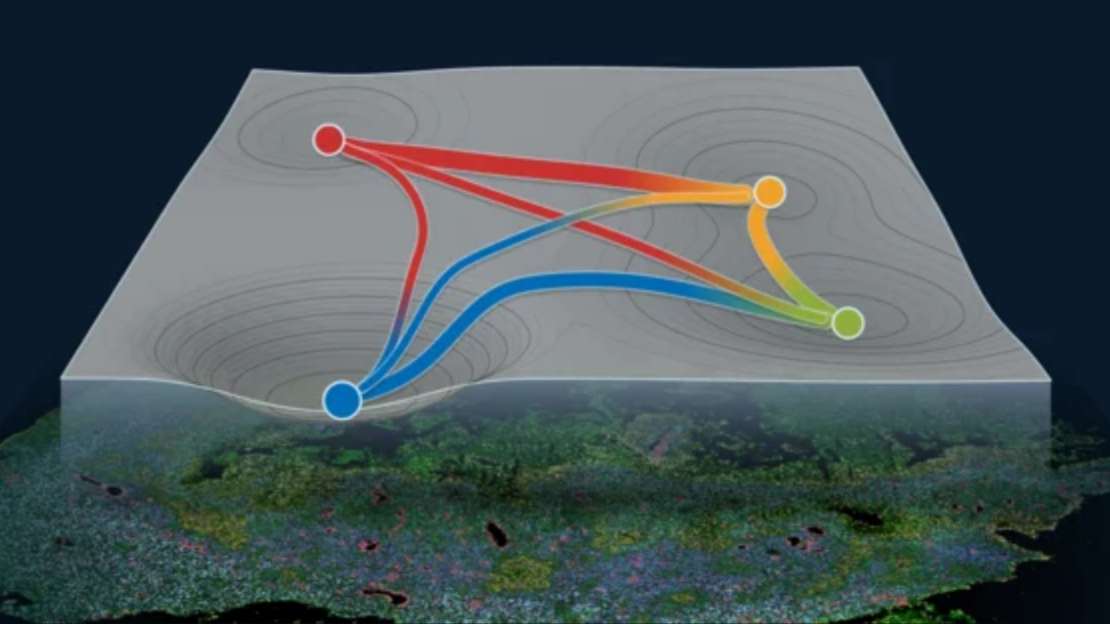
Caption: A tissue section of a brain tumor. The gene activity of all cells was analyzed at the spatial resolution (“transcriptomics”) and overlaid with a schematic representation showing the probability of transitions between the various cell states.
Terms of Use: Use is free of charge. The German Cancer Research Center (DKFZ) permits one-time use in connection with reporting on the topic of the press release or on the DKFZ in general. Please provide the following image credit: Bayraktar / Wellcome Sanger Institute and Mall / DKFZ
Distribution of the images to third parties is permitted only after prior consultation with the DKFZ Press Office (Tel. 06221 42 2854, Email: presse@dkfz.de). Use for commercial purposes is prohibited.