May 02, 2025

Pancreatic Cancer: Interactions between Neurons and Tumor
Pancreatic Cancer: Interactions between Neurons and Tumor

Nikon Imaging Center at Heidelberg University achieves three-dimensional reconstruction of nerve network in the pancreas tissue

Pancreatic cancer is fueled by connections to the nervous system, as was shown by scientists from the German Cancer Research Center (DKFZ) and the Heidelberg Institute for Stem Cell Technology and Experimental Medicine (HI-STEM). In a recent study, they discovered that the tumor targets and reprograms the neurons for its own benefit. The Nikon Imaging Center at Heidelberg University contributed to the molecular findings by providing three-dimensional imaging of the pancreatic tissue to display the nerve network.
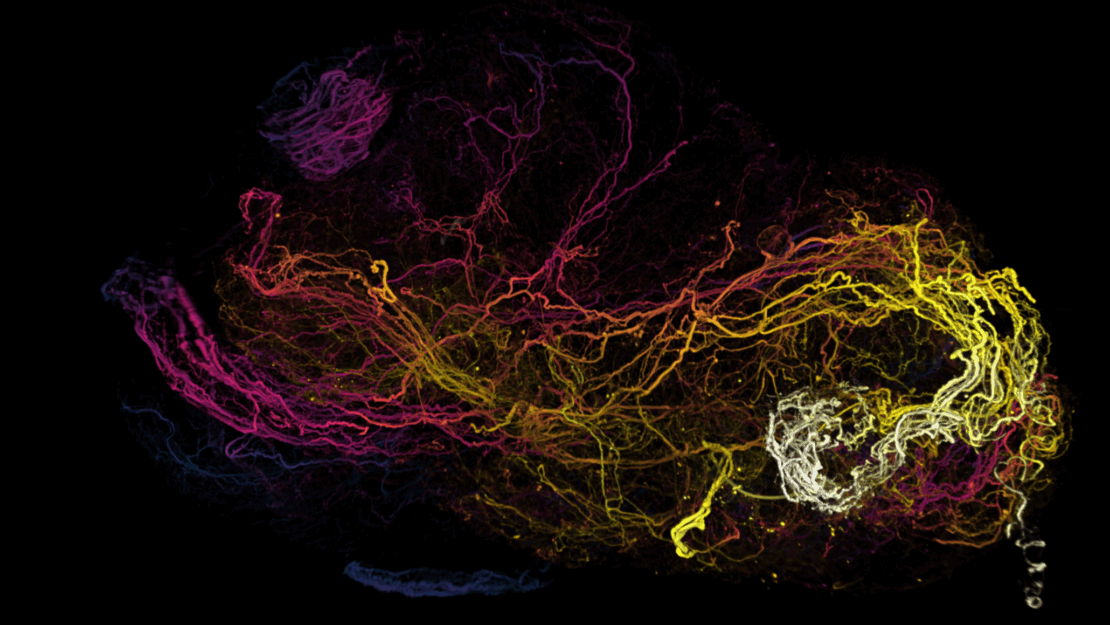
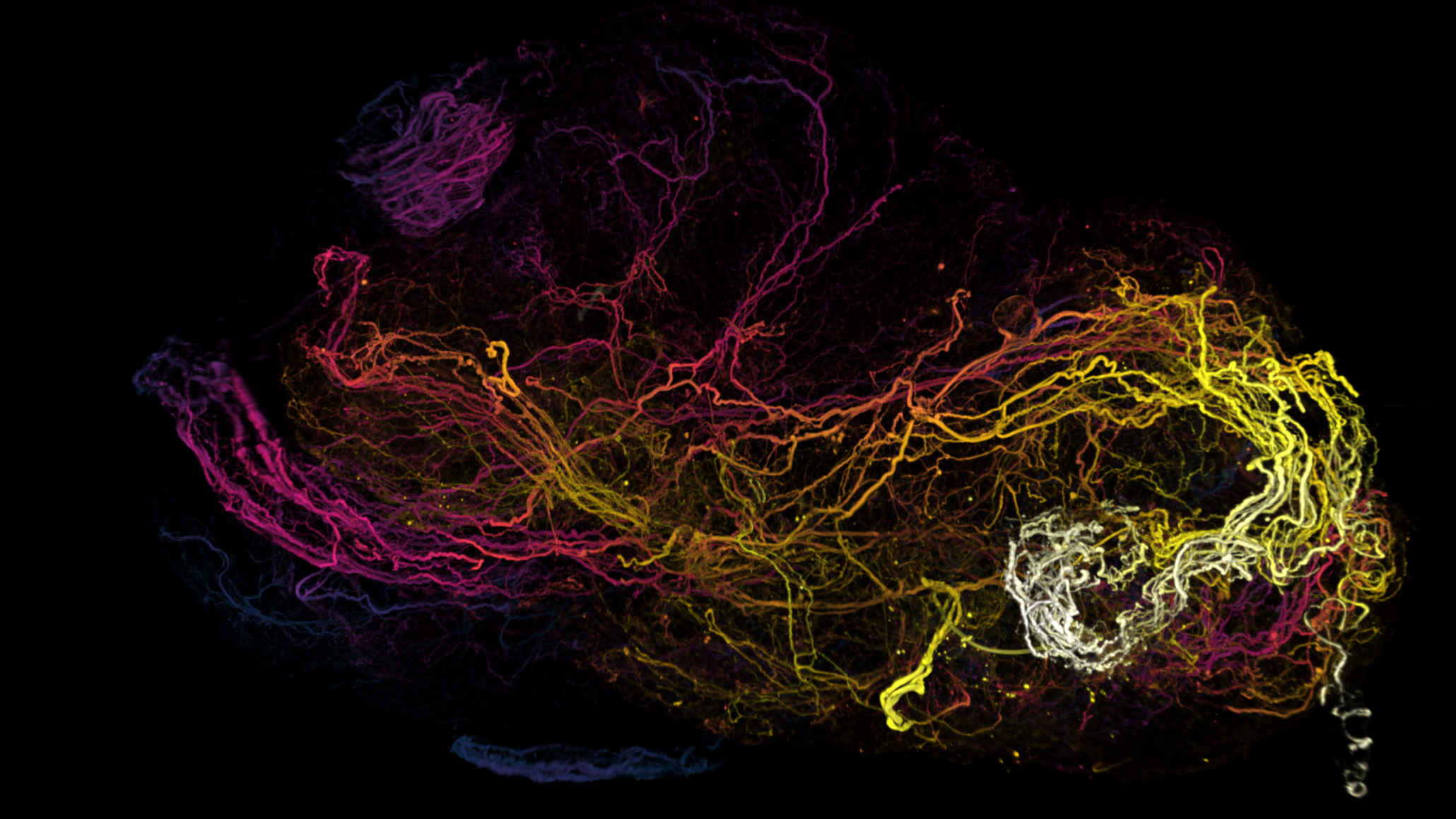
The whole tissue – here the pancreatic tumor of a mouse – was captured image by image and then reconstructed as volume. To that end, the peripheral nervous system in the pancreatic gland was stained with fluorescent dyes. The fluorescence glow of the neurons was then imaged with a method known as light-sheet fluorescence microscopy. That made it possible to visualize the dense network of neuronal structures that contribute to tumor growth. | © Nicolas Dross (Nikon Imaging Center der Universität Heidelberg) / Verena Thiel (HI-STEM)

In pancreas tumors the nerves are extremely well ramified and in contact with most of the tumor cells. To examine the molecular signature of the nerve cells in both healthy tissue and pancreatic cancer, the researchers around Prof. Dr Andreas Trumpp used a method newly developed in mice. They were able to determine the type of neurons that innervate the tumor and also show that the tumor changed their molecular signature. In their study published in the journal “Nature”, the researchers demonstrate how the pancreatic tumor targets and reprograms peripheral nerves for its own purposes. The neurons “manipulated” by the tumor then promote tumor growth and even continue to do so after the primary tumor has been removed.

The molecular studies on the interaction between neurons and tumors were complemented by three-dimensional reconstructions of the pancreatic nervous system. First author Dr Vera Thiel from HI-STEM collaborated on this with Dr Nicolas Dross from the Nikon Imaging Center at Heidelberg University. To visualize the whole tissue of the pancreas, the peripheral nervous system was stained with specific fluorescent dyes. The resulting fluorescence glow of the neurons was then imaged using light-sheet fluorescence microscopy, in order to combine these individual images into a three-dimensional representation of the volume. This way, the dense network of neuronal structures that foster tumor growth could be reconstructed and compared to the nerves in healthy tissue.

The Nikon Imaging Center is a central institution for light microscopy, located at the BioQuant Center of Heidelberg University. At the center, a team of postdoctoral researchers headed by Dr Ulrike Engel supports scientists working in the life sciences and in biomedical research.

Original publication

V. Thiel, S. Renders, J. Panten, N. Dross, K. Bauer, D. Azorin, V. Henriques, V. Vogel, C. Klein, A.M. Leppä, I. Barriuso Ortega, J. Schwickert, I. Ourailidis, J. Mochayedi, J.-P. Malm, C. Müller-Tidow, H. Monyer, J. Neoptolemeos, T. Hackert, O. Stege, D. T. Odom, R. Offringa, A. Stenzinger, F. Winkler, M, Sprick, A. Trumpp: Characterization of single neurons reprogrammed by pancreatic cancer. Nature 2025


Our latest News

discover more
New Publication from Sciomics GmbH: Fimepinostat Promotes Apoptosis and Decreases Cytokine Secretion in NF2-Related Human Schwannoma Cells

New Publication from Sciomics GmbH: Fimepinostat Promotes Apoptosis and Decreases Cytokine Secretion in NF2-Related Human Schwannoma Cells

Nagel, A.; Hass, E.W.; Hayes, H.; Huelbes, L.; Oliveira, S.; Hardin, H.M.; Marasigan, M.; Nisenbaum, E.; Misztal, C.; Telischi, F.F.; et al. Fimepinostat Promotes Apoptosis and Decreases Cytokine Secretion in NF2-Related Human Schwannoma Cells. Int. J. Mol. Sci. 2026, 27, 2636. https://doi.org/10.3390/ijms27062636 https://www.mdpi.com/1422-0067/27/6/2636 Simple Summary This study focuses on the action of fimepinostat, a dual histone deacetylase (HDAC)/phosphosphoinositide-3 kinase […]

Fraunhofer IPA wins the “euRobotics Technology Transfer Award” together with Trumpf and Lorch

Fraunhofer IPA wins the “euRobotics Technology Transfer Award” together with Trumpf and Lorch

Technology transfer that works: At the “European Robotics Forum” (ERF) in late March, the trio of applicants won the prestigious award. The award recognizes research that has found its way into industrial applications. The application focused on a “no-code” solution that allows companies to deploy cobots without specialized knowledge or significant welding effort, even for […]

Sanofi and Regeneron’s Dupixent approved in the EU as the first targeted medicine to treat young children with chronic spontaneous urticaria

Sanofi and Regeneron’s Dupixent approved in the EU as the first targeted medicine to treat young children with chronic spontaneous urticaria

Sanofi and Regeneron’s Dupixent approved in the EU as the first targeted medicine to treat young children with chronic spontaneous urticaria Paris and Tarrytown, NY, April 13, 2026. The European Commission has approved Dupixent (dupilumab) for the treatment of moderate-to-severe chronic spontaneous urticaria (CSU) in children aged two to 11 years with inadequate response to histamine-1 […]

GET IN TOUCH

Stay Updated with bioRN’s Newsletter

Sign up for our newsletter to discover more!
* required

BioRN (BioRN Network e.V. and BioRN Cluster Management GmbH) will use the information you provide on this form to be in touch with you and to provide updates and marketing. Please let us know all the ways you would like to hear from us:

You can update your subscription preferences or unsubscribe at any time. Just follow the unsubscribe or update link in the footer of automated emails you receive from us, or by contacting us at info@biorn.org. We will treat your information with respect. For more information about our privacy practices please visit our website: www.biorn.org. By clicking below, you agree that we may process your information in accordance with these terms.

We use Mailchimp as our marketing platform. By clicking below to subscribe, you acknowledge that your information will be transferred to Mailchimp for processing. Learn more about Mailchimp's privacy practices.

Intuit Mailchimp