Presentation of the EY German Biotechnology Report 2026 in Heidelberg: Strong Innovation Ecosystems Are Key to Scaling Innovation
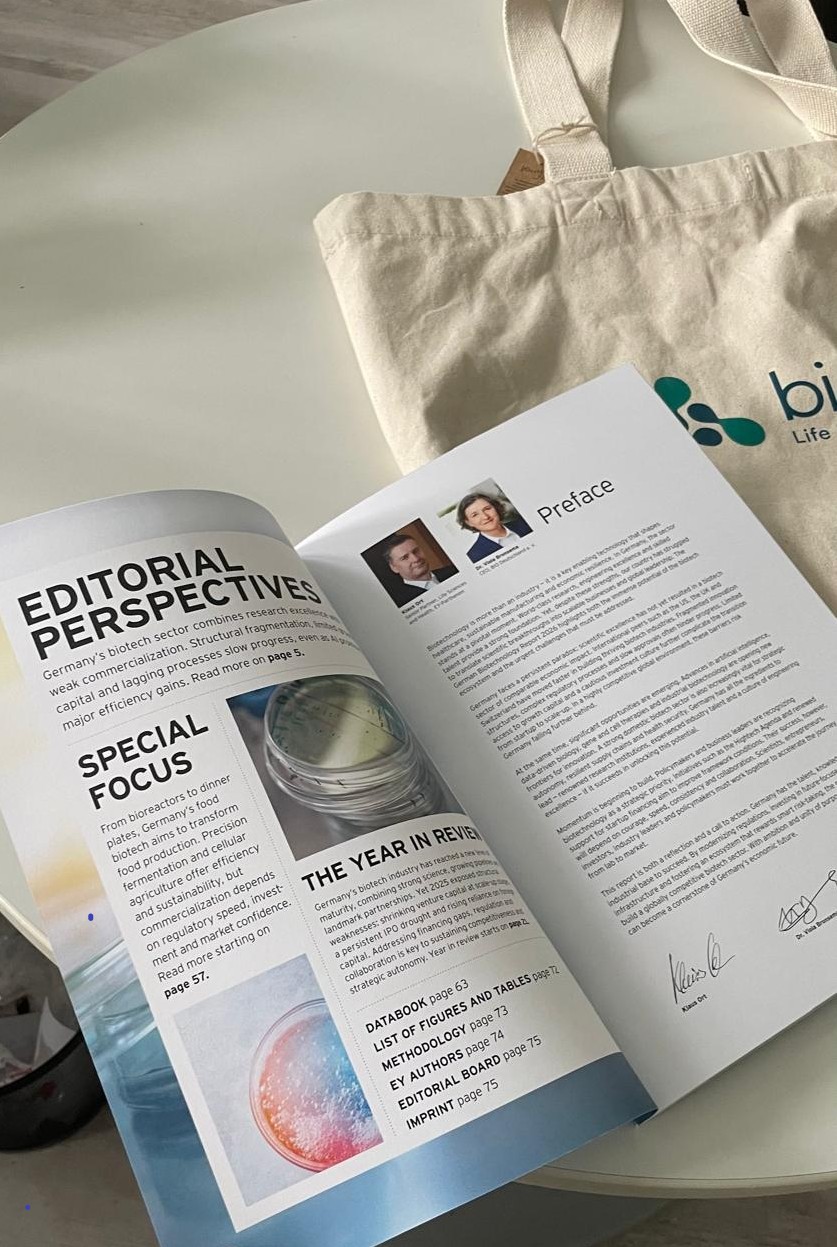
Heidelberg, 11 June 2026 – Germany continues to produce world-class science, breakthrough technologies and highly innovative biotechnology companies. However, the challenge is no longer generating innovation – it is creating the conditions that allow innovation to scale.
This was one of the central messages emerging from the presentation of the EY German Biotechnology Report 2026, which was hosted today in Heidelberg by bioRN, EY and Technologiepark Heidelberg.
The report highlights a mixed picture for the German biotechnology sector. While scientific excellence remains a major strength, access to growth capital has become increasingly challenging. Particularly striking was the sharp decline in Series B financing, which fell from €169 million in 2024 to just €7 million in 2025. Overall venture capital investments in German biotech declined by approximately one third, with 71 percent of all venture capital concentrated in only three financing rounds.
At the same time, developments elsewhere in Europe indicate that this is not solely a European challenge. Venture capital investments across Europe increased overall, and four biotech companies successfully completed IPOs during the year – none of them in Germany.
Another important trend highlighted in the report is the growing role of pharmaceutical companies in financing innovation. Strategic research partnerships and collaborations with substantial upfront investments increasingly compensate for the shortage of venture capital available to young biotechnology companies. However, this also raises important questions about the long-term competitiveness of Germany as a location for biotechnology innovation.
In his keynote address, Prof. Dr. Jochen Maas emphasized that future competitiveness will depend not only on scientific excellence, but also on the ability to connect research, talent, capital, manufacturing capabilities and entrepreneurial ambition within strong innovation ecosystems.
While many of the challenges identified in the report require action at both national and European level, regional innovation ecosystems also have an important role to play.
At bioRN, several initiatives are specifically designed to strengthen the conditions needed for innovation to grow. Through formats such as the bioRN Investment Circle, the Private Investors Day and the upcoming Life Science Investors Day, bioRN works to connect investors with emerging life science opportunities and strengthen access to private capital. Through the bioRN Pharma Circle and the Industry-Academia Day, the cluster facilitates collaboration between academic researchers and pharmaceutical companies. The bioRN C-Level Circle provides a trusted platform for biotechnology executives to exchange experiences, discuss strategic challenges and build valuable peer networks.
Together, these initiatives contribute to addressing some of the structural barriers highlighted in the EY report by strengthening collaboration, improving access to capital, fostering entrepreneurship and supporting the translation of scientific discoveries into real-world impact.
bioRN would like to thank Klaus Ort, Prof. Dr. Jochen Maas, EY, Technologiepark Heidelberg and all participants for an insightful discussion on the future competitiveness of Germany and Europe as locations for biotechnology and life sciences.
As the discussion in Heidelberg made clear, Germany does not lack scientific excellence. The challenge ahead is ensuring that outstanding research can be translated into successful companies, new therapies and sustainable economic growth.
You can download the EY Report here