Spine Tumor Surgery: Better Preparation with a Digital Twin
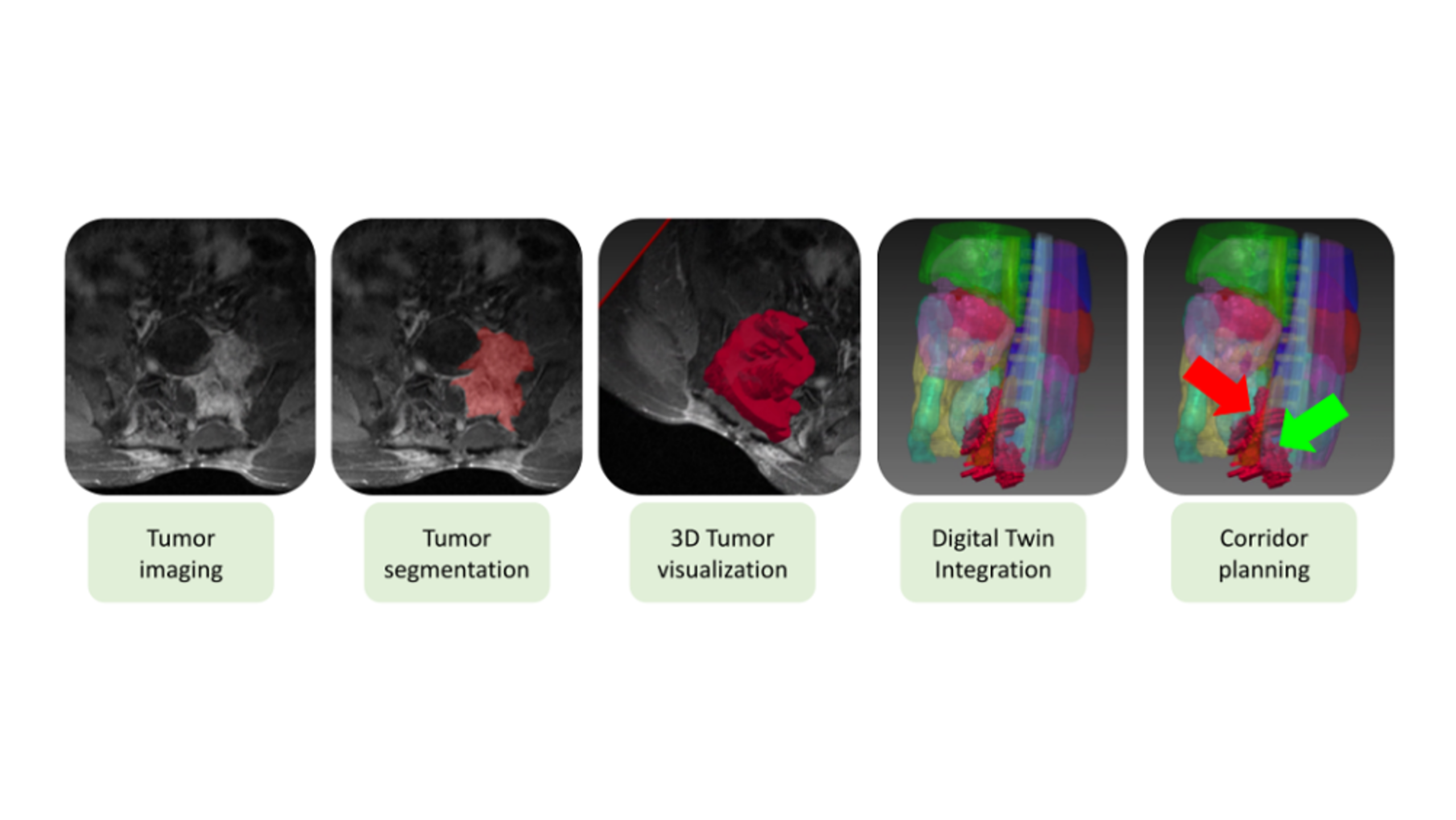
How can complex spinal tumor surgeries be planned and prepared more effectively in the future? As part of the IntelliSpine-Recon collaborative project, researchers will develop, among other innovations, a digital twin of the spine and a virtual training environment for surgeons. The junior research consortium, coordinated by the Heidelberg Faculty of Medicine at Heidelberg University, is being carried out in partnership with the Karlsruhe Institute of Technology (KIT). Over the next three years, IntelliSpine-Recon will receive approximately €1.6 million in funding from Federal Ministry of Research, Technology and Space.
Surgery for spinal tumors is highly complex and associated with significant risks. Over the next three years, researchers in medicine, computer science, and engineering will develop a range of artificial intelligence (AI)-supported tools designed to enable more targeted and patient-specific preparation of these procedures. These tools include a digital twin of the spine and a virtual training environment. In the long term, the project aims to improve patient care through the use of digital technologies. The collaborative project is coordinated by Privatdozentin (PD) Pavlina Lenga at the Heidelberg Faculty of Medicine at Heidelberg University.
At the heart of the project is the development of a digital twin of the spine. This virtual 3D model is based primarily on a patient’s medical imaging data, including computed tomography (CT) and magnetic resonance imaging (MRI) scans. Laboratory findings and information on disease progression are also incorporated. The AI-supported model provides a patient-specific representation of bones, tumors, nerves, and blood vessels, while highlighting critical areas containing essential anatomical structures. Using the digital twin, surgeons can plan tumor resections in advance and identify the safest, lowest-risk surgical approaches for each individual patient.
In a second step, the research team will develop a virtual training environment in which clinicians can rehearse the procedure. The system will include haptic feedback technology, meaning that an input device will generate tactile resistance or counterforces whenever a virtual instrument approaches a critical anatomical area. This will allow surgeons to test different approaches and identify potentially challenging aspects of an operation before entering the operating room. The Federal Ministry of Research, Technology and Space (Bundesministerium für Forschung, Technologie und Raumfahrt, BMFTR) is supporting the IntelliSpine-Recon consortium through its “Future eHealth” funding initiative with approximately € 1.6 million.
Spinal Chordomas and Sarcomas: Every Procedure Requires an Individualized Approach
The surgical treatment of malignant bone tumors of the spine, known as spinal chordomas and sarcomas, is particularly challenging for several reasons. Sensitive structures such as the spinal cord, dura mater, nerve roots, and major blood vessels may be located in close proximity to the tumor. Even small deviations from the planned surgical pathway can result in complications, for example through injury to blood vessels or the spinal cord. In addition, spinal chordomas and sarcomas are rare, can occur at different locations along the spine, and may have invaded surrounding tissues.
“Every surgical intervention requires an individualized approach, from diagnosis and treatment planning through surgery, reconstruction, and follow-up care,” says PD Lenga. The coordinator of the IntelliSpine-Recon consortium is a researcher at the Institute of Medical Informatics (Director: Professor Martin Dugas) and a board-certified neurosurgeon at the Department of Neurosurgery (Medical Director: Professor Sandro Krieg) of Heidelberg University Hospital. The Department’s Spine Surgery Section specializes in the treatment of spinal tumors, including rare spinal chordomas and sarcomas.
A “Closed Learning Loop” for Better Decision-Making
Another key focus of the project is so-called closed-loop learning. Insights gained through the development and use of the digital tools will be fed directly back into the continued improvement of the systems. In addition, the researchers will integrate clinical outcome data from patients with spinal bone tumors, as well as results from patient surveys assessing factors such as health-related quality of life and acceptance of AI-supported approaches. “Interdisciplinary tumor boards, advanced imaging, and the extensive experience of surgeons form the foundation of successful cancer treatment. With IntelliSpine-Recon, we do not aim to replace these strengths but to complement them in a targeted way,” says PD Pavlina Lenga. “By bringing together data from treatment planning, surgery, and follow-up care, we hope to gain a better understanding of which decisions lead to the best long-term outcomes for patients.” The consortium is not developing a market-ready medical device. Rather, it aims to create a prototype AI-supported assistance platform.
Project Partners and Their Roles
The interdisciplinary junior research consortium began its work on 1 November. The official consortium kick-off meeting will take place at Heidelberg University Hospital on 23 November. In addition to the researchers from the Department of Neurosurgery led by PD Lenga, scientists from the Department of Radiation Oncology and Radiation Therapy at Heidelberg University Hospital (Medical Director: Professor Jürgen Debus) are also involved. From the Division of Medical Image Computing, headed by Professor Klaus Maier-Hein, key contributors include Peter Neher and Robin Peretzke. The Institute of Medical Informatics (IMI) at Heidelberg University Hospital contributes its expertise in data integration, patient-reported outcome measures (PROMs), and clinical software development. The Division of Translational Medical Oncology at the National Center for Tumor Diseases (NCT) Heidelberg, headed by Professor Stefan Fröhling, supports the consortium in evaluating how the system could be implemented in clinical practice.
The team led by Balint Varga at Karlsruhe Institute of Technology (KIT) is developing components for the virtual surgical simulation and haptic feedback system. The German Sarcoma Foundation (Deutsche Sarkom-Stiftung) participates in the project as an associated partner. Patient representatives Markus Wartenberg and Katja Winter are coordinating the planned patient involvement activities on behalf of the foundation. Together with patients, they contribute the patient perspective to the development, evaluation, and communication of the project.
The BMFTR Funding Initiative “Future eHealth”
Through its “Future eHealth” funding initiative, the BMFTR supports interdisciplinary junior research consortia led by outstanding early-career researchers and focused on applying digital technologies to medical challenges. The funded projects are intended to generate new knowledge for computer-assisted healthcare while also helping participating researchers advance toward scientific leadership positions in the field of eHealth. In addition to coordinating IntelliSpine-Recon, researchers from Heidelberg are involved as consortium partners in two other “Future eHealth” projects.
Weitere Informationen im Internet
Department of Neurosurgery, Heidelberg University Hospital (in German)
Institute of Medical Informatics, Heidelberg University Hospital
Contact
PD Pavlina Lenga
Heidelberg Faculty of Medicine at Heidelberg University
Department of Neurosurgery and Institute of Medical Informatics, Heidelberg University Hospital
pavlina.lenga@med.uni-heidelberg.de