Synthetic Cells: Function Through Mutation
Just a few genetic changes transform simple RNA droplets into cell-like structures that can move and take up cargo
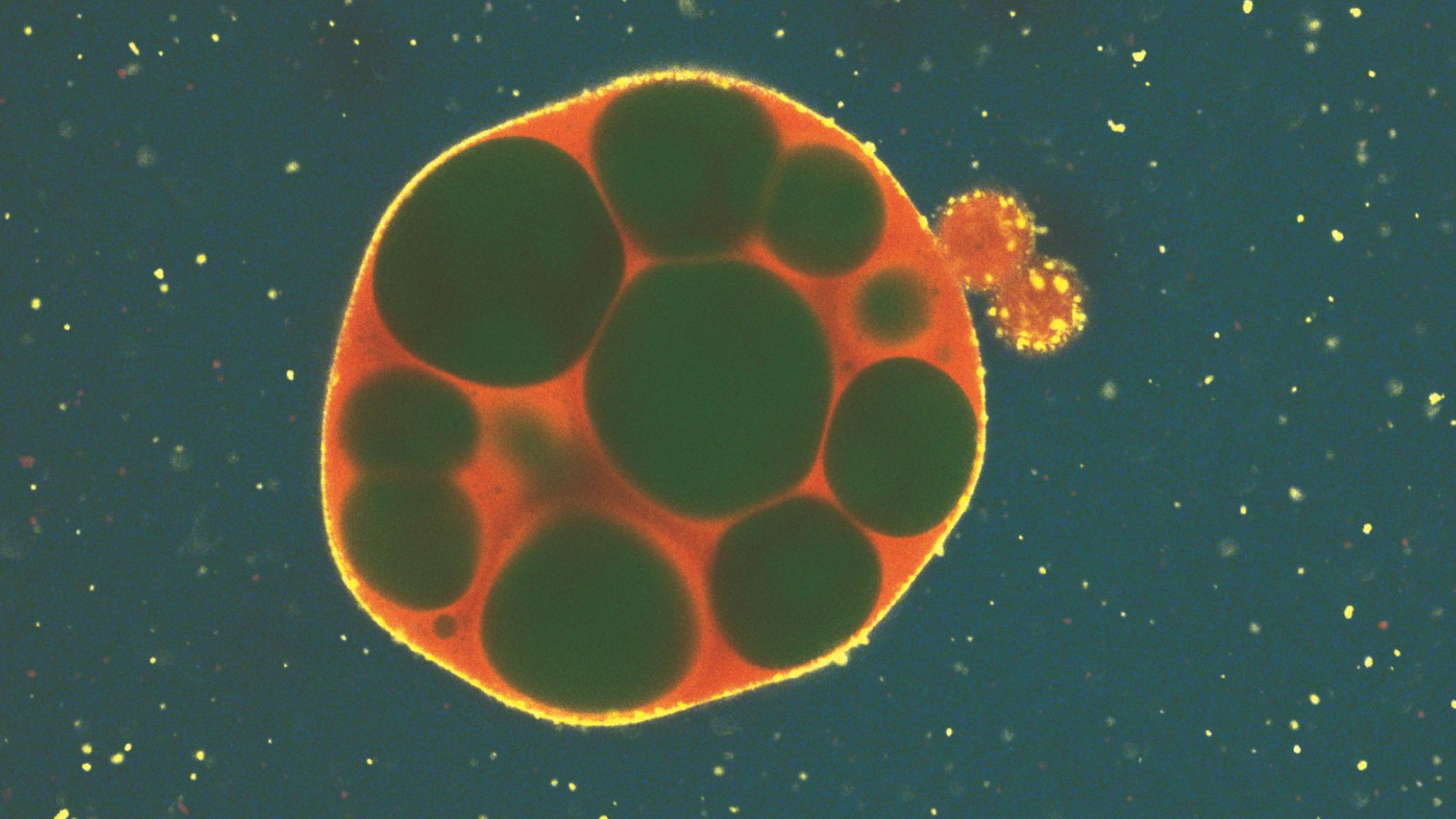
A small number of random genetic mutations cause simple RNA droplets to transform into cell-like structures. In this process, they form cavities, can move and are able to take up cargo. This has been demonstrated through research using nanostructures based on ribonucleic acid led by Prof. Dr. Kerstin Göpfrich at the Center for Molecular Biology of Heidelberg University (ZMBH) in cooperation with experts from the German Cancer Research Center and the University of Augsburg. Just a few molecular changes are enough to trigger these complex processes in very simple synthetic cells – a principle that the researchers also hope to harness for medical applications.
How life could have emerged from non-living matter is one of the oldest unanswered questions in science. For this to happen, a minimal cell must at least retain its genetic material while also being able to change, as Prof. Göpfrich explains. Creating such a minimal living cell from scratch using non-living components is one of the main goals of synthetic biology – the field in which Kerstin Göpfrich and her research group at the ZMBH work. The molecular biologist uses RNA droplets in her research. These are liquid-like, membrane-less nanostructures composed of synthetically produced ribonucleic acid (RNA) that spontaneously self-assemble.
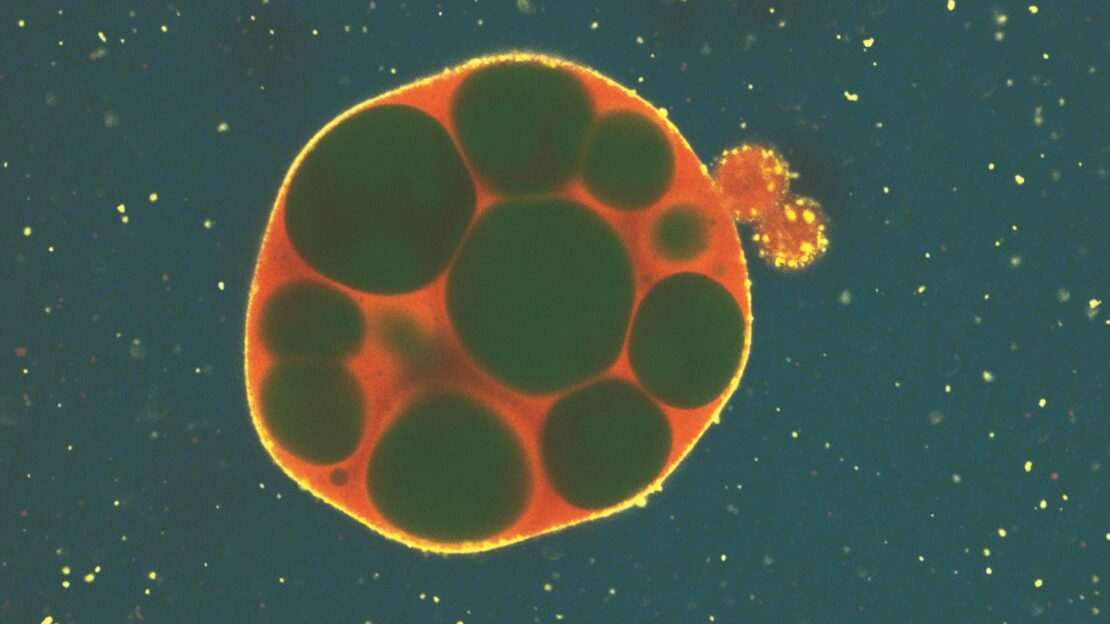
These RNA droplets can encapsulate the genetic template from which they are transcribed. “That establishes a basic prerequisite for a system that can evolve,” says William Verstraeten, a doctoral candidate in Prof. Göpfrich’s research group. The scientists were surprised to find that deliberately modifying the DNA template did not cause the droplets to dissolve, as expected. “Instead, they formed large cavities known as vacuoles, which remained stable for days or even weeks,” says Kerstin Göpfrich. According to her, a mutation rate of just around three percent was sufficient to produce these complex changes in the primitive synthetic cells.
The team led by Prof. Dr. Michael Platten at the German Cancer Research Center used a specialized sequencing technology to determine which mutations were responsible for the structural changes inside the droplets. This made it possible to create a “model mutant” and reliably reproduce the effect. “The vacuoles form when more and more new RNA enters the already viscous interior of the droplets during transcription. The rapid accumulation of mass can cause local instabilities, from which the cavities form,” explains Prof. Dr. Christoph Weber from the Institute of Physics at the University of Augsburg. The experiments conducted by the scientists confirmed that vacuole formation requires RNA droplets to have a radius of more than 20 micrometers and contain more than approximately two percent genetically modified material.
Further investigations showed that the cavities redistribute mass inside the droplets, producing tiny movements on the micrometer scale. According to the researchers, mutated RNA droplets traveled significantly farther than non-mutated ones and collided with one another more frequently; as a result, they fused and grew. The vacuoles also act as internal storage compartments: “They take up small molecules and can store this cargo inside them,” says Prof. Göpfrich.
“Mutagenesis therefore provides us with a new architecture and new functions that would be very difficult to design and build from scratch,” emphasizes the molecular biologist. As part of Heidelberg University’s SynthImmune Cluster of Excellence, the researchers aim to harness this process of mutation and selection to generate molecular functions from minimal synthetic components. “In future, we want to use this tool to develop synthetic immune effectors capable of evolving specific immune functions on their own.”
The research was conducted as part of the German Research Foundation-funded Collaborative Research Centre / Transregio 392 “Molecular Evolution in Prebiotic Environments”. The research groups led by Kerstin Göpfrich in Heidelberg and Christoph Weber in Augsburg are involved in the project. The work was also supported by the European Research Council, the International Human Frontier Science Program Organization, the Alfried Krupp von Bohlen und Halbach Foundation and the Carl-Zeiss-Stiftung. The findings have been published in the journal “Nature Chemical Engineering”.
Original publication
W. Verstraeten, M. P. Tran, A. Taskina, P. Jaiswal, I. S. Haugerud, C. Helbig, M. Hamberger, E. W. Green, M. Platten, C. A. Weber, and K. Göpfrich: Genetic encoding and mutagenesis of RNA droplet phenotypes. Nature Chemical Engineering (7 October 2026)