Tracing environmental change through river microbiomes in Luxembourg
New TREC pilot project explores how microbial life along rivers reflects environmental change and supports ecosystem health
The European Molecular Biology Laboratory (EMBL) and regional partners, including the Luxembourg Centre for Systems Biomedicine (LCSB) at the University of Luxembourg, have launched a pilot project in the Luxembourg area to investigate how microbial life within river ecosystems responds to human-driven environmental pressures. Researchers sampled water, soils, and a wastewater treatment plant along the Moselle to investigate microbial diversity, antimicrobial resistance, and chemical pollutants. The project, which is part of EMBL’s TRaversing European Coastlines (TREC) initiative, aims to detect environmental stress and to help set up long-term ecosystem monitoring, while strengthening cross-border collaboration.
The Rhine-Moselle ecosystem: a good model to study the impact of human activities
Human activities are placing increasing pressure on ecosystems, with consequences for both environmental and human health. The Rhine, one of the major rivers of Europe, and the Moselle, one of its biggest tributaries, form a complex ecosystem spanning France, Luxembourg, and Germany. Both rivers have been heavily engineered and serve as major transport routes, carrying the fingerprints of human activity across Europe. They pass through densely populated and industrial areas, as well as regions with intensive agriculture, constituting a perfect cross-border natural laboratory to assess human impact on water quality and the environment.
The current study focuses on riverine and terrestrial environments influenced by pollution and human-induced ecosystem changes, including climate change, aiming to better understand how microbiomes reflect and shape these impacts.
“Microorganisms are highly sensitive to environmental change and can act as early indicators of ecosystem health,” said Jan Korbel, Interim Head of EMBL Heidelberg. “Through TREC, we are building a coordinated framework to study these changes across Europe, and this project now assesses this approach in freshwater ecosystems. EMBL – with its extensive network of partners across its member states, including Luxembourg – is uniquely positioned to enable and coordinate such pan-European studies.”
Linking microbes and environmental change
As part of this project, researchers have collected samples from the two rivers, adjacent soils, and a wastewater treatment plant, as well as sites along the confluence of the Moselle and the Rhine. “In coordination with EMBL and the water agency in Luxembourg, we have selected relevant locations in Schengen and Grevenmacher,” explained Alissa Muller, postdoctoral researcher at the LCSB. “Now that we have samples from the different sites, we will contribute to their analyses, notably thanks to PathoFact, a bioinformatics tool developed by our team to identify pathogenic agents.”
Using metagenomics, environmental DNA, and detailed chemical and biogeochemical measurements, the teams will assess microbial diversity, antimicrobial resistance, and pollutants such as pharmaceuticals, heavy metals, PFAS, and pesticides. A focused study at a key wastewater treatment plant and the Moselle downstream will also investigate how antimicrobial resistance and chemical loads move from human infrastructure into the river.
By studying how microbial communities interact with their environment, the project aims to identify bioindicators that enable early detection of ecosystem stress and provide insights into ecosystem resilience. “This collaboration brings together local environmental expertise and advanced molecular analyses,” said Paul Wilmes, Professor of Systems Ecology at the University of Luxembourg and head of the Systems Ecology group at the LCSB. “It will generate actionable knowledge relevant to biodiversity, pollution, and human health, and support evidence-based environmental management.”
Marking the Luxembourg TREC stop and building a foundation for long-term monitoring
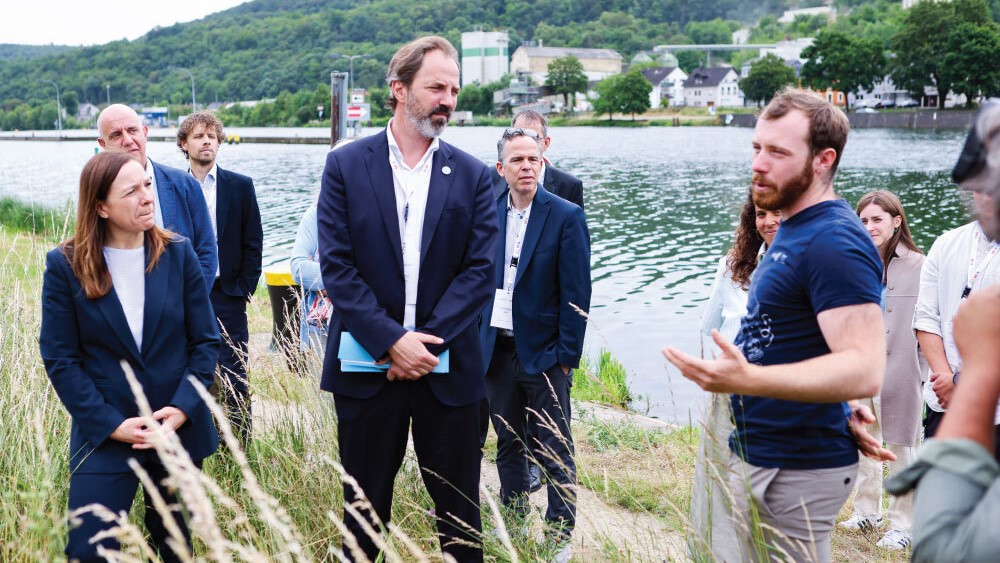
The end of the sampling campaign in Luxembourg was marked by an event on 8 June in Grevenmacher, bringing together scientists, policymakers, and regional stakeholders, including Luxembourg’s Minister for Research and Higher Education, Stéphanie Obertin who stated: “The TREC project perfectly illustrates the value of European scientific cooperation. By bringing together EMBL, the University of Luxembourg, and regional partners to study the Rhine-Moselle ecosystem, this initiative demonstrates that the major challenges of our time require interdisciplinary and cross-border approaches, built on the sharing of knowledge, expertise and data.”
Participants had the opportunity to visit a nearby sampling site to see a live demonstration of field activities and EMBL’s mobile laboratories, giving them a first-hand view of how environmental microbiome data are collected.
These data will contribute to improved detection of antimicrobial resistance and environmental pollution, providing a better understanding of the impact of human activities on this important but fragile ecosystem. In the longer term, the results from the TREC study will help establish a basis for systematic monitoring of ecosystems and their responses to climate change and other pressures.
By ensuring standardised data collection across sampling sites, EMBL and its collaborators enable robust comparisons and contribute to setting the foundation for future frameworks for studying ecosystem health across Europe. “With this multidisciplinary study of the Rhine and the Moselle, we hope to obtain an integrated picture to better guide cross-border decision making in relation to sustainability and health policy,” concluded Paul Wilmes.
- EMBL’s efforts to expand pioneering expedition-based research into freshwater ecosystems receive support from the Klaus Tschira Stiftung.
- The Luxembourg National Research Fund (FNR) supported the sampling campaign within the framework of an FNR INITIATE funded project: “Resilience of Neurological Health in Global Change: A One Health Approach – NEUROH-CHANGE”.