Brain Tumor Charity supports immunotherapy for childhood brain tumors with 1.5 million pounds sterling
Ependymomas, brain tumors that occur particularly in young children, are especially difficult to treat and more than half of the children affected have an increased risk of relapse. As part of an international consortium, the Hopp Children’s Cancer Center Heidelberg (KiTZ), the German Cancer Research Center (DKFZ), the Medical Faculty of Heidelberg University (MFHD) and Heidelberg University Hospital (UKHD) have received a grant of 1.5 million pounds sterling (GBP) from the British organization The Brain Tumor Charity to develop a new type of immunotherapy for ependymoma.
The Hopp Children’s Cancer Center Heidelberg (KiTZ) is a joint institution of the German Cancer Research Center (DKFZ), Heidelberg University Hospital (UKHD) and the University of Heidelberg (Uni HD).
Ependymomas are among the most common types of brain tumors, especially in children. They have a high risk of recurrence because they often become resistant to chemotherapy and other standard therapies during the course of treatment. New treatment methods are therefore urgently needed, also to improve the quality of life of those affected.
An international team of researchers has now been awarded the coveted Brain Tumor Charity UK grant of around £1.5 million for the development of an effective immunotherapy against ependymomas. The scientists from the Hopp Children’s Cancer Center Heidelberg (KITZ), the German Cancer Research Center (DKFZ), the Medical Faculty of Heidelberg University and Heidelberg University Hospital (UKHD), as well as the Great Ormond Street Institute of Child Health in London and the Princess Máxima Center in Utrecht want to develop cellular immunotherapy with so-called CAR-T cells for solid childhood tumors by specifically reprogramming the tumor environment.
CAR-T cell therapy is already achieving very good treatment results in children and adolescents with certain forms of blood cancer. In the case of childhood brain tumors, however, treatment with immunotherapies has often been less effective. This is also due to the cellular characteristics of childhood tumors, says Kristian Pajtler, coordinator and scientist of the funded project: “In contrast to many tumor types in adults, there are very few immune cells in most childhood tumors and their cellular environment that are important for an immune response against the tumor. The tumor prevents certain immune cells from migrating and even recruits cells that suppress an immune response,” he explains.
In the funded project, the researchers want to combat ependymomas with a targeted double strike: “In the first step, certain messenger substances trigger an inflammatory reaction specifically in the tumor,” explains Christian Seitz, who is also the coordinator and scientist of the funded project. “This ‘reprogramming’ of the cellular tumor environment makes the tumor more accessible for the second step, the treatment with CAR-T cells, which have been genetically modified to specifically recognize and fight tumor cells.” The team’s approach has already been very successful in animal models. A clinical trial is already being planned.
Kristian Pajtler emphasizes: “The funding from the Brain Tumor Charity now enables us to analyze individual tumor cells as well as the cells of the tumor environment comprehensively and in detail. In addition, we can develop methods for manipulating the tumor environment in ependymomas and optimize CAR-T cell therapy specifically for ependymomas. This opens up the opportunity to develop a completely new treatment strategy specifically for this cancer and hopefully other solid tumors in children and adolescents in the future.”
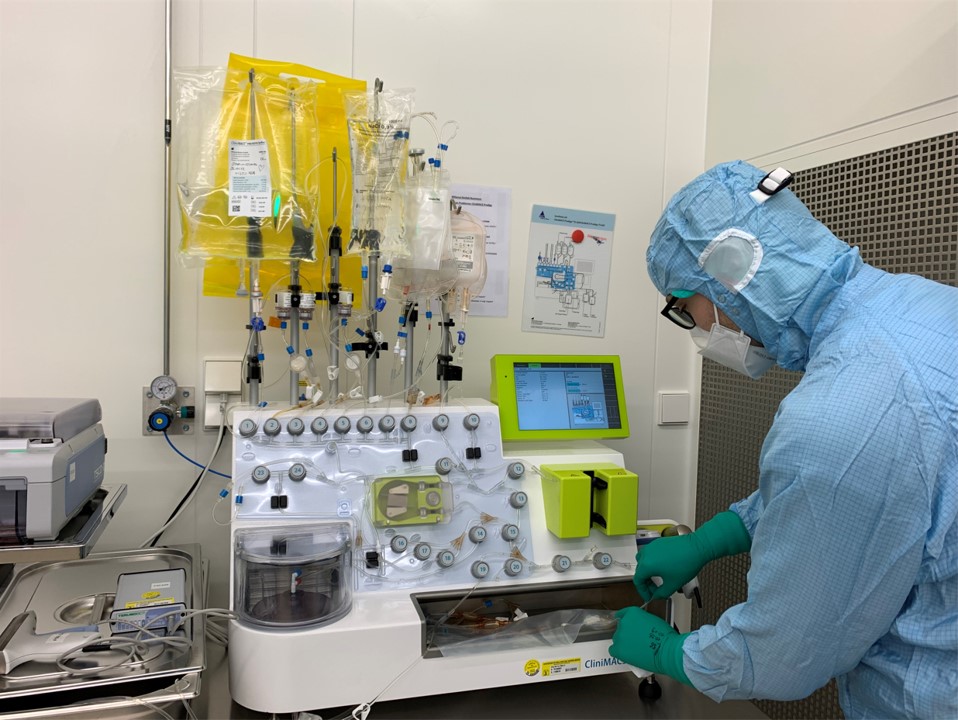
An Image for this press release is available for download at:
https://www.kitz-heidelberg.de/fileadmin/media/KiTZ-HD/News/2025/251021_Reinraum_c_MichaelSchmitt_UKHD.jpg
Caption:
In the “clean room”, the patients’ immune cells are filtered from their blood using special equipment and genetically modified so that they recognize and fight the cancer cells.
Note on use of images related to press releases
Use is free of charge. The German Cancer Research Center (Deutsches Krebsforschungszentrum, DKFZ) permits one-time use in the context of reporting about the topic covered in the press release. Images have to be cited as follows: “Source: Michael Schmitt/KiTZ”.
Distribution of images to third parties is not permitted unless prior consent has been obtained from DKFZ’s Press Office (phone: ++49-(0)6221 42 2854, E-mail: presse(at)dkfz.de). Any commercial use is prohibited.