Breakthrough Prize for former MPI scientist
Physicist Ulrich Haeberlen contributed to the award-winning “Myon g-2” project through his research.
July 16, 2026
An international research group has been awarded the “Breakthrough Prize for Fundamental Physics” for its decades of work on the “Myon g-2” particle physics experiment. Among the 387 laureates is a former researcher at the Max Planck Institute for Medical Research, physicist Ulrich Haeberlen.
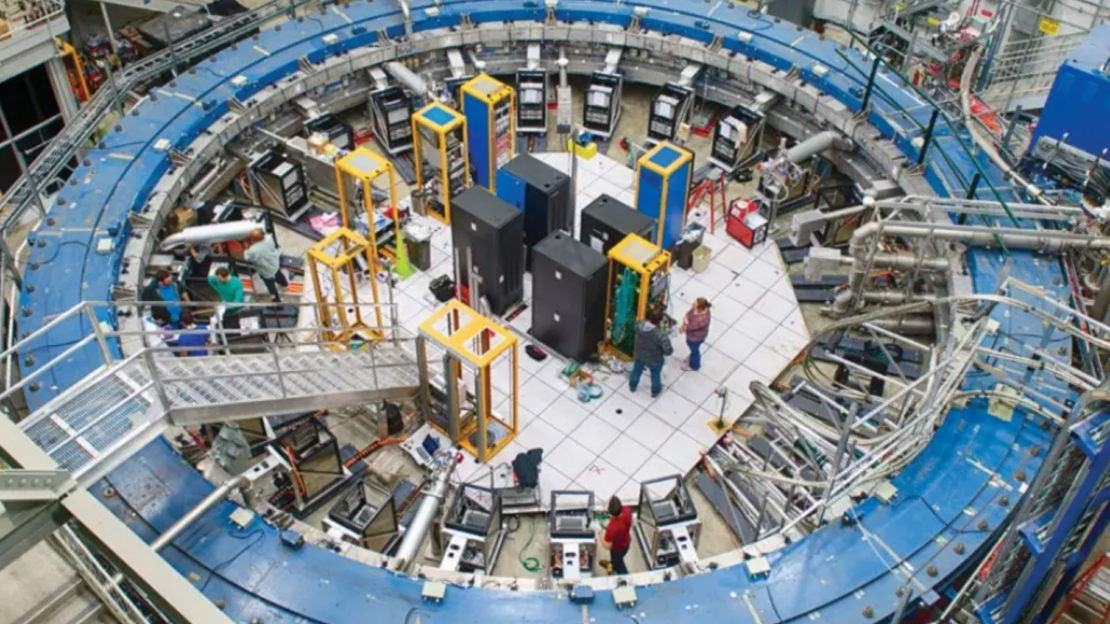
© Fermi National Accelerator Laboratory
- With this year’s Breakthrough Prize for Fundamental Physics, the jury honored researchers who measured the anomalous magnetic moment of the elementary particle, the muon, with exceptional precision.
- Ulrich Haeberlen conducted research in the 1970s and 1980s at the Max Planck Institute for Medical Research in the field of nuclear magnetic resonance spectroscopy.
- The physicist is one of more than 300 living co-authors whose measurement campaigns contributed to the award-winning project.
Decades of research
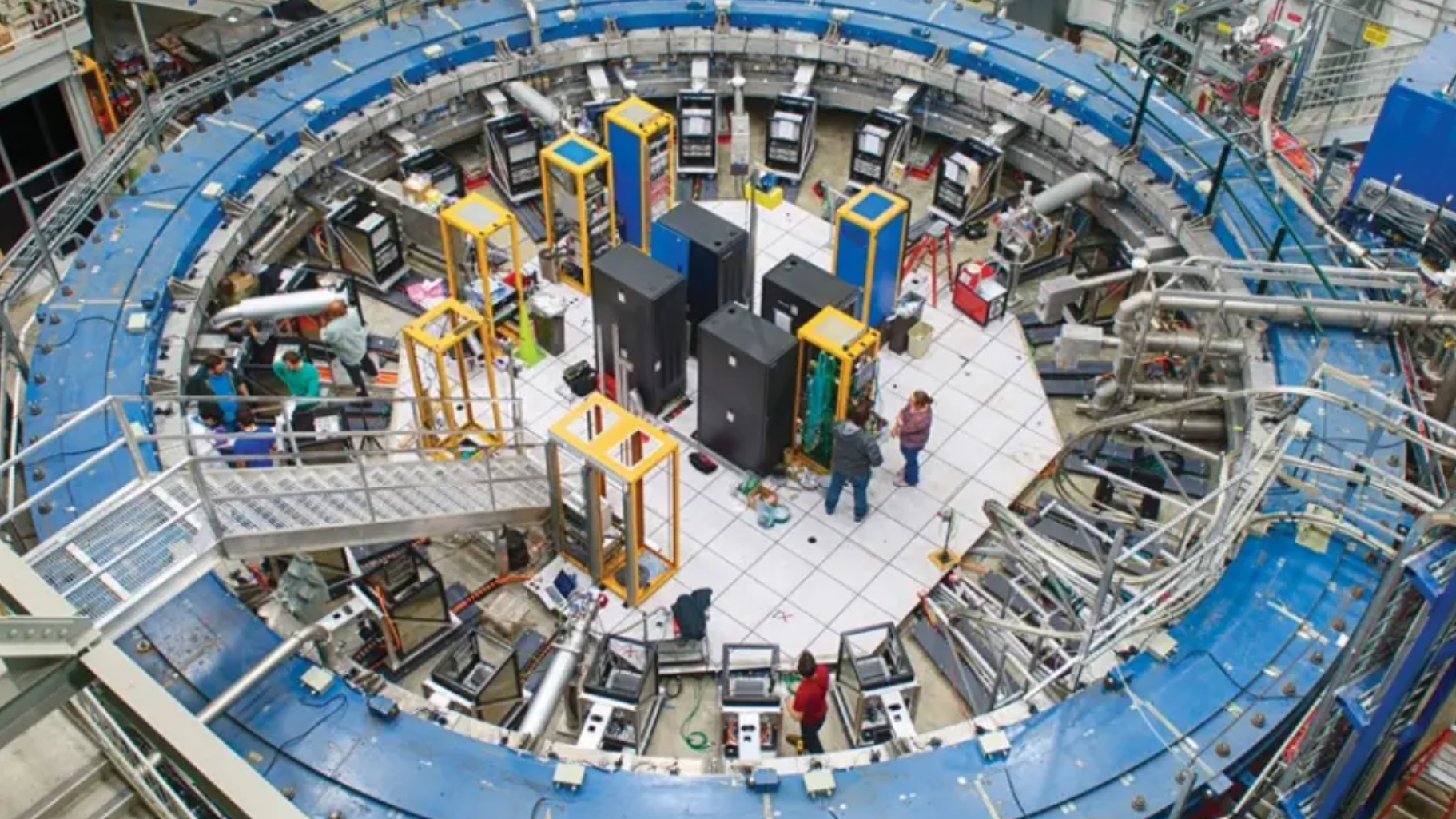
The “Muon g-2” particle physics experiment is a collaborative project involving research groups from the Fermi National Accelerator Laboratory (Fermilab) in the U.S., the CERN research center (Switzerland/France), and the Brookhaven National Laboratory (U.S.). The main component of the experiment was a giant superconducting magnetic ring. In this magnetic ring, muons – unstable elementary particles similar to electrons – were accelerated to nearly the speed of light and their subtle “wobbles” in the magnetic field were measured.
The final results, published in 2025, confirmed earlier anomalies that could be an important indication of new physical laws beyond the Standard Model. In doing so, the researchers demonstrated years of perseverance in their search for answers to fundamental questions in physics. Their experiments were recognized for their extraordinary precision.
A leading figure in the experiments
During his time at the Max Planck Institute for Medical Research (MPIMR), Heidelberg physicist Ulrich Haeberlen played a leading role in three of the four major experiments of the award-winning “Myon g-2” project by reporting his measurement results and publications to Brookhaven National Laboratory in the United States.
In 1969, Ulrich Haeberlen joined the Department of Molecular Physics at the MPIMR as a research associate. There, he conducted independent basic research in the field of nuclear magnetic resonance spectroscopy. In 1975, he earned his habilitation with a thesis on high-resolution nuclear magnetic resonance in solids. From 1987 until his retirement in 1999, Ulrich Haeberlen headed the Molecular Crystals Research Group.
The “Oscar” of science prizes
With a prize fund of three million dollars, the Breakthrough Prize is considered one of the world’s most lucrative research awards in the natural sciences and is known as the “Oscar” of science. In addition to fundamental physics, it is awarded in the categories of life sciences (biological sciences and medicine) and mathematics to individuals who have made profound contributions to human knowledge.
The award ceremony took place in April 2026 in California in the presence of many celebrities from the film industry, elite sports, and the tech industry.