June 13, 2025

Clonal hematopoiesis landscape in frequent blood donors

Clonal hematopoiesis landscape in frequent blood donors

Key Points

  • CH analysis of a unique and uniform cohort of exclusively healthy individuals exposed to a novel type of selection pressure was conducted.
  • Novel EPO-responsive DNMT3A mutations with distinct in vivo and in vitro growth behavior were identified.

Abstract

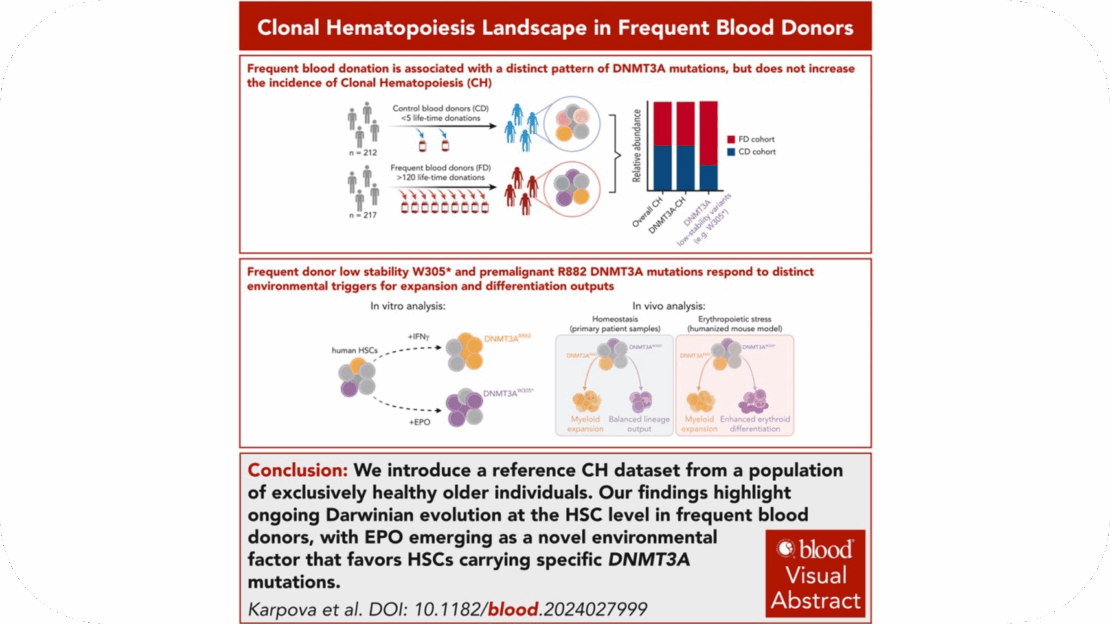
Donor blood saves lives, yet the potential impact of recurrent large-volume phlebotomy on donor health and hematopoietic stem cells (HSCs) remains largely unexplored. In our study, we conducted a comprehensive screening of 217 older male volunteer donors with a history of extensive blood donation (>100 lifetime donations) to investigate the phenomenon of clonal hematopoiesis (CH). No significant difference in the overall incidence of CH was found in frequent donors (FDs) compared with sporadic donors (<10 lifetime donations; 212 donors). However, upon deeper analysis of mutations in DNMT3A, the most commonly affected gene in CH, we observed distinct mutational patterns between the FD and age/sex-matched control donor cohorts. Functional analysis of FD-enriched DNMT3A variants examined in CRISPR-edited human HSCs demonstrated their competitive outgrowth potential upon stimulation with erythropoietin (EPO), a hormone that increases in response to blood loss. In contrast, clones harboring leukemogenic DNMT3A R882 mutations increase upon stimulation with interferon gamma. Through concurrent mutational and immunophenotypic profiling of primary samples at single-cell resolution, a myeloid bias of premalignant R882 mutant HSCs was found, whereas no significant lineage bias was observed in HSCs harboring EPO-responsive DNMT3A variants. The latter exhibited preferential erythroid differentiation when persistent erythropoietic stress was applied to CRISPR-edited human HSC xenografts. Our data demonstrate a nuanced, ongoing Darwinian evolution at the somatic stem cell level, with EPO identified as a novel environmental factor that favors HSCs carrying certain DNMT3A mutations.
Karpova D, Huerga Encabo H, Donato E, Calderazzo S, Scherer M, Llorian-Sopena M, Leppä AM, Würth R, Stelmach P, Papazoglou D, Ferrelli A, Ngo S, Kotova I, Harenkamp S, Zimmer K, Wolf D, Panten J, Reed J, Przybylla A, Tonn T, Kopp-Schneider A, Velten L, DiPersio JF, Wong TN, Bonnet D, Bonig H, Trumpp A.

Subjects: 
Hematopoiesis and Stem CellsPlenary PapersTransfusion Medicine

Our latest News

discover more
European Biotech Act: bioRN brings Industry and Policymakers together

European Biotech Act: bioRN brings Industry and Policymakers together

How can Europe strengthen its global competitiveness in biotechnology? Heidelberg, July 7th: This question was at the heart of a high-level roundtable hosted by the bioRN Life Science Cluster with Member of the European Parliament Hildegard Bentele. Representatives from Ascendis Pharma, BD, PROGEN, Novaliq, BASF Agricultural Solutions, PEPperPRINT, Evotec and Isenbruck Bösl Hörschler joined the […]

AbbVie Announces TEPKINLY® (epcoritamab) in Combination with Lenalidomide and Rituximab is Approved by the European Commission for the Treatment of Relapsed or Refractory Follicular Lymphoma

AbbVie Announces TEPKINLY® (epcoritamab) in Combination with Lenalidomide and Rituximab is Approved by the European Commission for the Treatment of Relapsed or Refractory Follicular Lymphoma

NORTH CHICAGO, Ill., July 6, 2026 /PRNewswire/ — AbbVie (NYSE: ABBV) today announced that the European Commission (EC) granted marketing authorization for TEPKINLY® (epcoritamab) in combination with lenalidomide and rituximab (TEPKINLY + R2) for the treatment of adult patients with relapsed or refractory (R/R) follicular lymphoma (FL). The approval is based on results from the pivotal Phase 3 […]

Optimized Formula: New Bio-Ink Can Depict the Cell Environment Even More Accurately

Optimized Formula: New Bio-Ink Can Depict the Cell Environment Even More Accurately

It should be biofunctional – that is, it should replicate the natural cellular environment as closely as possible – and it should be printable: bioink. Achieving both of these properties at the same time is an enormous challenge that conventional biomaterials often fail to meet. Together with two partner companies, researchers at the NMI have now taken an important […]

GET IN TOUCH

Stay Updated with bioRN’s Newsletter

Sign up for our newsletter to discover more!
* required

BioRN (BioRN Network e.V. and BioRN Cluster Management GmbH) will use the information you provide on this form to be in touch with you and to provide updates and marketing. Please let us know all the ways you would like to hear from us:

You can update your subscription preferences or unsubscribe at any time. Just follow the unsubscribe or update link in the footer of automated emails you receive from us, or by contacting us at info@biorn.org. We will treat your information with respect. For more information about our privacy practices please visit our website: www.biorn.org. By clicking below, you agree that we may process your information in accordance with these terms.

We use Mailchimp as our marketing platform. By clicking below to subscribe, you acknowledge that your information will be transferred to Mailchimp for processing. Learn more about Mailchimp's privacy practices.

Intuit Mailchimp