Coaching for Robots: Jens Kober brings people and machines together
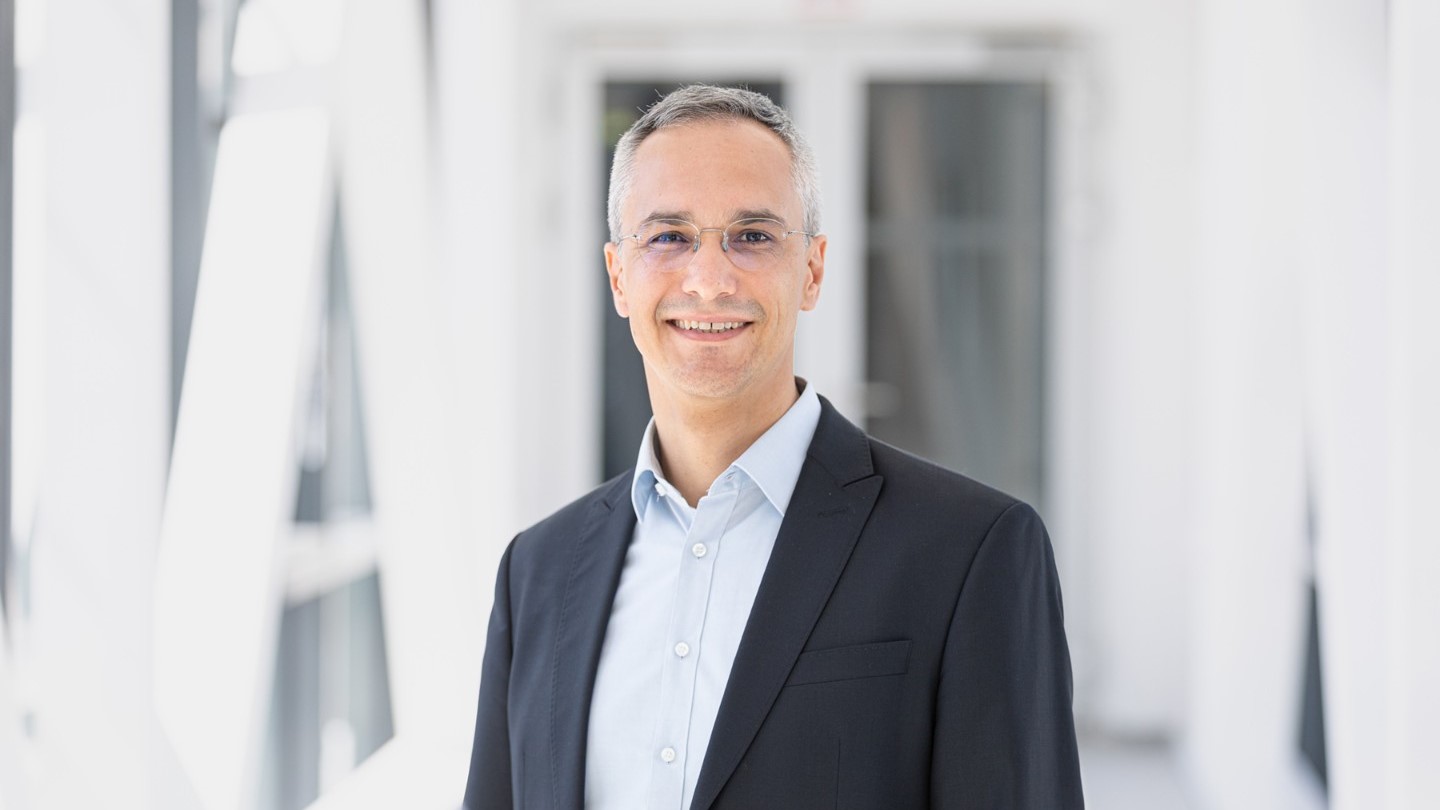
Robots that can learn and adapt require not only data, AI tools, and algorithms but also direct communication with their users. Jens Kober would like to improve this interaction and as the new head of a research team at Fraunhofer IPA, he is focusing in particular on construction robotics.
Professor Jens Kober
Whether helping out around the house, bringing meals to patients, assisting with surgeries, harvesting tomatoes in the greenhouse, lending a hand on a construction site, or stocking shelves at the supermarket. “Cognitive robots need to be capable of more than just performing the same task 24 hours a day on the factory floor. They must be aware of their surroundings, react to changing conditions, act independently when needed, adapt to new situations, and work alongside their human counterparts to perform a range of tasks,” explains Jens Kober. He is the new head of a research team at Fraunhofer Institute for Manufacturing Engineering and Automation IPA and heads the new Department of Learning and Interactive Robots at the Institute for Artificial Intelligence at the University of Stuttgart.
Humans are training robots
Cognitive robots are systems based on the complex interaction of various components ranging from sensor technology and speech recognition to control systems and human-machine interaction. In this wide-ranging field, Kober researches and develops AI-based methods, tools, and algorithms that make it possible to further train cognitive robots in their respective areas of application beyond basic programming.
Whether via a keyboard, touchscreen, or even physical contact, he gathers the data needed for this task directly from interactions between people and robots. “We directly involve people in the learning process,” says Kober. “They guide the robot in much the same way that coaches guide athletes or teachers guide students. This is extremely important for efficiently getting cognitive systems up and running.”
User-friendly programming
The challenge here is not merely to store new information and retrieve it immediately but rather to generalize it and apply it to similar situations. After all, every household, every product in the supermarket, every patient, and every small production run in industrial manufacturing is different. “The various applications all have one thing in common,” says Kober. “There are countless possible variations of each task.”
He considers it unrealistic to program robots in advance for every possible scenario in their intended operating environments. That is precisely why he wants to enable the future users and ‘colleagues’ of these intelligent machines to teach and train their robots themselves. “Because they understand the task and its requirements better than anyone else.”
Applied Research in the Stuttgart Innovation Ecosystem
At Fraunhofer IPA, Kober, who spends his free time designing origami models and enjoys singing in a classical choir, hopes to take his research in cognitive robotics to the next level. So far, he has focused primarily on developing and optimizing algorithms. He now intends to place a stronger emphasis on human–machine interaction. “What truly motivates me is taking the next step—bringing research out of the laboratory and into real-world applications.”
With its strong university and non-university AI and robotics research institutions as well as an industrial sector willing to invest in robotics, AI, and machine learning, the Stuttgart region offers an ideal environment for pursuing this goal. “Here, I can cover the entire spectrum—from basic research to practical applications.”
About the person
Jens Kober has been a full professor of the Foundations of Cognitive Robotics at the Institute for Artificial Intelligence at the University of Stuttgart and a research group leader at the Fraunhofer IPA since March 2026.
The 44-year-old had previously served as an associate professor and assistant professor at Delft University of Technology in the Netherlands. Other stops in his academic career included Bielefeld University, the Honda Research Institute Germany, the Max Planck Institute for Intelligent Systems (MPI-IS), and the Technical University of Darmstadt.
Kober is the recipient of the “Robotics Science and Systems Early Career Award 2022” and the “IEEE-RAS Early Academic Career Award in Robotics and Automation 2018.” In 2013, his doctoral thesis received the Georges Giralt PhD Award as the best robotics PhD thesis completed in Europe in 2012. He is a fellow of the European Laboratory for Learning and Intelligent Systems (ELLIS), secretary of the Robot Learning Foundation, and serves in various capacities for the Institute of Electrical and Electronics Engineers (IEEE).