Dr. Felix Kommoss awarded the 2026 Rudolf Virchow Prize
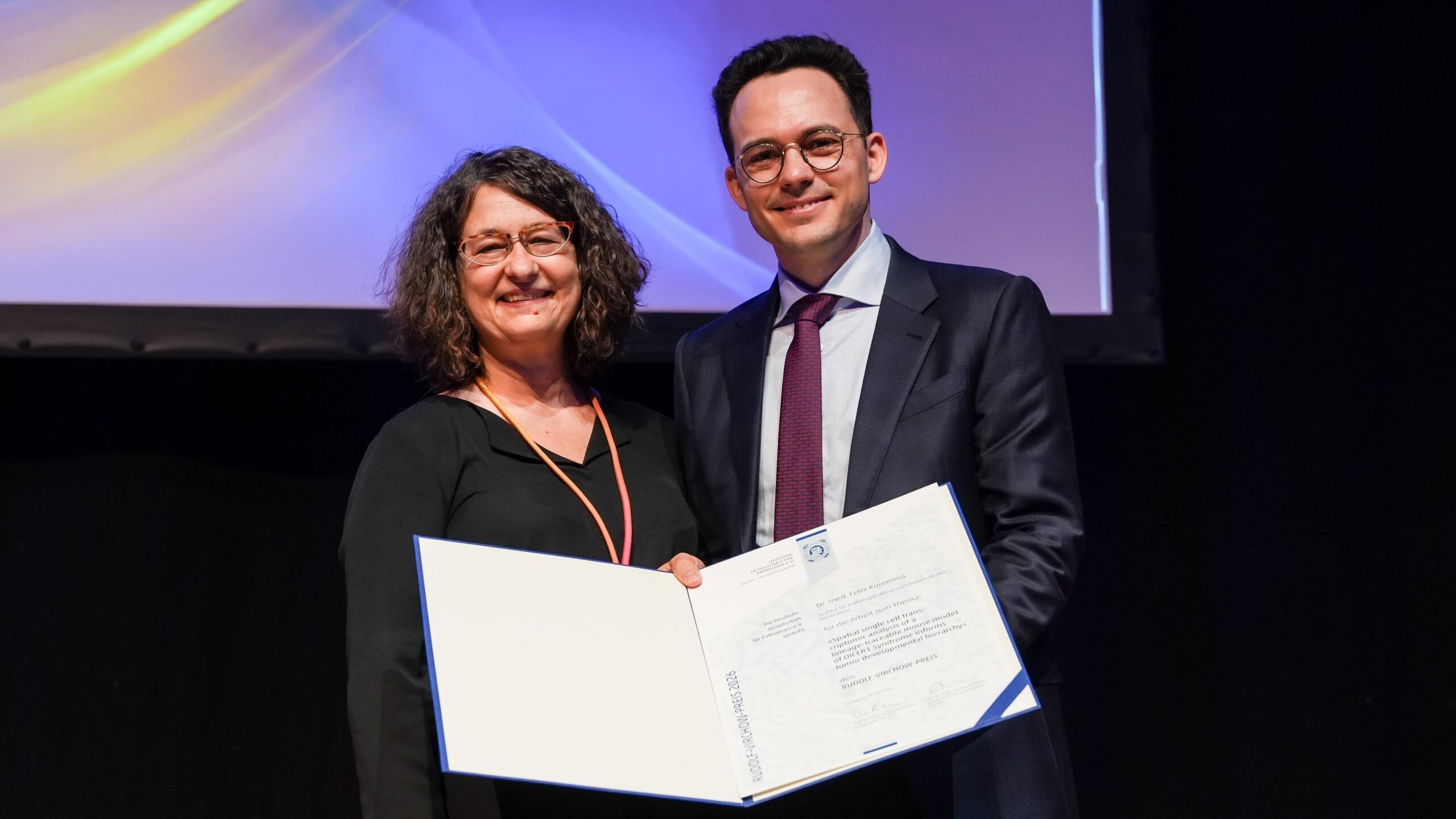
For his research on the development of rare malignant tumors in the hereditary DICER1 tumor predisposition syndrome, Dr. Felix Kommoss has been awarded the Rudolf Virchow Prize of the German Society of Pathology (Deutsche Gesellschaft für Pathologie, DGP) – the most prestigious research award in the field of pathology in Germany. Dr. Kommoss conducts research at the Heidelberg Faculty of Medicine at Heidelberg University and serves as Senior Physician and Head of Gynecologic Pathology at the Institute of Pathology, Heidelberg University Hospital.
DICER1 tumor predisposition syndrome is a rare hereditary condition that increases the risk of developing a range of tumors. It is caused by alterations in the DICER1 gene, which plays a key role in normal cell growth and cell division in the human body. Affected individuals often develop tumors in childhood or early adulthood, some of which follow an aggressive clinical course. Working with an international research team, Dr. Felix Kommoss identified a population of connective tissue precursor cells as a potential origin of DICER1-associated tumors and traced how different tumor cell types emerge from these cells. “Our findings contribute to a better understanding of the development of these previously understudied tumors and may, in the long term, provide a foundation for new diagnostic and therapeutic approaches,” says Dr. Felix Kommoss.
In the award-winning study, the researchers used a mouse model to determine which cells give rise to these tumors, where these cells are located within the tissue, and how they change over the course of tumor development. The results, published in the journal Nature Communications, show that distinct tumor cell types arise from specific connective tissue precursor cells, including muscle-like cells as well as particularly rapidly proliferating tumor cells that are associated with a more aggressive disease. Comparable cell populations and developmental trajectories were also identified in human tumor samples.
The study, supported by the German Research Foundation (DFG), builds on work conducted by Dr. Felix Kommoss during his postdoctoral research in the laboratory of Professor David Huntsman at the University of British Columbia, Canada, and at BC Cancer, a Canadian organization for cancer care and research based in Vancouver. The Rudolf Virchow Prize, endowed with €5,000, is awarded annually by the German Society of Pathology (DGP) to researchers under the age of 40 for a scientific publication that has recently been published or not yet published at the time of submission.
Original publication
Kommoss FKF, Zhang JYH, Lynch BJ et al. Spatial single cell transcriptomic analysis informs tumor developmental hierarchy of DICER1 syndrome related sarcoma. Nat Commun 17, 4608 (2026). https://doi.org/10.1038/s41467-026-70971-6
Further information is available online
Review of the award ceremony on the DGP website (in German)
Information about the Rudolf Virchow Prize (in German)
Website of the Institute of Pathology at UKHD (in German)
Contact
Dr. Felix Kommoss
Heidelberg Faculty of Medicine at Heidelberg University
Head of Gynecologic Pathology
Institute of Pathology, Heidelberg University Hospital
+49 6221 56-32516
felix.kommoss@med.uni-heidelberg.de