Faster and brighter protein labeling with new tool SNAP-tag2

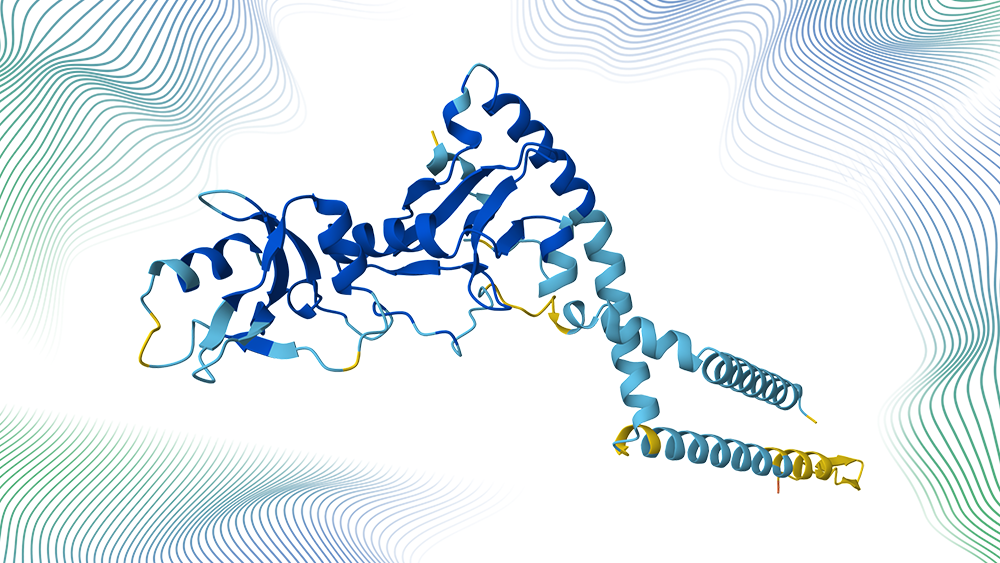
The protein SNAP-tag is a powerful tool for labeling proteins with synthetic fluorophores for bioimaging. Scientists at the Max Planck Institute for Medical Research in Heidelberg have engineered a much improved version named SNAP-tag2 as well as optimized substrates for faster labeling in live cells.
The protein SNAP-tag is a powerful tool for labeling proteins with synthetic fluorophores for bioimaging. Scientists at the Max Planck Institute for Medical Research in Heidelberg have engineered a much improved version named SNAP-tag2 as well as optimized substrates for faster labeling in live cells.
- SNAP-tag2 has fast reaction kinetics with an improved set of substrates and shows more efficient fluorescence labeling in living cells.
- The new SNAP-tag2 labeling system works effectively in a broad range of bioimaging applications and opens up new possibilities for multi-color imaging.
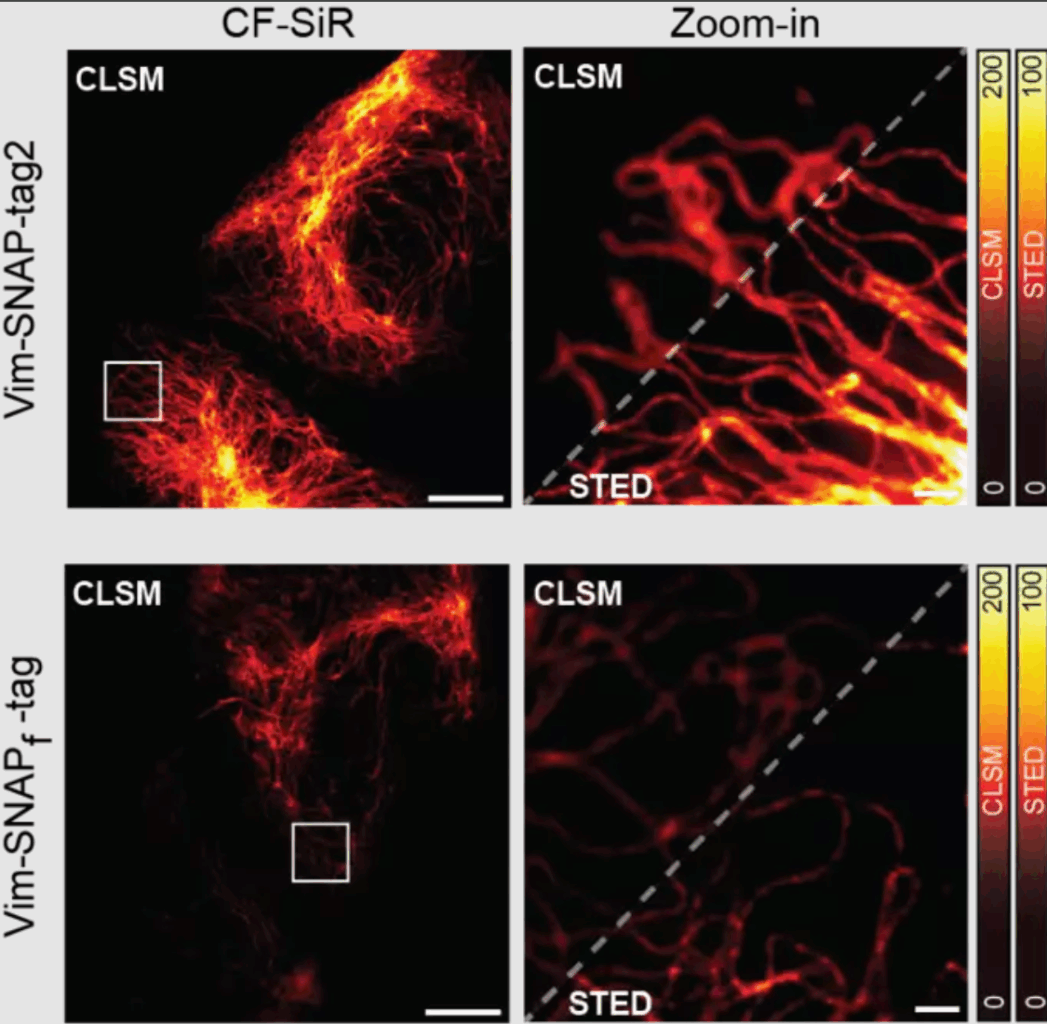
- It is compatible with super-resolution imaging techniques like STED microscopy. The journal Nature Chemical Biology has now published the corresponding study.
© MPI for Medical Research
A highly engineered SNAP-tag mutant
Self-labeling protein tags such as SNAP-tag offer the opportunity to attach bright and photostable synthetic fluorophores to proteins of interest for later analysis, and are widely used in biochemistry.
“SNAP-tag was originally developed from a human DNA-repair enzyme. Further engineering of an already heavily modified protein was one of the biggest challenges”, says Stefanie Kühn, who led the project team consisting of further scientists at the Max Planck Institute (MPI) for Medical Research including Julien Hiblot, Veselin Nasufovic and director Kai Johnsson and a team from the University of Groningen. “Furthermore, we wanted to find a substrate core that works well in cells with various fluorophores attached. We decided to use a combination of substrate optimization and protein engineering to develop SNAP-tag2.”
© MPI for Medical Research
Increased reactivity
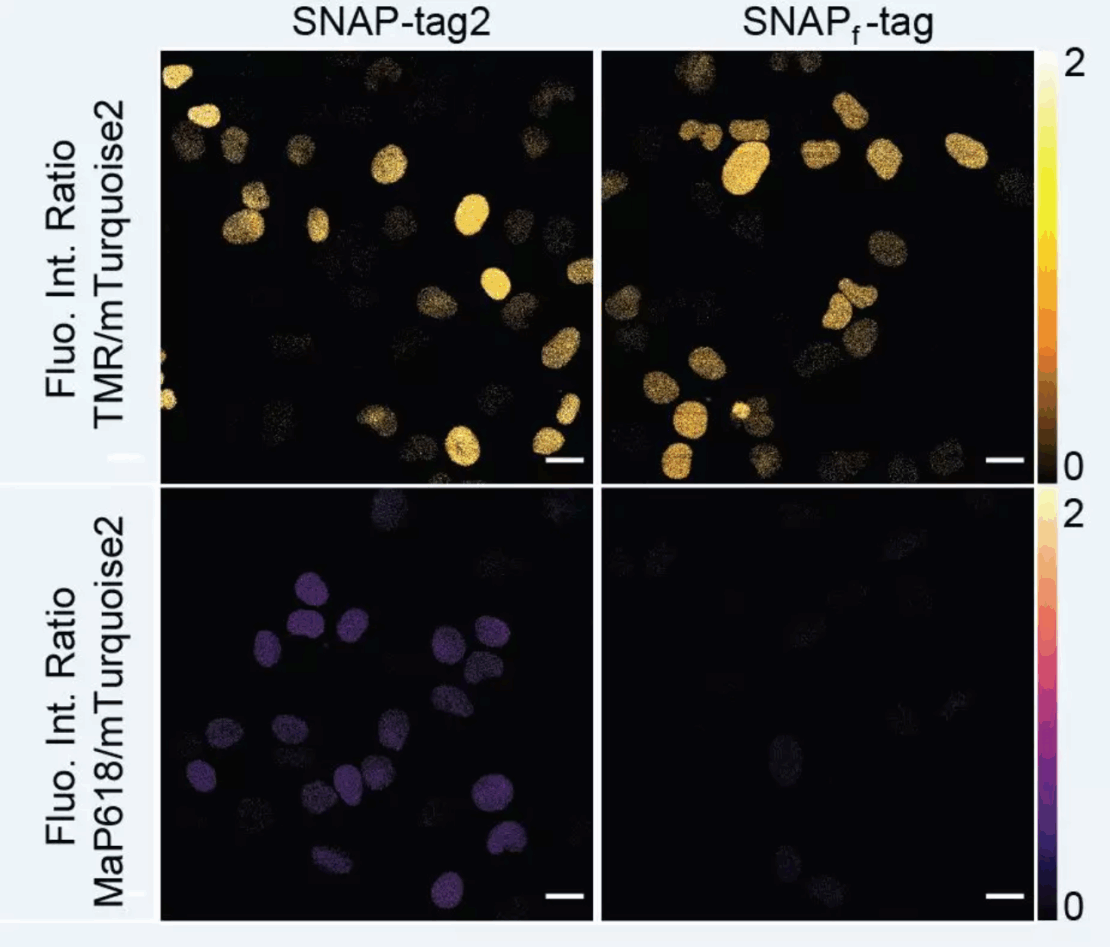
The utility of the so far widely used SNAP-tag in live-cell applications can be restricted by its relatively slow labeling kinetics and the limited cell permeability of its substrates. The scientists at the MPI for Medical Research wanted to find a solution for this. SNAP-tag2 reacts fast with the new cell-permeable substrates: It shows a labeling rate constant that corresponds to a 100-fold improvement over comparable SNAP-tag-substrate pairs.
More efficient fluorescence labeling in live cells
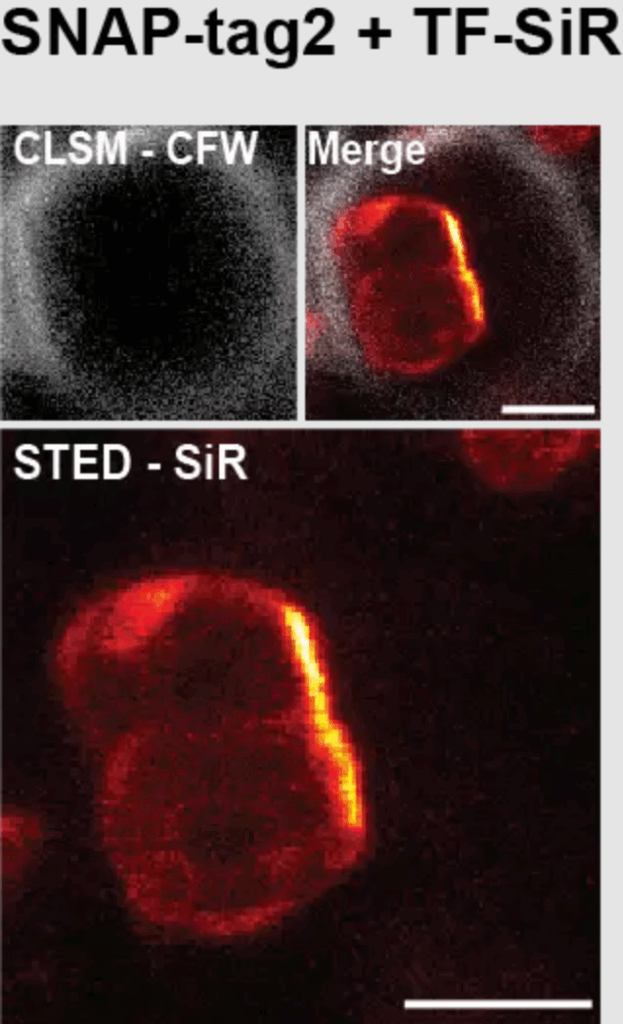
© MPI for Medical Research
SNAP-tag2 offers further advantages. When labeled with highly fluorogenic dyes, it also shows a 5-fold increase in fluorescence brightness relative to the currently used SNAP-tag. The faster labeling kinetics and brightness of SNAP-tag2 translates into a greatly improved performance in mammalian cells and in yeast. It also allows the use of super-resolution microscopy imaging techniques such as STED microscopy and working with other cell types known to be refractory to chemical labeling such as yeast cells.
“SNAP-tag2 together with its improved substrates is superior to the previously used SNAP-tag versions in every application we have tested, and we hope that it will also excel in in vivo applications”, says Stefanie Kühn.
Further areas of application possible
In summary, the team expects that the improvements introduced to SNAP-tag2 will advance the utility of this already widely adopted tool for live-cell imaging and other applications in life sciences. In addition, SNAP-tag2 opens up new possibilities for multi-color imaging applications.