GenScript Joins Lilly TuneLab to Advance AI-Enabled Drug Discovery
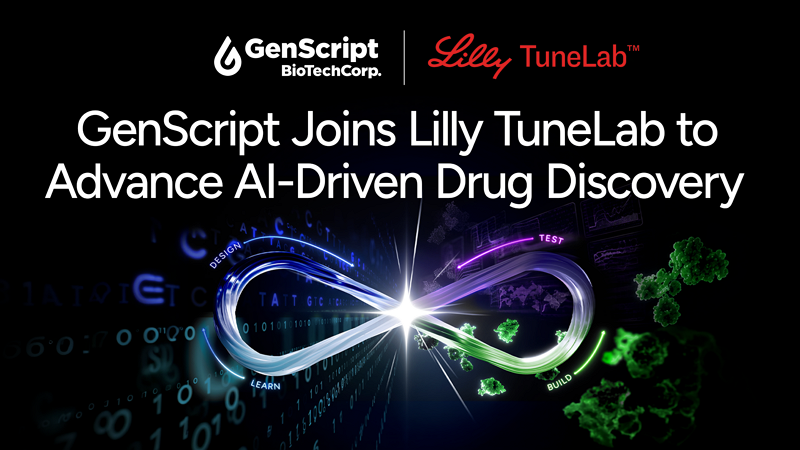
GenScript to offer wet lab data generation services to biotech companies using the TuneLab drug discovery platform
GenScript Biotech Corporation today announced an agreement with Lilly TuneLab™, a collaborative AI/ML drug discovery platform created by Eli Lilly and Company (Lilly). Through the agreement, GenScript will offer preferred-rate wet lab services to TuneLab member companies, helping them rapidly generate experimental data and translate AI-generated predictions into biological evidence.
Lilly TuneLab provides participating biotech companies access to AI/ML models trained on decades of Lilly’s research data, including models that predict antibody developability properties and small molecule ADMET properties. Hosted by a third party and using federated learning, the platform allows biotechs to contribute experimental results back to improve the models. GenScript can then help companies turn AI-enabled predictions into wet lab data by expressing, purifying, and characterizing prioritized sequences under standardized, fully documented protocols, helping to accelerate candidate evaluation.
“AI-enabled drug discovery will advance only as fast as the industry can generate reliable biological evidence,” said Ray Chen, President of GenScript Life Science Group. “The industry’s next leap requires connecting AI prediction, wet-lab production, and testing at a scale that fragmented solutions simply cannot match. By helping researchers rapidly transform promising sequences into actionable experimental data, we can help close one of the critical gaps between AI insight and therapeutic discovery.”
Lilly TuneLab is part of Lilly Catalyze360, alongside Lilly Ventures, Lilly Gateway Labs, and Lilly ExploR&D, which together support biotech innovation by providing access to strategic capital, lab space and technology, and research and development capabilities.
Backed by more than two decades of drug discovery and biologics experience, GenScript is building the scale and infrastructure needed to make laboratory testing a practical extension of AI-enabled discovery. Its end-to-end sequence-to-data capabilities help researchers identify promising candidates earlier, allocate resources more effectively and, ultimately, move stronger therapeutic programs toward patients.