Hardware for humanoid robots: New perspectives for industrial value creation in Europe
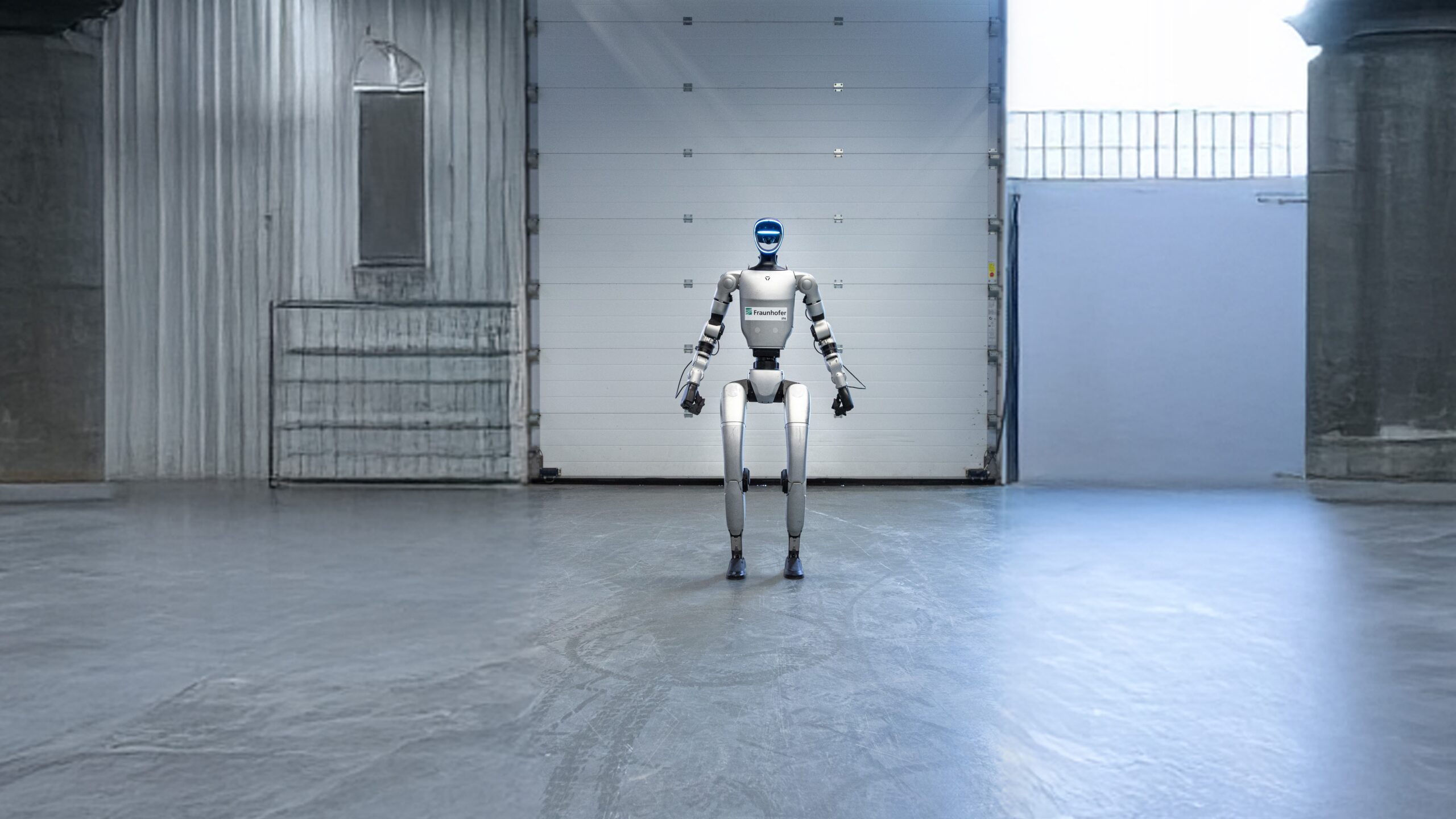
Together with the management consultancy P3, Fraunhofer IPA has investigated how component manufacturers could benefit from producing hardware components for humanoid robots. The results are available free of charge in the white paper “The Humanoid Hardware Value Chain: Can the European Manufacturing Industry Capitalize on the Humanoid Momentum?”
Source: Fraunhofer IPA/Picture: Rainer Bez.
Humanoid robots are currently developing at a rapid pace. The predicted growth potential is enormous. They are set to replace and even surpass the automotive industry in terms of market potential. And in the media and at trade fairs, they are the prime example of “embodied AI,” i.e., the complete integration of artificial intelligence (AI) processes with machine components or entire systems. The focus is particularly on the markets in the US and Asia, where a great deal of progress is being made in terms of software and hardware.
But there is also a lot of activity in Europe. In addition, the manufacturing industry in this region is facing structural changes. This raises the question: How can local industry benefit from this booming technology and potentially tap into new markets? A team of authors from the Fraunhofer Institute for Manufacturing Engineering and Automation IPA and the management consultancy P3 has investigated this question. In a recently published white paper, they examined the role played by the hardware of these robots and why manufacturing companies in Europe should take a keen interest in this.
Renaissance of hardware: key role in the market
Despite advances in AI, hardware components largely determine the cost-effectiveness, reliability, and scalability of humanoid robots. However, there is currently a lack of standardized hardware architecture. In addition, important components for this type of robot, such as actuators, gears, batteries, and sensors, only partially meet industrial requirements in terms of robustness, service life, and cost structure.
These market gaps, combined with the very good market forecasts mentioned at the outset, represent a great opportunity. Early entry into the underlying value chain is therefore relevant for companies that have long had extensive expertise in the context of automation, mechatronics, and industrial manufacturing.
To assess the market potential more accurately, the team of authors analyzed the value chain of humanoid robot hardware for sensors, actuators, structure, and energy, and created a bottom-up cost model. The cost model was applied to three scenarios and enables a structured comparison of low-cost, mid-range, and high-end humanoid configurations. It also illustrates how different hardware decisions affect overall system costs. The analysis highlights hardware components that dominate total expenditure and pose the greatest challenges for cost-effective scaling, especially for humanoid systems intended for continuous industrial operation. Flexible hands are currently still the biggest bottleneck.
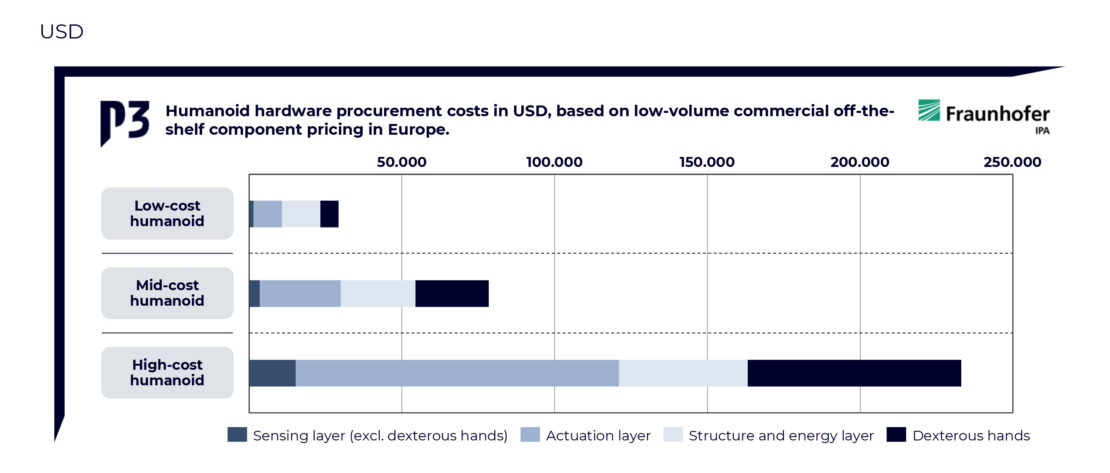
Source: Fraunhofer IPA/P3.
Fraunhofer IPA contributes extensive market and technology knowledge.
Vincent Bezold, business segment manager at Fraunhofer IPA and co-author of the white paper, summarizes the recommendations for action as follows: “In order to tap into this growth market, it is crucial that companies engage specifically in the development and industrialization of cost- and performance-relevant hardware components. They should also strive for early and close cooperation with manufacturers of humanoids.”
The white paper is part of extensive technological and strategic work at Fraunhofer IPA on humanoid robots. This ranges from developing in-depth global market knowledge and needs analyses to the development of technology components or entire applications.
In order to provide companies with exactly the knowledge they need for investment decisions, the institute will publish further reports in the first quarter of 2026: A benchmark will enable humanoid robots to be tested extensively and compared in terms of six criteria, including energy efficiency, functional and IT security. With the help of a readiness navigator, companies can classify both robots themselves and applications in terms of specific requirements at five maturity levels.
Whitepaper for download: https://s.fhg.de/Whitepaper-Humanoide-Hardware