March 20, 2026

Heidelberg researcher receives prestigious Paul Ehrlich Young Scientist Award for brain tumor research
Heidelberg researcher receives prestigious Paul Ehrlich Young Scientist Award for brain tumor research

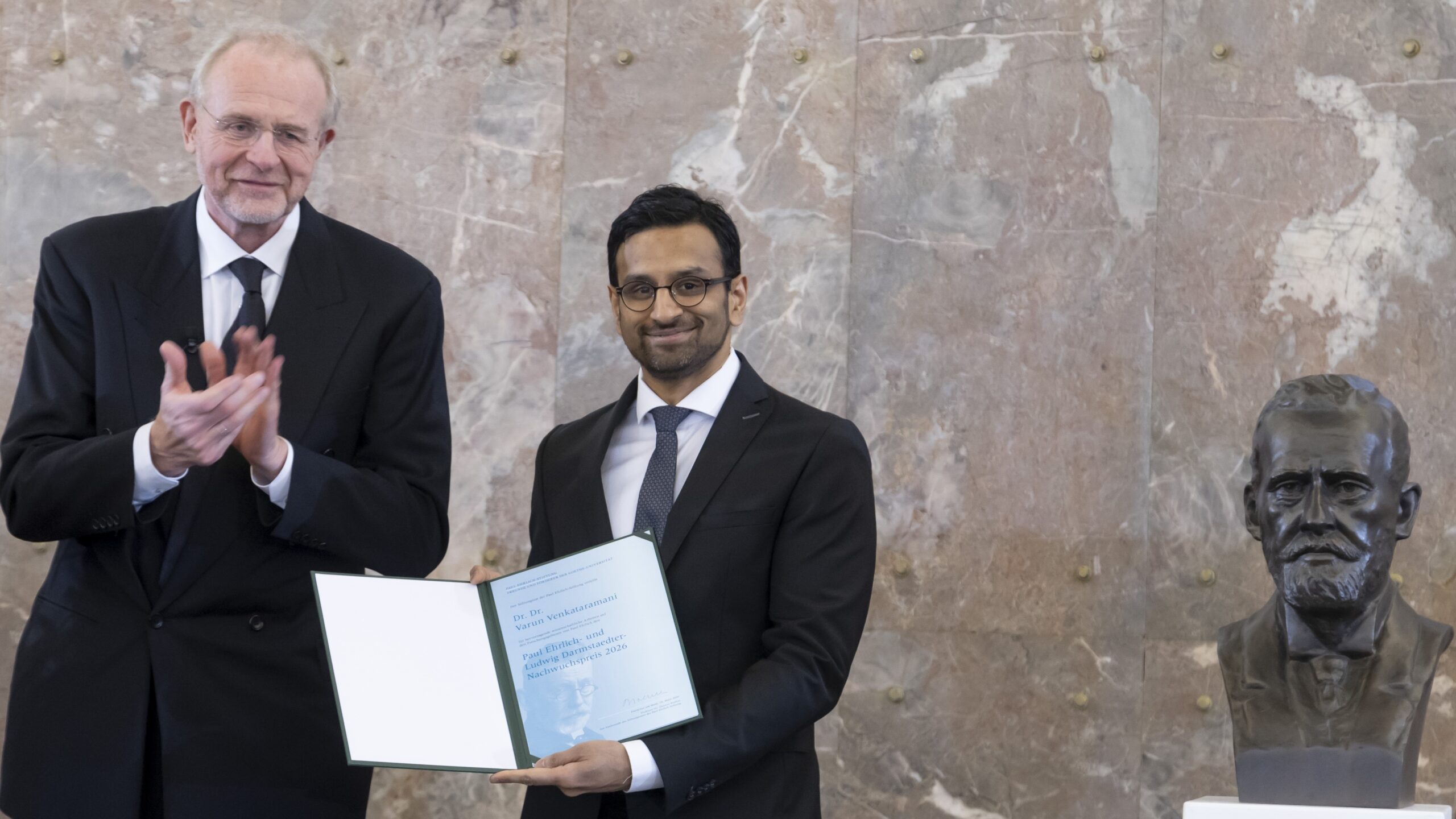
Brain tumors can hijack the nervous system, tap into its activation signals, and thereby accelerate their growth. For these groundbreaking discoveries regarding the role of the nervous system in the growth of brain tumors, the Paul Ehrlich Foundation honored Dr. Dr. Varun Venkataramani, a neuroscientist at Heidelberg University’s Faculty of Medicine and a neuro-oncologist at the Department of Neurology at Heidelberg University Hospital (UKHD), with the 2026 Paul Ehrlich and Ludwig Darmstaedter Young Scientist Award. The award was presented to him by the Chairman of the Foundation Board on March 14, 2026, at Frankfurt’s Paulskirche.

Full Text in German below.


Heidelberger Forscher erhält renommierten Paul Ehrlich-Nachwuchspreis für Hirntumorforschung

Gehirntumore können das Nervensystem kapern, dort Aktivierungssignale abgreifen und dadurch ihr Wachstum beschleunigen. Für diese wegweisenden Entdeckungen zur Rolle des Nervensystems beim Wachstum von Gehirntumoren zeichnete die Paul Ehrlich-Stiftung Dr. Dr. Varun Venkataramani, Neurowissenschaftler an der Medizinischen Fakultät Heidelberg der Universität Heidelberg und Neuroonkologe an der Neurologischen Klinik des Universitätsklinikums Heidelberg (UKHD), mit dem Paul Ehrlich-und-Ludwig Darmstaedter-Nachwuchspreis 2026 aus. Die Auszeichnung überreichte ihm der Vorsitzende des Stiftungsrates am 14. März 2026 in der Frankfurter Paulskirche.
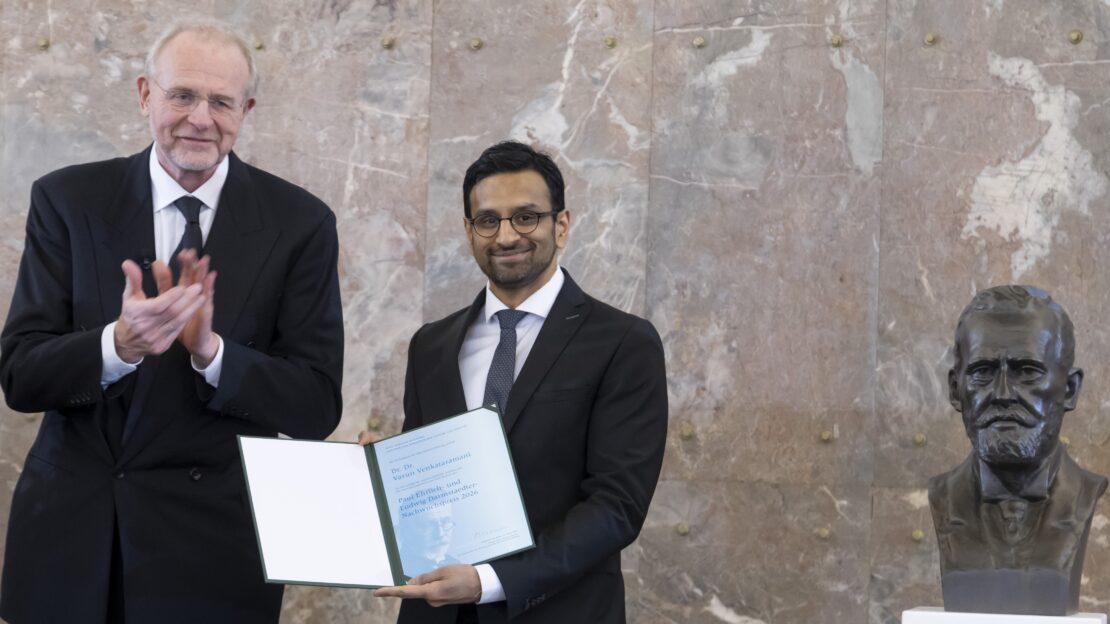
Dr. Dr. Varun Venkataramani (rechts), Neurowissenschaftler an der Medizinischen Fakultät Heidelberg der Universität Heidelberg und Neuroonkologe an der Neurologischen Klinik des Universitätsklinikums Heidelberg (UKHD), erhält den Paul Ehrlich-und-Ludwig Darmstaedter-Nachwuchspreis 2026 . Foto: Uwe Dettmar

Der 36-Jährige entdeckte, dass Glioblastome Kontakte, sogenannte Synapsen, zu Nervenzellen aufbauen, und durch deren Impulse schneller wachsen. Diese Entdeckung begründete ein neues Forschungsfeld, die Cancer Neuroscience. Auf Basis seiner Erkenntnisse forscht Venkataramani an zwei Ansätzen, wie das Wachstum dieser Hirntumoren ausgebremst werden könnte. Diesen wegweisenden Arbeiten bescheinigt der Stiftungsrat der Paul Ehrlich-Stiftung eine „exzeptionelle translatorische Signifikanz […] im Geiste Paul Ehrlichs“. Der Paul Ehrlich- und Ludwig Darmstaedter-Nachwuchspreis wird von der Paul Ehrlich-Stiftung einmal jährlich an junge Forschende in Deutschland verliehen und ist mit 60.000 Euro dotiert.

Weitere Informationen im Internet

Pressemitteilung und weitere Informationen von der Preisverleihung der Paul Ehrlich-Stiftung

Labor Dr. Dr. Venkataramani

Institut für Anatomie und Zellbiologie an der Medizinischen Fakultät Heidelberg der Universität Heidelberg

Neurologie und Poliklinik an der Neurologischen Klinik des Universitätsklinikums Heidelberg
Our latest News

discover more
PRECISEU launches Open Call to accelerate interregional innovation in personalised medicine

PRECISEU launches Open Call to accelerate interregional innovation in personalised medicine

Across Europe, the conversation around personalised medicine is no longer about potential—it is about implementation. The challenge is not only scientific progress, but how to move innovation across regions, systems and stakeholders in a coordinated way. In this context, the PRECISEU project has launched its Open Call for Joint Interregional Projects (JIPs), opening on 13 […]

Digital recording of health status

Digital recording of health status

Successful pilot project at Heidelberg University Hospital Regularly surveying patients about their health-related quality of life is a key aspect of patient-centred medicine. At Heidelberg University Hospital, a new digital system is being used for this purpose in a pilot project: patients complete online questionnaires on their own mobile devices, after which the data is […]

A mouse model for Dry Eye Disease

A mouse model for Dry Eye Disease

Experimentica utilizes a validated mouse model of dry eye disease. Dry eye disease-like pathology is induced using transdermal scopolamine patches in combination with desiccating environmental stress. The induced pathology is characterized using corneal fluorescein staining, tear volume measurements, and histology for lacrimal gland infiltration, goblet cell loss, and corneal abnormalities. Dry eye disease, also referred […]

GET IN TOUCH

Stay Updated with bioRN’s Newsletter

Sign up for our newsletter to discover more!
* required

BioRN (BioRN Network e.V. and BioRN Cluster Management GmbH) will use the information you provide on this form to be in touch with you and to provide updates and marketing. Please let us know all the ways you would like to hear from us:

You can update your subscription preferences or unsubscribe at any time. Just follow the unsubscribe or update link in the footer of automated emails you receive from us, or by contacting us at info@biorn.org. We will treat your information with respect. For more information about our privacy practices please visit our website: www.biorn.org. By clicking below, you agree that we may process your information in accordance with these terms.

We use Mailchimp as our marketing platform. By clicking below to subscribe, you acknowledge that your information will be transferred to Mailchimp for processing. Learn more about Mailchimp's privacy practices.

Intuit Mailchimp