Heidelberg Researchers Receive Else Kröner Memorial Fellowships for Projects on Kidney Disease and AI-Based Diagnostics
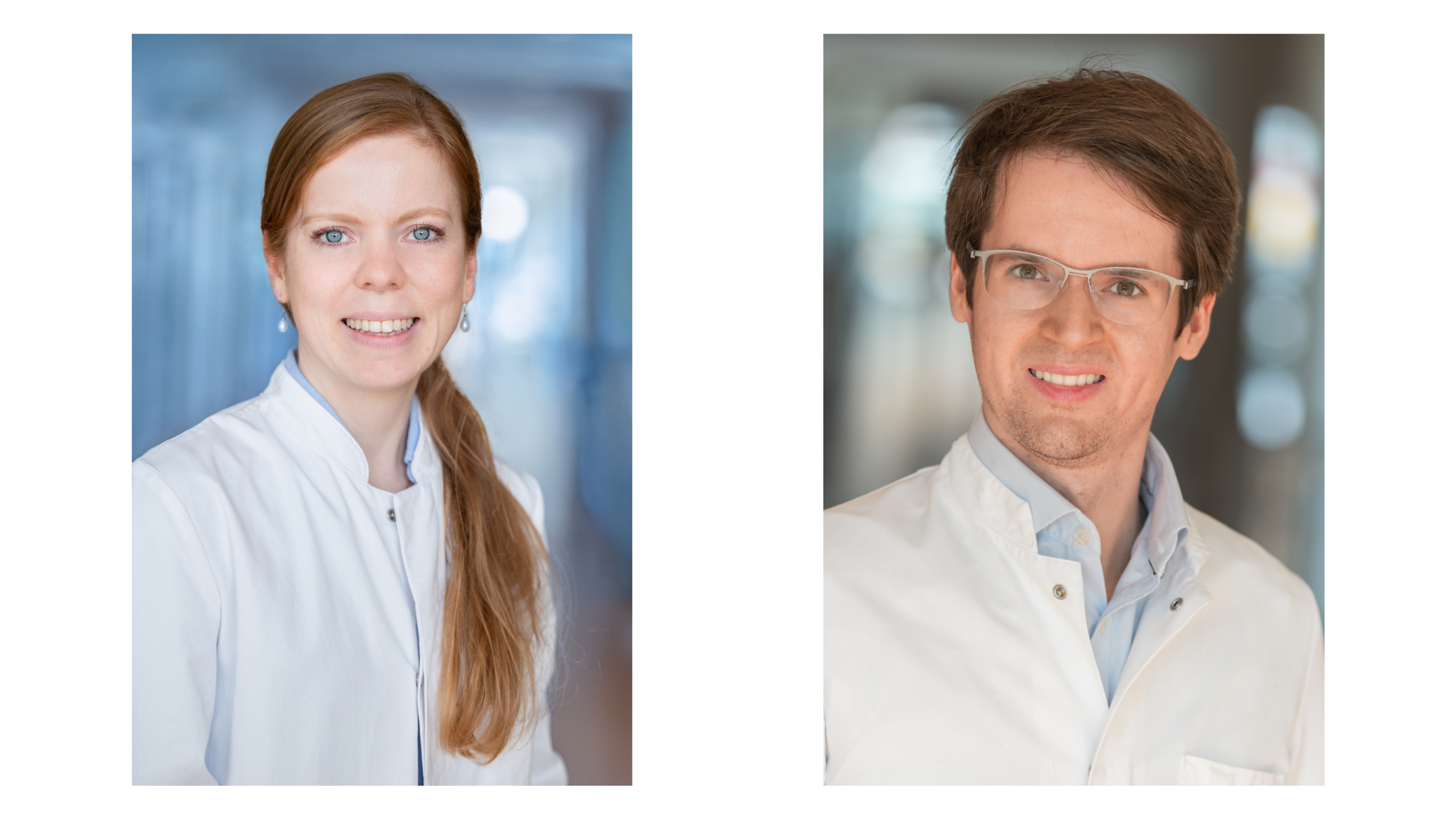
Why do certain congenital kidney disorders vary so widely in severity among affected individuals? Can AI improve breast cancer diagnostics? These are the questions being addressed in current projects by two early-career researchers at the Heidelberg Faculty of Medicine at Heidelberg University. The Else Kröner-Fresenius Stiftung is supporting the research of Dr. Caroline M. Kolvenbach and Dr. André Pfob with its Else Kröner Memorial Fellowship for exceptionally talented young physicians, awarding each researcher €250,000 over the next two years.
right: Dr. André Pfob
Alterations in the HNF1B gene are among the most common genetic causes of congenital kidney malformations. However, the severity of kidney disease in affected patients can vary considerably, ranging from mild structural abnormalities to severe malformations associated with an early decline in kidney function. Dr. Caroline M. Kolvenbach, a researcher at the Heidelberg Faculty of Medicine at Heidelberg University and a physician at the Department I of Pediatric Nephrology, Hepatology and Transplantation Medicine (Medical Director: Professor Jun Oh) within the Center for Child and Adolescent Medicine at Heidelberg University Hospital, is investigating the reasons behind these differences. The Else Kröner-Fresenius Stiftung (Foundation, EKFS) is supporting Dr. Kolvenbach’s project, “Deciphering Allele-Dependent Phenotypic Differences in HNF1B-Associated Kidney Disease,” through its Else Kröner Memorial Fellowship for exceptionally talented young physicians over the next two years.
For her research, Dr. Caroline M. Kolvenbach will combine clinical and genetic data from patients with congenital kidney malformations with experimental model systems. In particular, she will use so-called kidney organoids, laboratory-grown mini-organs derived from patients’ own cells as well as genetically engineered stem cells, to investigate how different variants of the gene affect kidney development. “My goal is to gain a better understanding of both the development of HNF1B-associated congenital kidney malformations and the factors underlying their highly variable clinical presentation,” says the researcher. In the long term, her findings could help identify potential targets for future therapies.
AI-Supported Image Analysis for Improved Breast Cancer Diagnostics
Whether a suspicious breast lesion is benign or malignant cannot always be determined conclusively by ultrasound examination alone. To ensure diagnostic certainty, tissue samples are often obtained through a biopsy, although a large proportion of these findings ultimately prove to be benign. Additional information can be provided by shear wave elastography (SWE), an imaging technique that visualizes differences in tissue stiffness and elasticity. This is clinically relevant because malignant tumors are often stiffer than benign lesions. Using SWE alongside ultrasound examination could help reduce unnecessary invasive procedures in women with benign lesions. However, image interpretation is complex and differs between individual patients.
Together with his team, Dr. André Pfob has developed an AI-based method that automatically analyzes imaging data and could support physicians in their diagnostic decision-making. Dr. Pfob serves as Scientific Head of the Senology Study Center at the Heidelberg Faculty of Medicine at Heidelberg University and as Group Leader Patient-centered AI at the newly established Institute for Medical AI (IMAI; Director: Professor Jakob N. Kather) at Heidelberg University Hospital. As a physician, he also works at the Breast Center within the Heidelberg Oncology Center, which comprises Heidelberg University Hospital and St. Elisabeth Hospital Heidelberg.
In previous studies, he demonstrated that the AI-based approach can reliably detect breast cancer while reducing the number of unnecessary biopsies. Beginning in November, Dr. André Pfob will investigate whether these findings can be confirmed under real-world clinical conditions in the study “AI-Supported Shear Wave Elastography for Improved Breast Cancer Diagnostics: A Prospective Phase II Validation Study.” He will likewise receive support through the EKFS Else Kröner Memorial Fellowship for a period of two years.
Background: The Else Kröner Memorial Fellowships
The Else Kröner Memorial Fellowship enables young physicians to be released from clinical duties for two years in order to pursue a promising medical research project in a focused manner. The programme is designed to lay the foundation for scientific independence and a future career as a clinician scientist. In 2026, a total of nine exceptionally talented physicians from German university hospitals will receive an EKFS Memorial Fellowship, each valued at €250,000. The fellowships are awarded in memory of entrepreneur and philanthropist Else Kröner.
Further Information Online
Else Kröner Memorial Fellowships
Department I of Pediatric Nephrology, Hepatology and Transplantation Medicine at UKHD (in German)
Contact
Dr. Caroline M. Kolvenbach
Heidelberg Faculty of Medicine at Heidelberg University
Department I of Pediatric Nephrology, Hepatology and Transplantation Medicine, Center for Pediatric and Adolescent Medicine, Heidelberg University Hospital
caroline.kolvenbach@med.uni-heidelberg.de
Dr. André Pfob
Heidelberg Faculty of Medicine at Heidelberg University
Institute for Medical AI (IMAI), Heidelberg University Hospital
Breast Center within the Heidelberg Oncology Center, comprising Heidelberg University Hospital and St. Elisabeth Hospital Heidelberg
andre.pfob@med.uni-heidelberg.de