Heisenberg Professorship for Aurélie Ernst
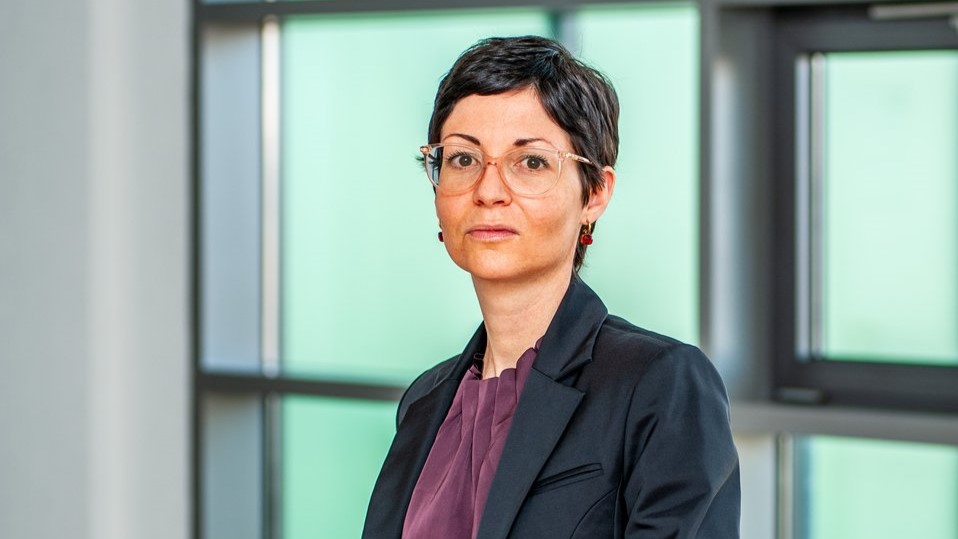
With funding from the German Research Foundation’s (DFG) Heisenberg Program, DKFZ researcher Aurélie Ernst aims to investigate how massive changes in the genome contribute to the development of cancer. Her research focuses on a phenomenon known as chromothripsis – a catastrophic event in the genome in which chromosomes break apart and are reassembled incorrectly. In the long term, the findings are expected to open up new possibilities for earlier detection, prevention, and more targeted treatment of particularly aggressive tumors.
When cancer develops, a cell’s genome undergoes changes. Sometimes this does not happen step by step, but rather in a single dramatic event: one or more chromosomes break into numerous fragments and are subsequently reassembled incorrectly. This phenomenon is known as chromothripsis. It occurs in an estimated 30 to 50 percent of all cancers and can dramatically alter the affected cells, thereby driving tumor growth.
Aurélie Ernst’s research group is investigating how chromothripsis arises and what molecular and cellular consequences such massive damage to the genome have. To this end, the team combines analyses of patient samples and experimental model systems with modern methods of single-cell, spatial, and functional genomics. The long-term goal: to better understand the early development of tumors and to identify biological mechanisms that can be used for prevention or intervention as early as possible.
Are there signs of chromosomal instability even before a cancer diagnosis?
With funding from the Heisenberg Program, the genomics researcher aims to trace how chromosomally unstable tumors develop spatially and temporally. She also seeks to decipher the molecular mechanisms that trigger chromothripsis and other forms of chromosomal instability.
In addition, Ernst is looking for changes that occur even before the actual cancer diagnosis. This area, in particular, could be of special medical significance in the long term. Since chromothripsis often occurs early in tumor development, Ernst is examining, among other things, cells from people with an increased hereditary risk of cancer. Using new experimental and computer-based methods, she aims to identify characteristic molecular markers of incipient chromosomal instability that can predict the potential development of the disease.
Ernst’s long-term goal is ambitious: to understand when and why an initially healthy genome becomes unstable—and to one day use this knowledge to detect cancer early and halt its progression before a tumor that is difficult to treat develops.
The DFG’s Heisenberg Program is aimed at outstanding researchers who meet all the requirements for appointments to a long-term professorship. The five-year DFG grant is intended to enable them to assume a leadership position and pursue key research topics.
A photo of Aurélie Ernst is available for download at:
https://www.dkfz.de/fileadmin/user_upload/Skoe/Pressemitteilungen/2026/Ernst_Aurelie.jpg
Terms of Use for Images Accompanying Press Releases
Use is free of charge. The German Cancer Research Center (DKFZ) permits one-time use in connection with reporting on the topic of the press release or on the DKFZ in general. Please provide the following image credit: “Source: Petra Arnold/DKFZ.”
Distribution of the images to third parties is permitted only after prior consultation with the DKFZ Press Office (Tel. 06221 42 2854, Email: presse@dkfz.de). Use for commercial purposes is prohibited.