How a Tiny Gene Ensures the Survival of Male Birds
Researchers from Heidelberg and Edinburgh identify a mechanism that balances the genetic disparity between sex chromosomes
Birds have developed a unique evolutionary solution to ensure the survival of males – a powerful microRNA. This tiny gene allows male embryos to survive despite a genetic imbalance between the sexes by balancing the activity of the sex chromosomes. An international research team led by biologists from Heidelberg University and the University of Edinburgh (Scotland) has discovered this previously unknown mechanism, which differs significantly from the system that mammals have developed in the course of evolution to address the same biological challenge.
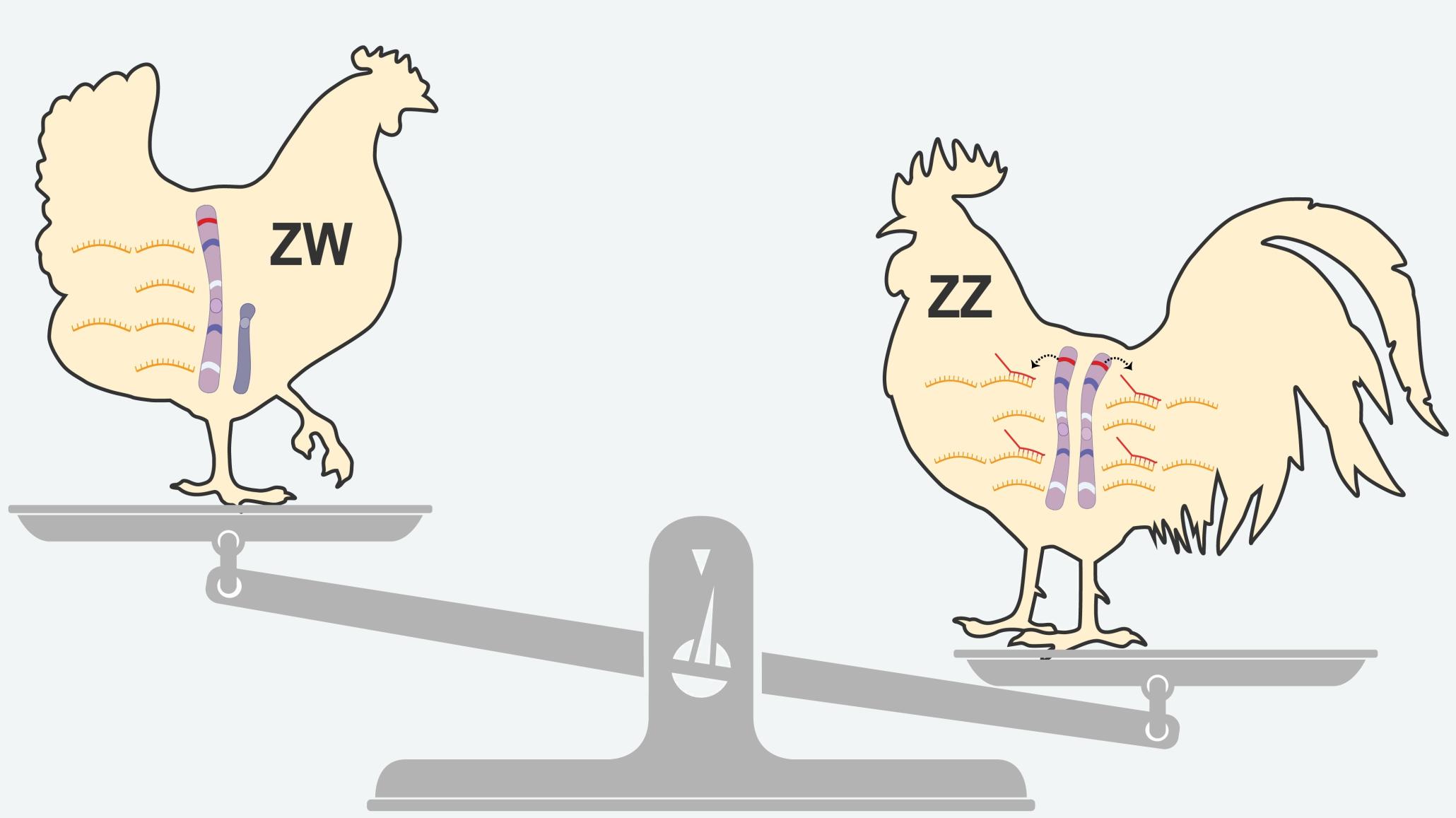
Sex chromosomes, which determine whether an individual is male or female, originated from an ordinary pair of chromosomes. In mammals, females carry two X chromosomes, while males have one X and one Y chromosome. In contrast, male birds have two Z chromosomes, and female birds have one Z and one W chromosome. Over time, the Y chromosome in mammals and the W in birds lost most of their genes due to their highly specialized sex-specific roles, meaning one sex retains two copies of most genes while the other has only one. Mammals compensate for this genetic imbalance by boosting the activity of the X chromosome in both sexes and “silencing” one of the two X chromosomes in females.
Using chickens as an example, the international research team has now demonstrated how birds resolve this issue. The loss of genetic material on the female-specific W chromosome is offset by increased activity of key genes on the Z chromosome. While this is vital for the survival of female birds, it leads to genetic overactivity in males with two Z chromosomes, resulting in growth defects if left unbalanced. The researchers, led by Prof. Dr Henrik Kaessmann (Heidelberg University) and Dr Mike McGrew (University of Edinburgh), suspected that a previously discovered microRNA – a short regulatory ribonucleic acid – plays a crucial role in this process.
“This microRNA is predominantly active in male birds, which led us to assume that it helps balance the activity of the Z chromosome,” explains Prof. Kaessmann, who conducts research at the Center for Molecular Biology of Heidelberg University (ZMBH). To test their hypothesis, the researchers used gene editing to remove the microRNA and studied the effects during early chicken development. While male embryos could not survive without the microRNA, females developed normally. According to the researchers, the same tiny gene is found in all bird species examined thus far, but not in other animals. “It is the only known microRNA that is essential for the survival of one sex, but not the other,” says Dr Amir Fallahshahroudi, former postdoc in Prof. Kaessmann’s team at the ZMBH and current group leader at Uppsala University in Sweden.
According to Dr McGrew, the mechanism of the male-specific microRNA works like a dimmer switch, dialing down the overactive genes on the two male Z chromosomes. “Our findings show that birds have developed a distinct evolutionary solution to offset the genetic imbalance between sex chromosomes and ensure the survival of male animals,” he emphasizes. They also highlight that evolution can arrive at different solutions for the same biological problem – and that tiny genes can have a dramatic impact on survival. “We now have to ask whether other animal species also use microRNAs to regulate their sex chromosomes, or whether they rely on different systems entirely,” adds Prof. Kaessmann.
Alongside the researchers from Heidelberg, Edinburgh and Uppsala, scientists from Abu Dhabi and China were also involved in the study. This research was funded by various organizations and foundations, including the European Research Council, the NOMIS Foundation, the Swedish Research Council and the Biotechnology and Biological Sciences Research Council (UK). The results have been published in the journal “Nature”.
Original publication
A. Fallahshahroudi, S. Yousefi Taemeh, L. Rodríguez-Montes, N. Trost, D. Frank, P. Lafrenz, J. Koubek, G. Tellez, M. Ballantyne, A. Idoko-Akoh, L. Taylor, A. Sherman, M. Davey, C. Ma, E. Sorato, M. Johnsson, C. Grozou, Y. Xue, L. Liu, G. Kramer, C.-J. Rubin, M. Cardoso-Moreira, M. J. McGrew, H. Kaessmann: A male-essential miRNA is key for avian sex chromosome dosage compensation. Nature (published online 16 July 2025).
DOI: 10.1038/s41586-025-09256-9