October 09, 2025

How Fibrosis Disrupts the Heart’s Electrical Signals
How Fibrosis Disrupts the Heart’s Electrical Signals

Innovative imaging technique reveals hidden electrical connections in diseased hearts and provides new therapeutic approaches

Cardiac fibrosis can be life-threatening: the formation of connective tissue in the heart muscle causes it to become stiffer, impairs electrical signal transmission, and weakens pumping capacity, which can lead to cardiac arrhythmias. However, the effects of cardiac fibrosis on the electrical conductivity of the heart have been insufficiently studied to date. A research team led by the University of Freiburg, with the participation of the Karlsruhe Institute of Technology (KIT), has now closed this gap, gaining new insights into the fundamentals of electrophysiology in cardiac fibrosis and thus opening up further possibilities for personalized diagnostic and therapeutic approaches.

Computer models and digital twins

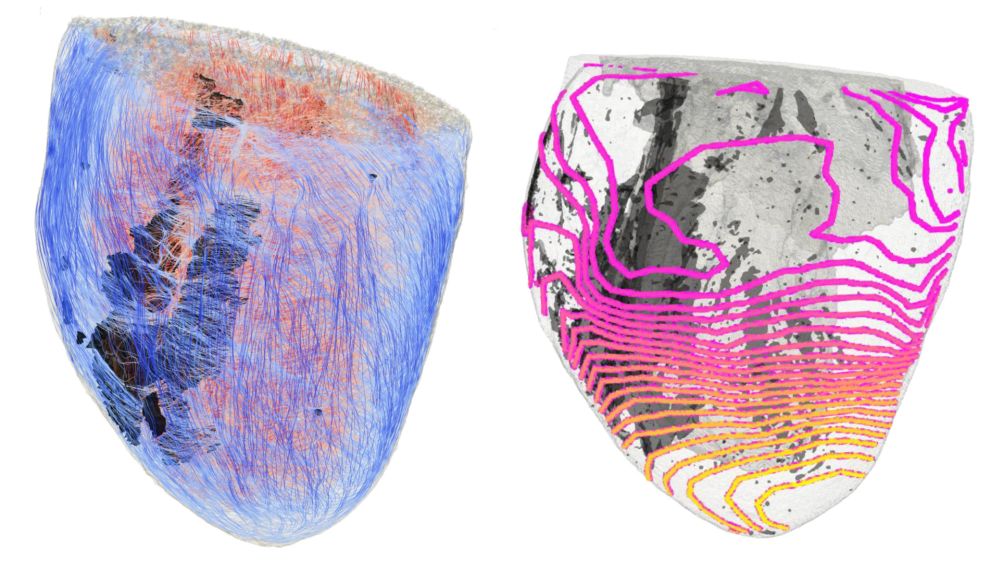
Using optical imaging and 3D computer models of mouse hearts, the researchers found that fibrotic tissue acts as a “low-pass filter” for electrical activation of the heart, the electrophysiology: The slowed or blocked transmission of electrical impulses at a higher pulse rate, for example due to physical exertion, can lead to dangerous cardiac arrhythmias – as is the case with arrhythmogenic cardiomyopathy, which occurs particularly in young people. Targeted stress tests are therefore important for the diagnosis of high-risk patients.

“For the first time, we were able to decipher the influence of connective tissue, interacting with the muscle cells of the heart, in arrhythmogenic cardiomyopathy”, explains Dr. Francesco Giardini from the University of Freiburg. The “Computer Models of the Heart” research group led by Dr.Axel Loewe from KIT has integrated the experimental data in computer simulations and developed a digital twin of the biological experiment, showing the disrupted propagation of excitation at higher heart rates. “We want to extend the method to larger animal models and models of the human heart in order to further develop digital twins for precision cardiology and thus improve clinical diagnostics and treatment,” says Loewe.

lkr, October 7, 2025
Our latest News

discover more
GeneNovate® 2026: Heidelberger Forschende stärken unternehmerisches Denken für die nächste Generation von Gen- und Zelltherapien

GeneNovate® 2026: Heidelberger Forschende stärken unternehmerisches Denken für die nächste Generation von Gen- und Zelltherapien

Heidelberg, Juni 2026 – Mit dem Final Event von GeneNovate® am 25. Juni in der Münchner Residenz endet die dritte Runde des bundesweiten Entrepreneurship-Programms der Nationalen Strategie für gen- und zellbasierte Therapien (Nationale Strategie GCT). Im Rahmen der Abschlussveranstaltung präsentierten Wissenschaftlerinnen und Wissenschaftler aus ganz Deutschland ihre innovativen Geschäftsideen mit Potenzial für zukünftige Gesundheitslösungen und […]

Post-COVID Syndrome: Study Finds Hemodialysis Offers No Benefit to Patients

Post-COVID Syndrome: Study Finds Hemodialysis Offers No Benefit to Patients

A study recently published in *The Lancet Regional Health – Europe* calls into question the benefits of immunoadsorption—a specialized form of blood purification—for post-COVID syndrome. While the autoantibodies, which are thought to be a possible cause of the condition, can be removed from the blood, this does not improve the symptoms of those affected. The […]

Universität Heidelberg: Humboldt Professorship for Leading International Researcher

Universität Heidelberg: Humboldt Professorship for Leading International Researcher

Highly endowed research prize goes to Harvard scientist Mathias Lichterfeld on the proposal of Ruperto Carola In order to further strengthen Heidelberg University as an internationally recognized location of infection research, Prof. Dr Mathias Lichterfeld has been selected for an Alexander von Humboldt Professorship endowed with 7.8 million euros. Leading international academics are granted this […]

GET IN TOUCH

Stay Updated with bioRN’s Newsletter

Sign up for our newsletter to discover more!
* required

BioRN (BioRN Network e.V. and BioRN Cluster Management GmbH) will use the information you provide on this form to be in touch with you and to provide updates and marketing. Please let us know all the ways you would like to hear from us:

You can update your subscription preferences or unsubscribe at any time. Just follow the unsubscribe or update link in the footer of automated emails you receive from us, or by contacting us at info@biorn.org. We will treat your information with respect. For more information about our privacy practices please visit our website: www.biorn.org. By clicking below, you agree that we may process your information in accordance with these terms.

We use Mailchimp as our marketing platform. By clicking below to subscribe, you acknowledge that your information will be transferred to Mailchimp for processing. Learn more about Mailchimp's privacy practices.

Intuit Mailchimp