Institutional Partnership: Heidelberg and Harvard Sign Memorandum of Understanding
State of Baden-Württemberg funds the intensifying of existing cooperative relations with ten million euros
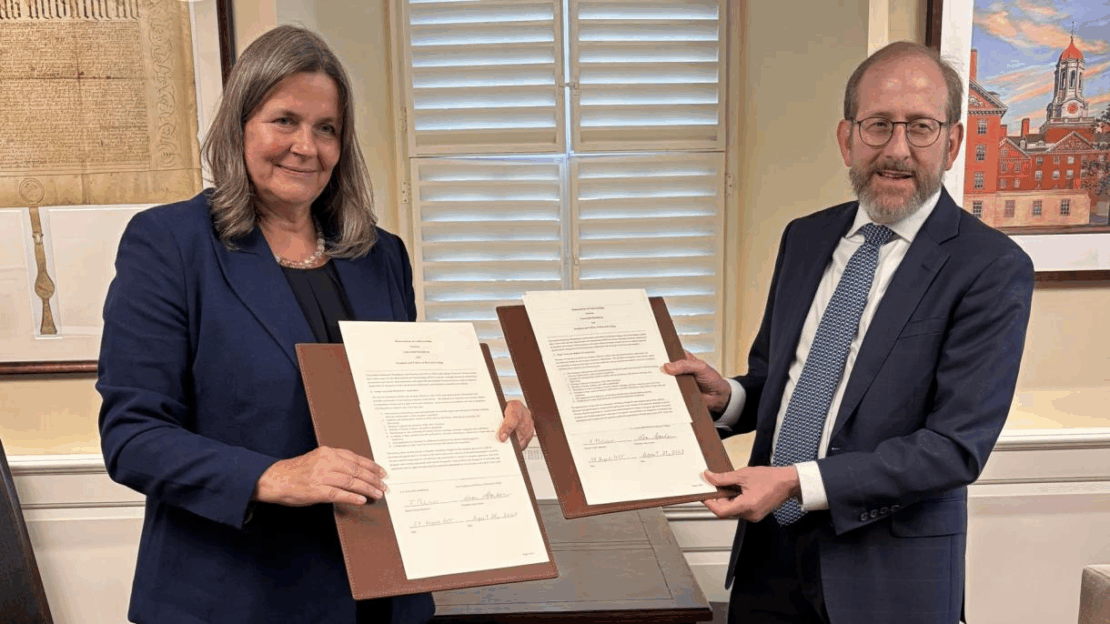
On the basis of the cooperative relations that have developed over time, Heidelberg University and Harvard University are going to deepen and expand their cooperation. Prof. Dr Alan M. Garber, President of Harvard University, and Prof. Dr Frauke Melchior, Rector of Heidelberg University in Germany, have signed a Memorandum of Understanding to that effect. As an institutional internationalization project, the state of Baden-Württemberg is providing the sum of ten million euros to support this Heidelberg initiative. The funding is part of the state’s “Global Partnership in Science” activities.
Harvard University has for decades been the U.S. university with which Heidelberg University has kept up the most extensive relations of active cooperation. These numerous individual connections – for example, through the Heidelberg Center for American Studies, the Heidelberg Center for Ibero-American Studies, the South Asia Institute, the Heidelberg Institute of Global Health, the Institute for Molecular Systems Engineering and Advanced Materials and the Centre for Astronomy – will now be fitted into a clearly structured framework. At the same time, the Memorandum of Understanding forms the basis for further subject-related agreements that the schools, departments, and units of both universities will explore and advance. Special significance is attached to promoting first-rate research with joint projects, specifically in the life sciences, molecular engineering sciences, natural sciences and selected humanities. Young researchers are also to receive sustainable support through the expansion of exchange programs.
To prepare for the structural deepening of the partnership, Heidelberg University has conducted a comprehensive stocktaking of all existing cooperation agreements with Harvard and supplemented it with a university-wide survey of potential future projects. Feasible lines of cooperation are currently being strategically planned and conceptualized in several disciplines – including in the fields of Global Public Health / Medicine, Life Sciences, Astrophysics, Sinology / Asia Studies, Theology, History and American Studies, Environmental Physics / Sustainability Sciences and Molecular Engineering.
Additional measures to intensify cooperation activities include establishing a teaching hub in Heidelberg with digital and hybrid teaching formats, creating an incubator to generate third-party-funded projects and organizing an innovation hub for transfer activities. Using the state funding available for financing visiting scholars and researchers in Heidelberg, the university has made preparations for concrete cooperation at the local level by providing laboratory facilities and work places as well as accommodation in its guest houses. That is designed to attract early-career researchers along with established scientists and scholars.
The President of Harvard University and the Rector of Heidelberg University signed the Memorandum of Understanding on 28 August 2025 in Cambridge (USA).