Light-Based 3D Printing: Innovative “Ink” Enables a Closed-Loop Material Cycle
Heidelberg research team develops a polymer material that can be broken down into its individual components and reused
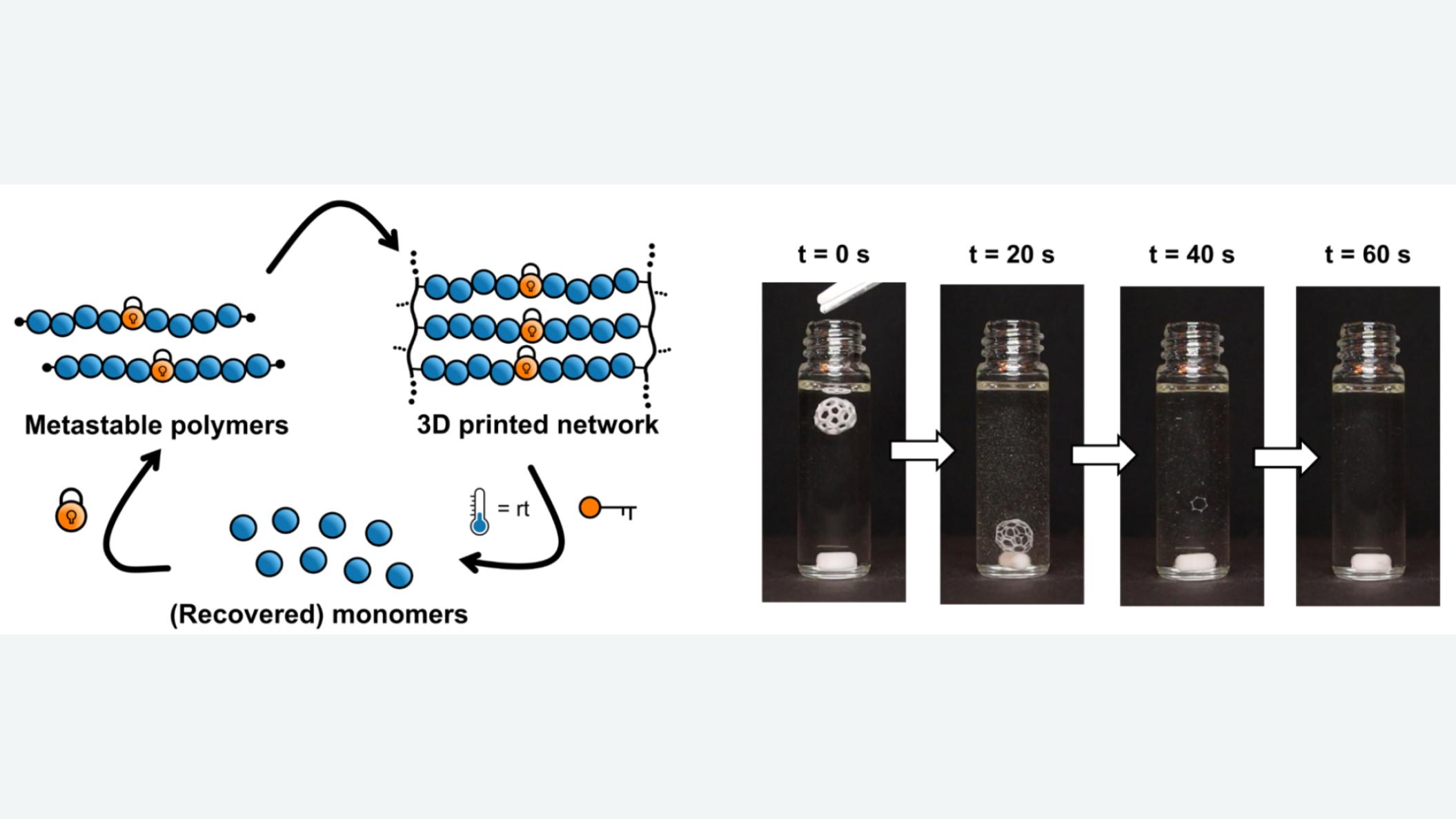
Polymers used for light-based 3D printing are very stable due to their chemical structure, but they are typically hard to recycle. A research team led by Prof. Dr. Eva Blasco, a researcher at the Institute for Molecular Systems Engineering and Advanced Materials (IMSEAM) at Heidelberg University, has now designed a polymer material that can be disassembled into its individual components when needed. A chemical “key” causes already printed material to break down into its molecular building blocks within seconds. They can be recovered and reused in a circular manufacturing process.
Among additive manufacturing – i.e., 3D printing – methods, high-precision light-based approaches such as digital light processing stand out for producing small and complex structures. They are used, for example, in personalized medicine or in soft robotics. These technologies are based on liquid “inks” that cure into solid, three-dimensional structures when exposed to light. They are usually made of so-called thermosets, whose building blocks are permanently and irreversibly linked into a permanent network. This makes the materials very stable, but they are practically non-recyclable and, according to the scientists, could become a source of constant waste streams.
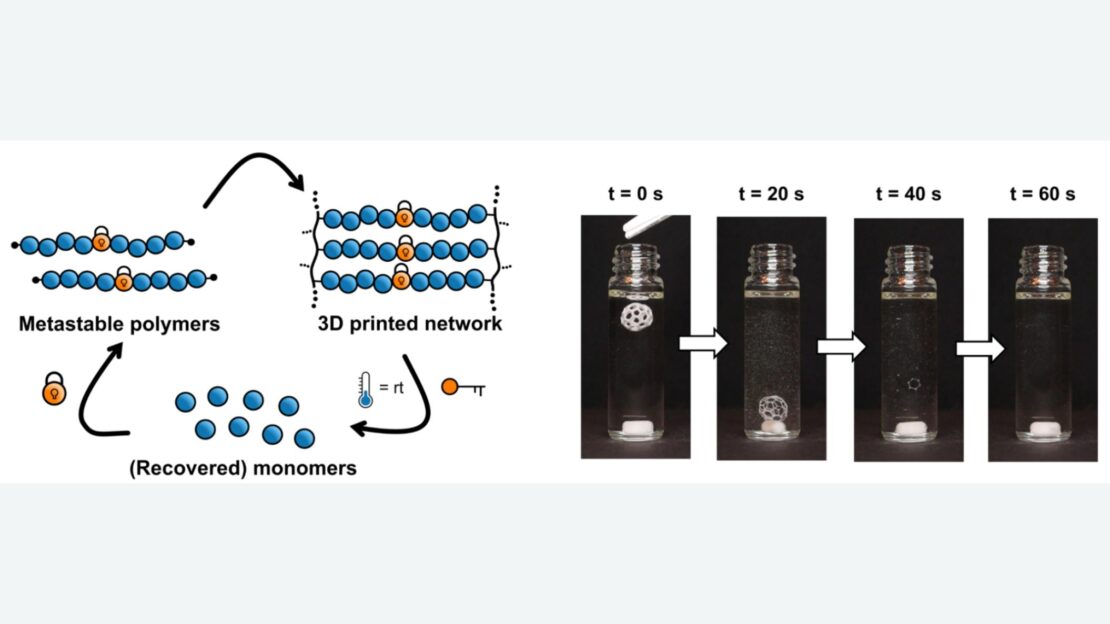
To make light-based 3D printing more sustainable, the Heidelberg research team has designed a so-called metastable material that can be broken down into its individual components without compromising precision, quality, or mechanical stability. As the basis for their work, the scientists used a special polymer that reacts to a chemical signal. “The long molecular chain is held together by a single predetermined breaking point. As soon as a specific chemical trigger opens this site, the entire chain breaks down into its constituent parts within seconds at room temperature, like a row of dominoes,” explains Johannes Markhart, a doctoral student conducting research in Eva Blasco’s team. The predetermined breaking point functions like a lock that opens only with the right key.
In its experiments, the research team was able to use the novel metastable material to produce various complex three-dimensional structures with details on the micrometer scale, thereby demonstrating its suitability as a high-resolution “ink”. “It combines high print quality with a property that has been virtually nonexistent in polymer materials for 3D printing until now: it can be completely disassembled into its individual parts without leaving any residue,” says Johannes Markhart. The scientists were then able to isolate these building blocks and convert them back into a polymer. Spectroscopic analyses confirmed that the chemical composition of the recycled polymer is identical to that of the starting material at the molecular level. “When reused, the material exhibited the same properties as it did during the first printing process,” says Dr. Philipp Mainik, who contributed to the research as a doctoral student.
“Our approach shows that stability and recyclability do not have to be mutually exclusive. We hope that it can pave the way for true chemical circularity and thus contribute to more sustainable manufacturing processes,” emphasizes Prof. Blasco, who, together with her group at IMSEAM and the Institute of Organic Chemistry at Heidelberg University, conducts research at the intersection of macromolecular chemistry, materials science, and additive manufacturing.
The research was conducted within the Excellence Cluster “3D Matter Made to Order”, a collaboration of Heidelberg University and the Karlsruhe Institute of Technology. The German Research Foundation, the Carl-Zeiss-Stiftung, and the Chemical Industry Fund provided funding for this research. The research findings have been published in the journal “Advanced Materials”.
Original publication
J. Markhart, P. Mainik, and E. Blasco: Metastable Polymers for Circular 3D Printing. Advanced Materials (18 August 2026),