PEPperPRINT GmbH launches cLIFT technology for next-generation peptide microarrays
Heidelberg, 10th of June 2025 – PEPperPRINT, a global leader in peptide microarray technology, celebrates its 15th anniversary with the launch of its next-generation peptide microarray platform: cLIFT, short for combinatorial Laser-Induced Forward Transfer. The new technology dramatically expands peptide printing capabilities and paves the way for innovative biomedical research applications.
Developed in collaboration with Dr. Felix Loeffler of the Max Planck Institute of Colloids and Interfaces and Dr. Frank Breitling of the Karlsruhe Institute of Technology, cLIFT offers a powerful upgrade to PEPperPRINT’s proprietary laser printing platform. With its high-resolution precision and extended chemistry compatibility, cLIFT sets a new benchmark for peptide microarray manufacturing.
Innovation at the Molecular Level
At the core of the new technology is a laser-based transfer process that deposits amino acids from a donor slide to an acceptor slide with pinpoint accuracy. The process is repeated in cycles for each amino acid to build high-density peptide microarrays layer by layer.
Key advances of the cLIFT platform include:
- 5 × higher density: up to 50,000 peptide spots per glass slide, enabling wider peptide or target protein coverage
- Site-specific modifications: effortless integration of post-translational modifications, including phosphorylation and glycosylation
- Non-natural amino acids: straightforward and cost-effective implementation of non-natural amino acids to generate e.g. full D-amino acid or N-methylated peptides
These enhancements significantly broaden the utility of peptide microarrays in different research fields such as epitope mapping, antibody and drug development, vaccine design, immunogenicity risk assessment, and biomarker discovery in cancer, autoimmune or infectious disease research.
Advancing Drug Discovery and Biomedical Research
Peptide microarrays are a powerful tool for analysis of antibody or protein-peptide interactions, enabling detailed immune response mapping. They can provide critical information for identifying therapeutic antibody candidates, monitoring immune responses to treatment, and evaluating immunogenicity risks. With the improvements introduced by cLIFT, scientists can now perform broader, deeper, and more customized analyses on a single microarray, leading to faster and more informed decision-making in therapeutic development.
Learn more: Upcoming Webinar
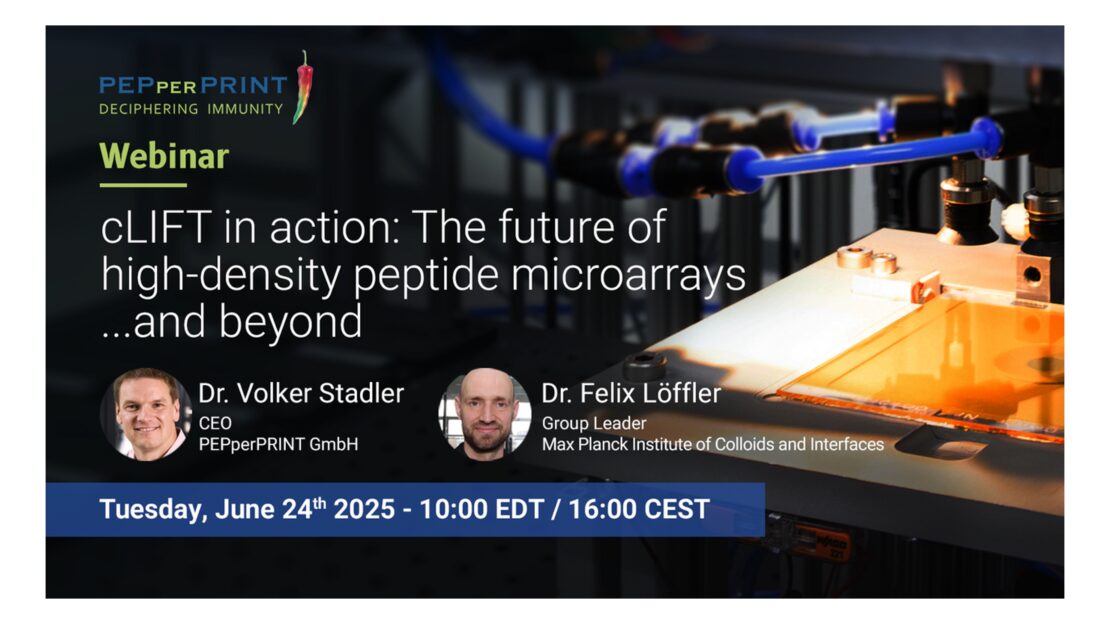
To share insights into the development and potential of cLIFT, PEPperPRINT will host a live webinar on Tuesday, June 24 at 16:00 CEST / 10:00 EDT. Presenting will be Dr. Volker Stadler and Dr. Felix Loeffler, who will discuss the new technology’s design, capabilities, and real-world applications in translational research.
Register here.
About PEPperPRINT GmbH
PEPperPRINT is the leading provider of high-density peptide microarrays and related microarray services including high-resolution epitope mapping and antibody profiling in cancer, autoimmune or infectious disease research. Headquartered in Heidelberg, Germany, the company combines award-winning proprietary laser printing technology with scientific expertise to empower scientists and accelerate discoveries in immunology, oncology, infectious diseases, and more. To learn more about PEPperPRINT, visit www.pepperprint.com.
Press contact:
Dr. Fiordiligie Casilag
Head of Marketing and Science Communication
fior.casilag@pepperprint.com