Quality Assurance in the Cell: Preventing Defective Protein Blueprints
Heidelberg biochemists and structural biologists from Shanghai decode the work of two control factors in mRNA splicing
Two molecular control factors play a decisive role in what is known as splicing, the cutting and assembly of mature messenger RNA – a prerequisite for protein synthesis in the cell. The poorly characterized factors are crucial to ensuring that the molecular machine responsible for splicing is working correctly. A research team led by Prof. Dr Ed Hurt at the Heidelberg University Biochemistry Center has deciphered how the two cellular quality inspectors work. The team collaborated with researchers from Fudan University in Shanghai (China).
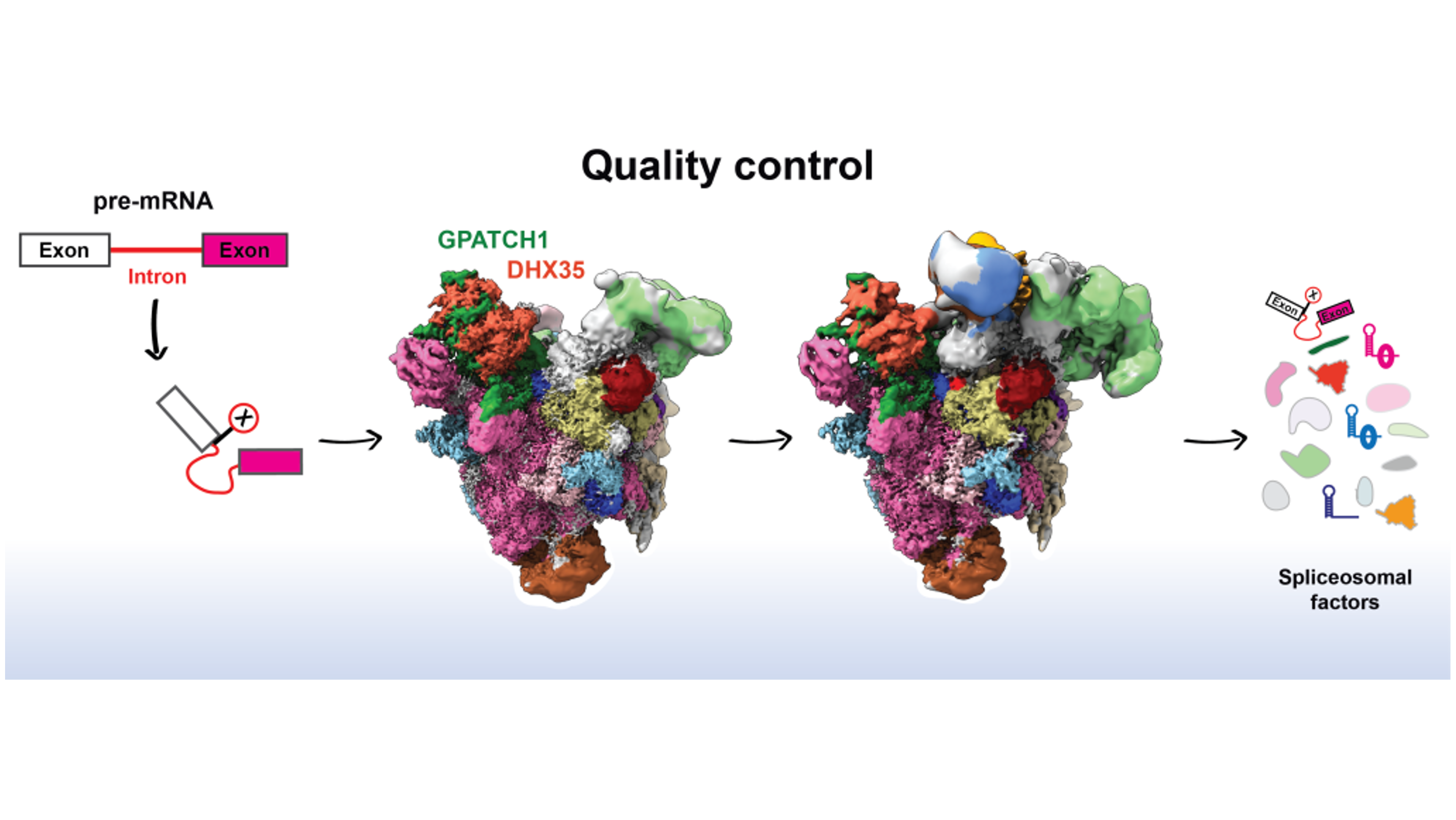
As basic building blocks of cells, proteins have vital functions in the organism. The instructions for their synthesis are found in the DNA. So that an exact blueprint for each protein can reach the production site in the cell, the information from the genome must be copied into messenger RNA, or mRNA for short. First, a precursor mRNA (pre-mRNA) is formed that contains both coding information for the protein (exons) as well as non-coding segments (introns). The introns need to be cut out of the pre-mRNA in the cell nucleus and the exons reconnected at the interfaces. This process is known as splicing. Ultimately, the spliced messenger RNA consists of only protein-encoding exons.
Splicing is catalyzed by a large molecular machine. This spliceosome is made up of variety of protein and RNA components, and for each splicing process, it is reassembled at the sites where an exon joins an intron and the intron in turn connects to another exon. It is absolutely vital that the splicing complex accurately recognizes exon-intron-exon junctions so the needed cuts can be made accurately. “The precise functioning of this molecular machine has already been well researched. What remained unclear, however, was whether the spliceosome can recognize and reject a precursor mRNA with a non-authentic splice site,” explains Prof. Hurt.
In studies with spliceosomes of the filamentous fungus Chaetomium thermophilum, the researchers were able to show that two proteins, GPATCH1 and DHX35, are crucial contributors to the precision of the splicing process. They succeeded once they were able to isolate the splicing complexes of the fungus that were in the midst of quality control and busy with rejecting a defective pre-mRNA. “When problems arise before the initial cut, the two proteins rush to the spliceosome to aid as quality controllers,” explains postdoc Dr Paulina Fisher. If the pre-mRNA is defective, GPATCH1 recognizes that the spliceosome should discontinue its work. As a second factor, DHX35 strips away the unsuitable precursor mRNA and eliminates it. Afterwards, the spliceosome itself is disassembled back into its individual parts, making it available for a new round of splicing.
“As cellular quality controllers, these two molecular control factors prevent a defective protein from potentially being manufactured from incorrectly spliced mRNA,” states the scientist. The researchers hope their findings will provide a better understanding of the mechanisms that ensure the accuracy of the splicing process. “They are also of clinical relevance, because defective splicing is associated with various diseases, among them cancer as well genetic and neurodegenerative diseases,” explains Ed Hurt. Along with the structural biologists from Shanghai, the Heidelberg biochemists also collaborated with a research group at the Max Planck Institute for Multidisciplinary Sciences in Göttingen.
Prof. Hurt’s research was conducted with funding from his ERC Advanced Grant. Other funds came from the National Key R&D Program of China, the National Natural Science Foundation of China, and the Shanghai Municipal Science and Technology Commission. The results of the research were published in the journal “Cell Research”.
Original publication
Y. Li, P. Fischer, M. Wang, Q. Zhou, A. Song, R. Yuan, W. Meng, F. X. Chen, R. Lührmann, B. Lau, E. Hurt, J. Cheng: Structural insights into spliceosome fidelity: DHX35-GPATCH1-mediated rejection of aberrant splicing substrates. Cell Research (published online 28 February 2025),