Rare bone tumors: Tailor-made mini-proteins switch off tumor drivers

Chordomas are rare bone tumors for which there are currently no effective drugs. A research team from the German Cancer Research Center (DKFZ) and the National Center for Tumor Diseases (NCT) Heidelberg has now developed a promising approach: Tailor-made mini-proteins specifically block the central driver of tumor development. In the result, they slowed the growth of chordoma cells in the laboratory and in a mouse model, while also revealing further molecular vulnerabilities of the tumor that could be addressed with already approved drugs.
Chordomas are rare bone tumors that usually develop at the base of the skull or on the spine. They grow aggressively locally, often recur, and respond poorly to chemotherapy. The standard treatment is surgery and radiation, and there is a lack of effective drugs.
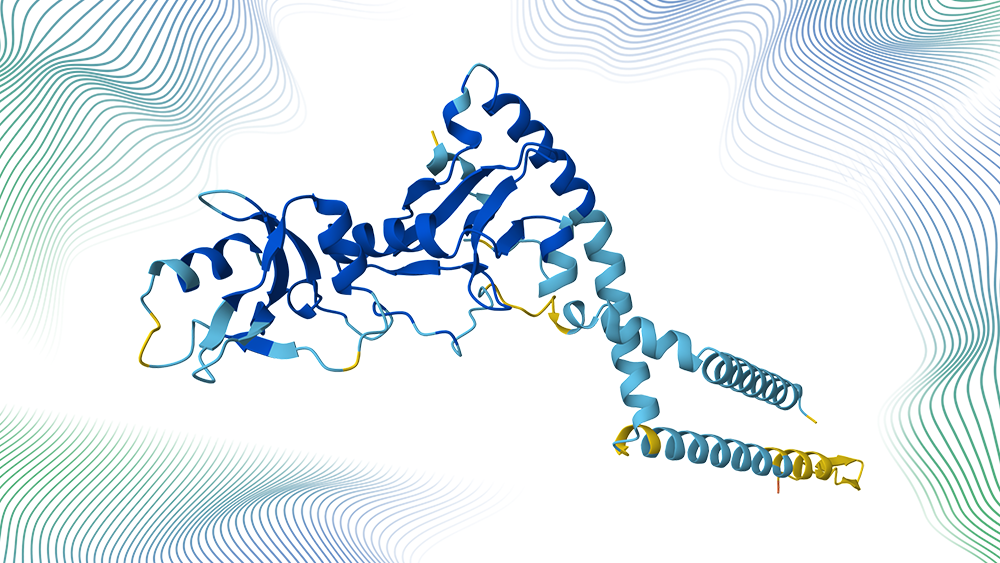
The transcription factor TBXT, which plays a central role in embryonic development, is considered the key driver of chordoma cancer. TBXT is not normally found in adults, but is overexpressed in over 90 percent of chordomas.Transcription factors such as TBXT, which act within the cell nucleus, are considered very difficult to target with normal drugs. However, the team led by Claudia Scholl (DKFZ) and Stefan Fröhling (NCT Heidelberg and DKFZ) has found a solution: they inhibited TBXT with tailor-made small binding proteins called DARPins.
The acronym stands for “Designed Ankyrin Repeat Proteins”. DARPins act similarly to antibodies, but can be easily produced in bacteria, for example, and, unlike antibodies, can also bind to target molecules within cells.
Using a technique that enables high-throughput screening of protein interactions, the researchers, in collaboration with Andreas Plückthun from the University of Zurich, succeeded in identifying DARPins that specifically dock to the DNA-binding domain of TBXT, thereby preventing the transcription factor from binding to DNA.
In chordoma cell cultures, it was confirmed that the selected DARPins selectively blocked the binding of TBXT to its target DNA. This slowed cell division, inhibited tumor growth in mice, and triggered signs of senescence and differentiation of the tumor cells.
Until now, DARPins have been developed against cell surface or cytoplasmic proteins, and some of these agents are already being tested in clinical trials. “We have now demonstrated for the first time that DARPins can also be effective against target proteins in the cell nucleus – this is a proof of concept with implications beyond chordoma,” says study leader Claudia Scholl.
What exactly happens in chordoma cells when the TBXT effect is blocked by DARPins? This is important to know because, in addition to TBXT itself, the genes activated by the transcription factor could also represent therapeutic targets that could be addressed alone or in combination with future TBXT-targeted drugs.
By systematically mapping all TBXT-dependent genes, the Heidelberg team identified entire networks of genes that are controlled by TBXT and whose disruption acts as a growth inhibitor for cancer cells. This also revealed signaling pathways that can be targeted with already approved drugs. For example, the dependence of chordoma cells on the activity of the JAK-STAT signaling pathway, which is co-driven by TBXT, turned out to be a therapeutic Achilles’ heel. This makes the cancer cells sensitive to drugs that block the enzyme JAK2, which is a central hub of this signaling pathway.
“The dependence on JAK-STAT signaling shows us a new therapeutic strategy that we can test relatively quickly, as several established JAK2 inhibitors are already available – drugs that are already approved for other diseases,” explains first author Sam Umbaugh. Co-study leader Stefan Fröhling, director at NCT Heidelberg, adds: “Our results open up two perspectives: On the one hand, TBXT-blocking DARPins provide tools for further research on this difficult tumor. On the other hand, they reveal concrete starting points for therapies that could be investigated in future clinical trials.”
Publication:
Charles S. Umbaugh, Marie Groth, Cihan Erkut, Kwang-Seok Lee, Joana Marinho, Simon Linder, Florian Iser, Jonas N. Kapp, Petra Schroeter, Simay Dolaner, Asli Kayserili, Dominic Helm, Martin Schneider, Julia Hartmann, Philipp Walch, Thomas F.E. Barth, Kevin Mellert, Birgit Dreier, Jonas V. Schaefer, Andreas Plückthun, Stefan Fröhling, and Claudia Scholl:
Selective targeting of TBXT with DARPins identifies regulatory networks and therapeutic vulnerabilities in chordoma. Science Advances 2025, DOI: https://www.science.org/doi/10.1126/sciadv.adu2796