Three nationwide research projects in the Network of University Medicine under Heidelberg leadership start the next funding phase
With RACOON-LCS, PENGUIN and CanTEN, Heidelberg University’s Faculty of Medicine is leading projects on lung cancer screening, penicillin allergy and fungal infections within the Network of University Medicine (NUM), together with one other coordinating university for each project.
Researchers at the Heidelberg Faculty of Medicine at Heidelberg University are jointly leading three newly launched nationwide research projects in the third funding phase of the Network of University Medicine (NUM), together with partners at other universities and university hospitals. The projects address different medical challenges: In RACOON-LCS, the teams are developing a nationwide data space for lung cancer screening, PENGUIN is investigating ways to improve care for patients with penicillin allergy, and CanTEN is evaluating new treatment strategies for severe fungal infections. NUM brings together the research activities of Germany’s universities and university hospitals and strengthens cross-site research into prevention, diagnostics and treatment. The three projects have received a total of around €5.4 million in funding.
RACOON-LCS: A data space and AI for the new lung cancer screening programme
Since April 2026, people in certain risk groups in Germany have been eligible for lung cancer screening using low-dose computed tomography (LDCT). The imaging data generated through the screening programme are to be evaluated nationwide according to uniform quality standards and used for scientific research.
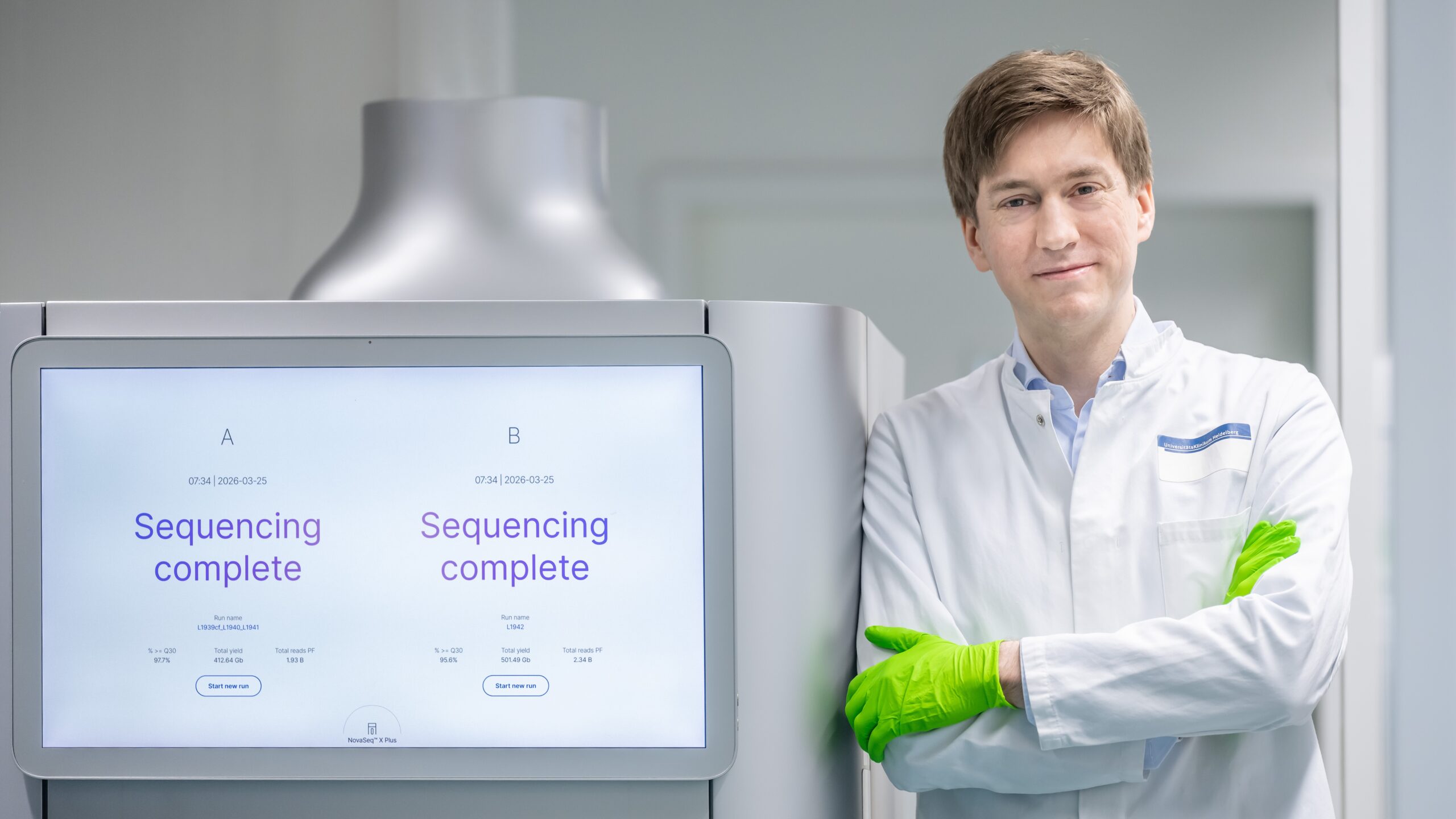
To this end, Privatdozent Dr. Matthias A. Fink from Heidelberg University‘s Faculty of Medicine and Senior Physician at the Department of Diagnostic and Interventional Radiology at Heidelberg University Hospital, coordinates the RACOON-LCS project together with Professor Dr. Amanda Tufman at LMU University Hospital Munich. The project builds on the RACOON infrastructure established during the COVID-19 pandemic to enable the cross-site exchange of radiological imaging data. The project is funded by the Federal Ministry of Research, Technology and Space (BMFTR) with a total of around €850,000.
RACOON-LCS is creating the first nationwide data space for screening data. It is designed to support quality assurance across different sites and enable scientific analyses. One focus is on AI-based detection systems: They are intended to detect and classify pulmonary nodules at an early stage, analyse lung structures and improve the assessment of the risk of malignant changes. The researchers are also examining how reliably these systems perform at different university hospitals. In addition, RACOON-LCS is investigating whether large language models can make medical findings easier to understand for patients and medically informed laypeople.
By July 2028, the data space is expected to include more than 4,500 quality-assured datasets as well as data from around 3,700 patients newly enrolled in the study. A total of 36 university hospitals are participating in the project.
PENGUIN: Identifying incorrect penicillin allergy labels and improving antibiotic treatment
Around ten per cent of the population have a diagnosis of penicillin allergy. In fact, more than 90 per cent of these patients do not have a true penicillin allergy. Nevertheless, the “penicillin allergy” label often remains in their medical records, with significant consequences: Patients receive alternative antibiotics that are often less appropriate. This can complicate treatment, prolong hospital stays and promote antibiotic resistance.
With the PENGUIN project, researcher Dr. Elham Khatamzas, PhD, from Heidelberg University’s Faculty of Medicine and senior consultant physician in the Division of Infectious Diseases and Tropical Medicine at the Center for Infectious Diseases of Heidelberg University Hospital, together with Dr. Insa Joost from the Institute of Medical Microbiology and Hospital Hygiene at Düsseldorf University Hospital, aims to investigate how presumed penicillin allergies can be reliably assessed and incorrect allergy labels subsequently removed from patients’ medical records. This approach is known as “delabeling”.
If a suspected penicillin allergy is not confirmed, patients should once again be able to receive appropriate penicillin antibiotics more frequently. PENGUIN is also investigating how this approach can be sustainably integrated into routine clinical practice. The multicentre observational study is planned to include a total of 437 patients. Twelve university hospitals are participating in PENGUIN. The project has received a total of around €1.3 million in funding.
CanTEN: Reassessing treatment duration for severe fungal infections
Candidaemia is a rare but life-threatening infection in which yeasts enter the bloodstream. Current guidelines recommend continuing treatment with an antifungal medication for 14 days after fungi are no longer detectable in the blood. However, whether this treatment duration is actually necessary has never been investigated in a clinical trial. The aim is to ensure that patients receive treatment only for as long as medically necessary.
Together with Professor Dr. Oliver A. Cornely from the European Excellence Center for Invasive Fungal Infections at Department I of Internal Medicine at Cologne University Hospital, PD Dr. Susanne Picardi from Heidelberg University‘s Faculty of Medicine and senior physician at the Department of Anesthesiology at Heidelberg University Hospital aims to investigate in the CanTEN project whether a shorter treatment duration is possible for uncomplicated candidemia. The project is funded by the BMFTR with approximately €3.3 million.
The CanTEN researchers will first investigate whether a ten-day treatment is as effective and safe as the current 14-day standard treatment. If this is the case, a seven-day treatment will be evaluated in a second step. They will also investigate, among other aspects, how often the infection recurs, how well patients recover and how well the medication is tolerated.
The study is randomised, double-blind and placebo-controlled: Patients are randomly assigned to different treatment groups. Neither the patients nor the treating physicians know who receives the medication for how long and who receives a placebo. This is intended to ensure that the study results are as reliable as possible.
Because candidaemia is a rare disease, a suffciently large number of patients can only be recruited through cross-site collaboration among university hospitals. Twenty-five university hospitals across Germany are participating in CanTEN. Depending on how the study progresses, between 106 and 420 patients are expected to participate.
About the Network of University Medicine (NUM)
Within NUM, all 37 German university medical centres are jointly conducting large interdisciplinary clinical research projects for the first time. Originally launched to coordinate COVID-19 research across German university medicine, the network now focuses on the joint collection and use of complex medical research data in clinical settings. To this end, the network has established specialised research infrastructures.
Further information
Network of University Medicine
RACOON-LCS | Netzwerk Universitätsmedizin