November 06, 2026

Lost in the Crowd? How Crowding Affects Drug-Protein Binding
Lost in the Crowd? How Crowding Affects Drug-Protein Binding

2. November 2026

Macromolecular crowding, such as in the interior of biological cells, profoundly influences how molecules interact; however, its effects on drug-target binding rates and pathways remain poorly understood.

In a recent publication, researchers from the Molecular and Cellular Modelling (MCM) group have developed a novel multiresolution Brownian dynamics framework to tackle the complexity of crowded environments, combining atomistic and coarse-grained representations to simulate molecular association. “By simulating protein-small molecule complexes in environments with varying macromolecular crowder densities and types, we discovered that crowding exerts competing effects,” says Riccardo Beccaria, one of the first authors of the study.

The presence of other macromolecules can hinder binding by physically obstructing target sites and slowing down overall diffusion. However, the simulations revealed that crowding can also enhance association rates. “Through mechanisms involving molecular channeling and electrostatic caging — which effectively trap interacting molecules in close proximity — the crowded environment can guide molecules toward successful binding,” Beccaria adds.

Furthermore, the study demonstrates that crowding fundamentally alters not just the rate at which molecules associate, but also their binding pathways. “These results highlight the importance of considering the impact of crowded environments on biomolecular and therapeutic interactions,” says HITS group leader Rebecca Wade.
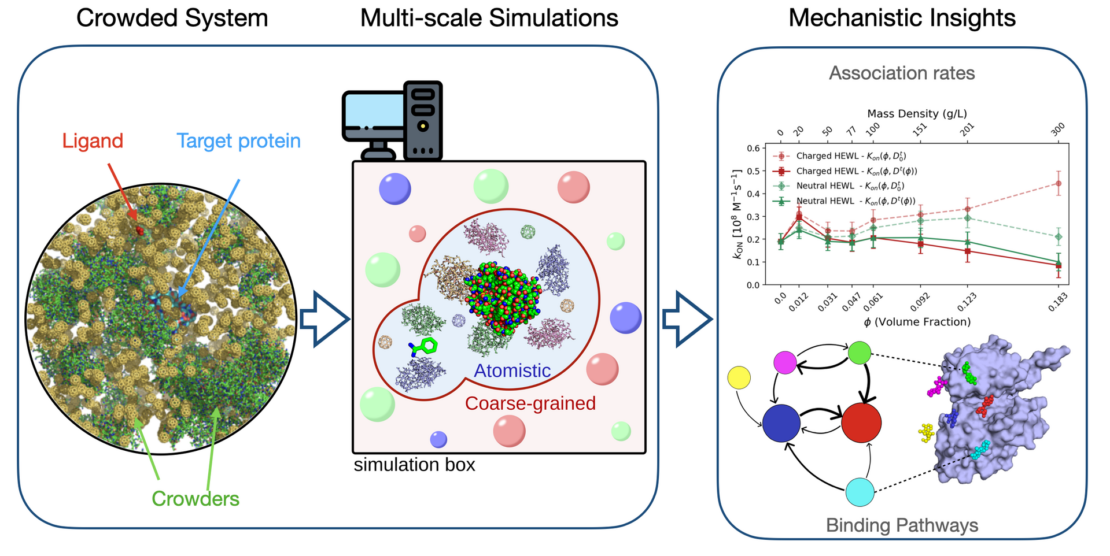
Graphical Abstract: From a Model of a Crowded System to Multiscale Simulations providing Mechanistic Insights

Publication:

Beccaria R, Muniz-Chicharro A, Wade RC.
Multiscale Brownian dynamics simulations reveal effects of macromolecular crowding on protein-ligand association (29 May 2026)
www.pnas.org/doi/10.1073/pnas.2617950123

Scientific Contact:

Prof. Dr. Rebecca Wade
Molecular and Cellular Modeling group
Heidelberg Institute for Theoretical Studies (HITS)
Phone: +49 6221 533 245
rebecca.wade@h-its.org

Riccardo Beccaria
Molecular and Cellular Modeling group
Heidelberg Institute for Theoretical Studies (HITS)
riccardo.beccaria@h-its.org

Media Contact:

Angela Michel
Head of Communications
Heidelberg Institute for Theoretical Studies (HITS)
angela.michel@h-its.org

Our latest News

discover more
New Publication: Neuroendocrine Differentiation Mediates Escape from HER2-Targeted Therapy in Breast Cancer

New Publication: Neuroendocrine Differentiation Mediates Escape from HER2-Targeted Therapy in Breast Cancer

Roberto Würth, Tasneem Cheytan, Paul Schwerd-Kleine, Ewgenija Gutjahr, Elisa Donato, Verena Thewes, Beatrice Charlotte Tröster, Theresa Mulholland, Torsten Müller, Daria Doncevic, Laura L Michel, Celina V Wagner, Polina Kozyulina, Mario Hlevnjak, Marc Zapatka, Julia Bulkescher, Rebecca Weber, Sarah-Jane Neuberth, Vera Thiel, Thilo Miersch, Michael Scherer, Johannes Betge, Jeroen Krijgsveld, Carl Herrmann, Peter Lichter, Andreas Schneeweiss, Martin R Sprick, Andreas Trumpp  Neuroendocrine differentiation (NED) promotes lineage plasticity and therapy resistance in prostate and lung cancers. Here we identify NED as a route of […]

Heidelberg Researchers Receive Else Kröner Memorial Fellowships for Projects on Kidney Disease and AI-Based Diagnostics

Heidelberg Researchers Receive Else Kröner Memorial Fellowships for Projects on Kidney Disease and AI-Based Diagnostics

Why do certain congenital kidney disorders vary so widely in severity among affected individuals? Can AI improve breast cancer diagnostics? These are the questions being addressed in current projects by two early-career researchers at the Heidelberg Faculty of Medicine at Heidelberg University. The Else Kröner-Fresenius Stiftung is supporting the research of Dr. Caroline M. Kolvenbach […]

QuantiLight licences Max Planck sensor technology 

QuantiLight licences Max Planck sensor technology 

Exclusive global licence forms the basis for a portable system for the rapid determination of drug levels following organ transplants  November 03, 2026 To the Point Transplant recipients require regular blood tests to ensure that the concentration of anti-rejection drugs remains within an appropriate range. Too low a drug concentration can increase the risk of […]

GET IN TOUCH

Stay Updated with bioRN’s Newsletter

Sign up for our newsletter to discover more!
* required

BioRN (BioRN Network e.V. and BioRN Cluster Management GmbH) will use the information you provide on this form to be in touch with you and to provide updates and marketing. Please let us know all the ways you would like to hear from us:

You can update your subscription preferences or unsubscribe at any time. Just follow the unsubscribe or update link in the footer of automated emails you receive from us, or by contacting us at info@biorn.org. We will treat your information with respect. For more information about our privacy practices please visit our website: www.biorn.org. By clicking below, you agree that we may process your information in accordance with these terms.

We use Mailchimp as our marketing platform. By clicking below to subscribe, you acknowledge that your information will be transferred to Mailchimp for processing. Learn more about Mailchimp's privacy practices.

Intuit Mailchimp