

Network News
Sarcomas in soft tissue usually occur in young people and are particularly difficult to treat. Due to a lack of laboratory models, the causes of their development are still poorly understood. A team of researchers from the Hopp Children’s Cancer Centre Heidelberg (KiTZ), the German Cancer Research Centre (DKFZ) and Heidelberg University Hospital (UKHD) has […]
read more
KEY PROTEINS FOR MALARIA REPRODUCTION FOUND IN THE MOSQUITO
How can the malaria pathogen be prevented from multiplying successfully? Dr Franziska Hentzschel, a scientist at the Medical Faculty of Heidelberg University, has discovered a new approach to this. Her research is reported in the current issue of the renowned journal ‘Nature Microbiology’. Malaria is triggered by the single-celled parasite Plasmodium, which is transmitted to humans […]
read more
PEPperPRINT GmbH launches cLIFT technology for next-generation peptide microarrays
Heidelberg, 10th of June 2025 – PEPperPRINT, a global leader in peptide microarray technology, celebrates its 15th anniversary with the launch of its next-generation peptide microarray platform: cLIFT, short for combinatorial Laser-Induced Forward Transfer. The new technology dramatically expands peptide printing capabilities and paves the way for innovative biomedical research applications. Developed in collaboration with Dr. Felix Loeffler of […]
read more
Colorectal cancer screening via smartphone?
Colorectal cancer screening programs are currently underutilized in Germany. This also applies to testing for blood in the stool. The immunological stool tests can detect tiny amounts of blood in the stool. Scientists at the German Cancer Research Center (DKFZ) have investigated whether smartphone-based testing could be a meaningful alternative or supplement to traditional laboratory […]
read more
HOW DO CANCER CELLS BECOME RESISTANT? WILHELM SANDER FOUNDATION FUNDS TWO RESEARCH PROJECTS AT MFHD AND UKHD
Cancer cells can become resistant to treatment: Drugs that were previously successful in combating the tumour then lose their effect. Two research teams from Heidelberg University’s Faculty of Medicine (MFHD) and Heidelberg University Hospital (UKHD) are currently trying to decipher how this ‘therapy resistance’ develops. The team led by Prof Dr Kai Breuhahn and Dr […]
read more
Clonal hematopoiesis landscape in frequent blood donors
Key Points Abstract Donor blood saves lives, yet the potential impact of recurrent large-volume phlebotomy on donor health and hematopoietic stem cells (HSCs) remains largely unexplored. In our study, we conducted a comprehensive screening of 217 older male volunteer donors with a history of extensive blood donation (>100 lifetime donations) to investigate the phenomenon of […]
read more
Small extracellular vesicles and particles (sEVPs) derived from tumor-free pre-metastatic organs promote breast cancer metastasis and support organotropismNew Collaborative Research Centre on Cancers of Blood-Forming Bone Marrow
Abstract Metastatic breast cancer remains largely incurable, partly due to our incomplete understanding of its intricate underlying mechanisms. Notably, inercellular communication mediated by small extracellular vesicles and particles (sEVPs) has emerged as a key feature of metastasis. While tumor-derived sEVPs have been extensively studied and are known to be pro-metastatic, the role of sEVPs from […]
read more
Universität Heidelberg Successful With Three Applications for Clusters of Excellence
Funding for research projects at the highest level internationally In the context of the Excellence Strategy of the Federal and State Governments, Heidelberg University has been successful with three applications in the Cluster of Excellence funding line. According to the decision on selection announced today (Thursday 22 May 2025), not only will the existing cluster […]
read more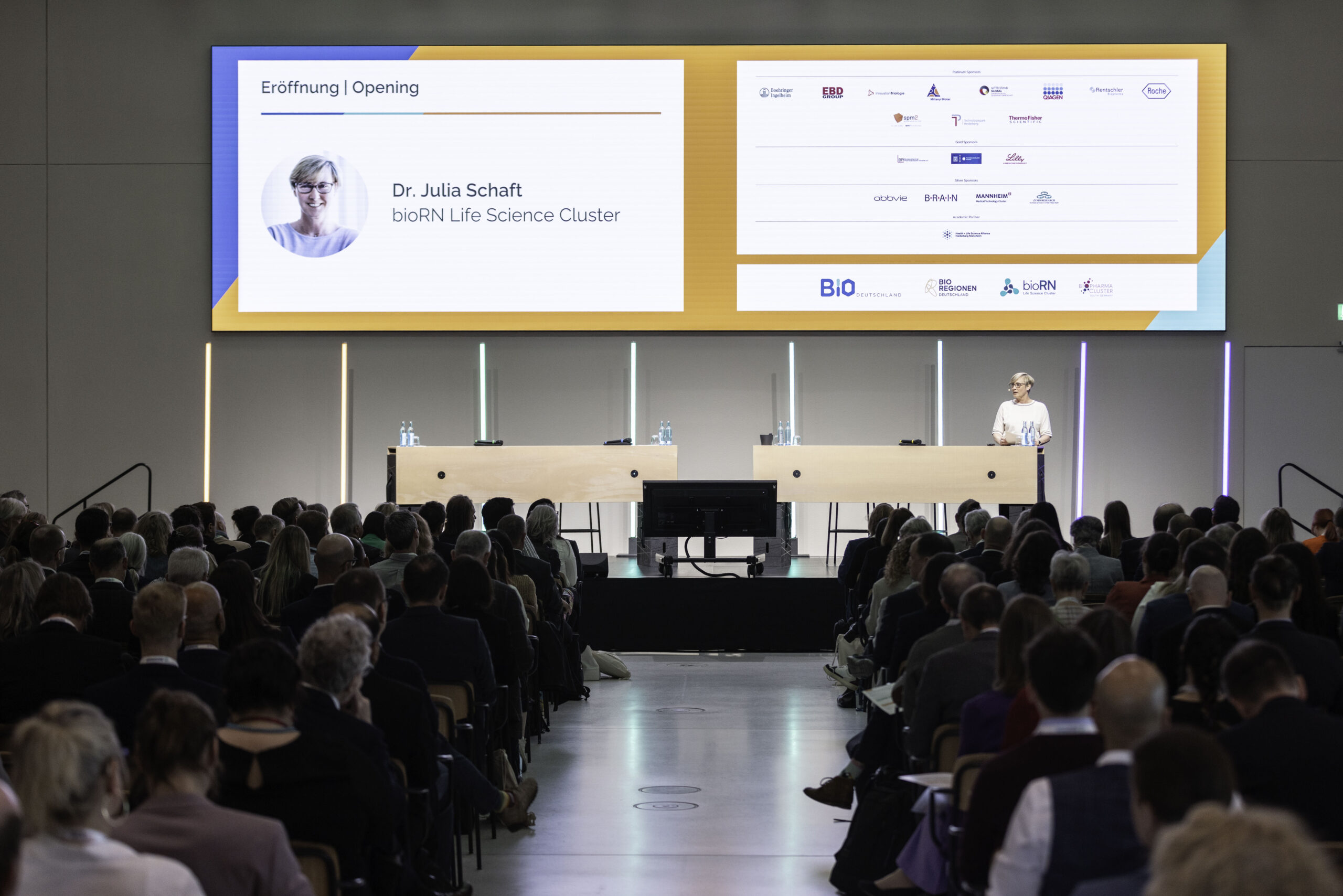
Biotechnologie-Branche tagt im Life Science Hot Spot Heidelberg
Heidelberg 9. April 2025: Mehr als 1000 Teilnehmerinnen und Teilnehmer aus dem Biotech-Sektor sind heute in Heidelberg zu ihrer jährlichen Konferenz, den Deutschen Biotechnologietagen, eingetroffen. Unternehmerinnen und Unternehmer, Wissenschaftler sowie Vertreterinnen und Vertreter aus Politik, Administration und Medien tauschen sich hier für zwei Tage über die neuesten Entwicklungen in der Branche und die Rahmenbedingungen für […]
read more